 The Palestinians who are ChristiansA tenth of the population, and a surprise to Americans · 1912 to 2022
1912 to 2022
The Palestinians who are Christians
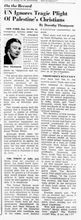
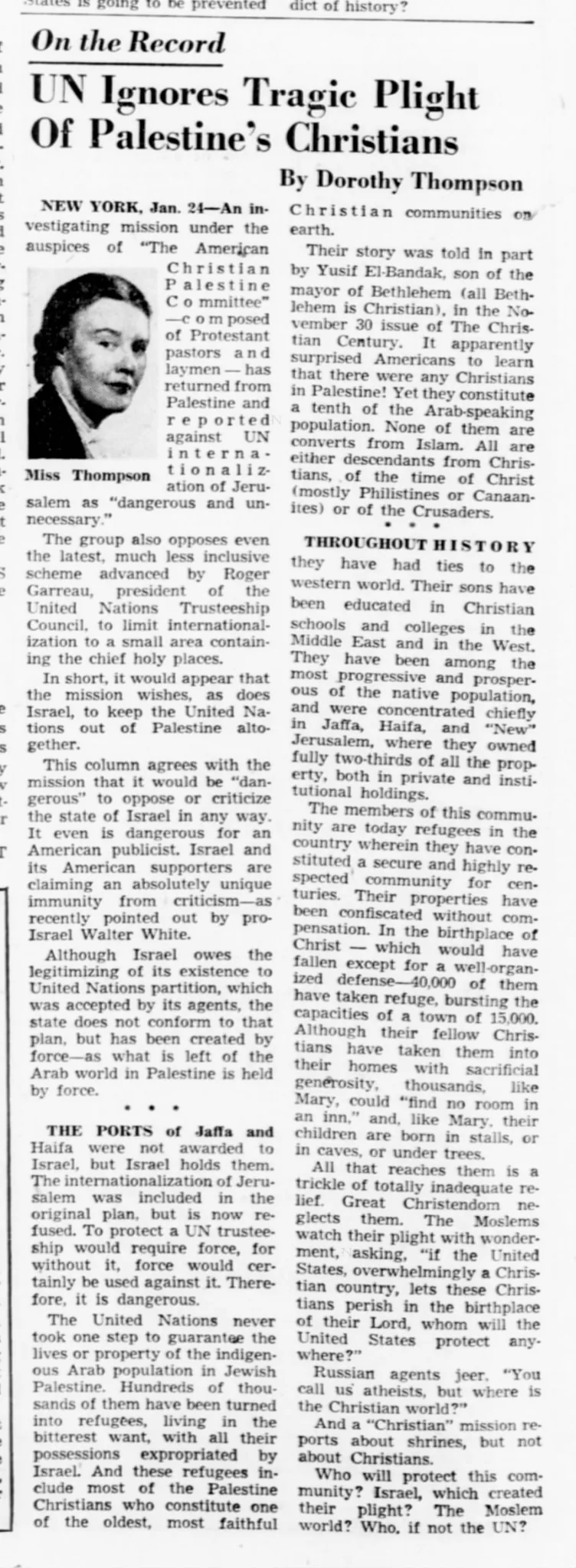
In January 1950 a syndicated American columnist stopped mid-argument to point out something he had noticed about his own readers.
“It apparently surprised Americans to learn that there were any Christians in Palestine! Yet they constitute a tenth of the Arab-speaking p…”
The same column notes that the United Nations never took one step to guarantee the lives or property of the indigenous Arab population in Jewish Palestine. The surprise he is describing has not worn off. American coverage of this place resolves, again and again, into Muslims against Jews, and a third of a people falls out of the sentence.
CP-1950-006The frame that separates them
The habit of setting Palestinian Christians against their Muslim neighbours rather than beside them is older than the state, and in this archive it begins with a rumour.
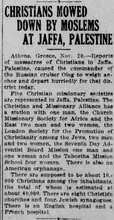
“CHRISTIANS MOWED DOWN BY MOSLEMS AT JAFFA, PALESTINE”
The headline states a massacre as fact. Underneath it is an Athens dateline, no casualty counted, no witness quoted, and a single piece of evidence: a Russian cruiser weighed anchor and departed hurriedly for that district. The story does give a figure, and it is the one worth keeping: about 10,000 Christians among some 40,000 inhabitants of Jaffa.
 CP-1912-002
What they were actually doing
Seven years later, American correspondents in Palestine kept meeting an organisation whose name says the thing plainly. Muslims and Christians had not divided. They had formed a society together, and its subject was Zionism.
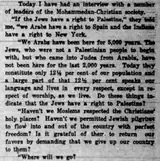
“If the Jews have a right to Palestine, we Arabs have a right to Spain and the Indians have a right to New York… Haven’t we Moslems respected the Christians’ holy places?”
The Deseret News headline calls them leaders of the Mohammedan-Christian society. They are speaking as one body, and the argument they make to an American reporter is an argument about precedent and about custody of other people’s shrines.
 CP-1919-008
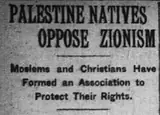
“PALESTINE NATIVES OPPOSE ZIONISM”
The line under it in the New York Times: Moslems and Christians Have Formed an Association to Protect Their Rights. The alliance is named accurately in the paper of record in 1921. The headline above it calls the people natives.
 CP-1921-001
Then the verb
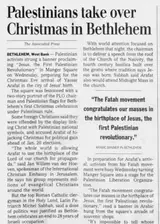
By the 1990s the two categories have come apart in American headlines, and a Palestinian has become something a Christian is not. December 1995, Bethlehem handed back after twenty-eight years of occupation.
“Palestinians take over Christmas in Bethlehem”
Take over. The people of Bethlehem are the subject of that verb, in their own town, at their own Christmas. Inside, a banner in Manger Square reads Jesus, the First Palestinian Revolutionary — which is a claim the headline has already ruled out by treating Palestinians as arrivals.
 CP-1995-004
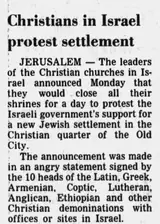
“Christians in Israel protest settlement”
Ten church heads — Latin, Greek and the rest — close every shrine they have for a day over a Jewish settlement in the Christian quarter of the Old City. The Palestinians in this story are the Christians, and the objection is theirs, but the headline files them under a religion rather than a people.
 CP-1990-002
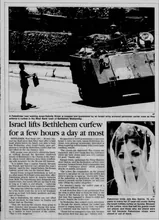
“They are denying the citizens from going to their churches and mosques during this incursion… This is very dangerous.”
Mayor Hanna Nasser of Bethlehem, giving his quotes from a house he was not permitted to leave. On the same page, a man who died of a heart attack lies unburied for more than three days while his family seeks permission to carry him to the Church of the Nativity, and the priest who finally says the Mass notes that fifty people were allowed in. The Palestinians in this story are Christians and the thing being restricted is their church.
 CP-2002-030
When they get their names
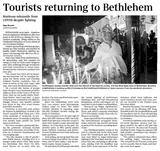
“Bethlehem’s Christmas crowds return after years of pandemic quiet”
Four Palestinians named in one story, each with a job and an opinion: a hotel owner, a man who runs an olive wood workshop, the mayor. They are named because this is a trade story about a good season. The separation barrier appears once, in a clause, near the end. Being covered as a business rather than as a conflict is, in this archive, the most reliable way for a Palestinian to get his name in an American paper.
 CP-2022-044
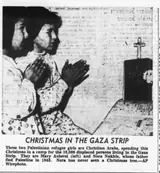
“Christmas in the Gaza Strip”
Two Palestinian girls, named, in a Christmas news photograph. The caption says refugee and it says Christian Arabs, and it holds both at once without appearing to notice that American readers were being told something they did not know.
 CP-1959-004
Nothing here was invented by any one newspaper. A frame settles into a language and then does its work without anyone choosing it each morning. But the effect is a specific subtraction: a people who were a tenth of Jaffa in 1912, who organised jointly against Zionism in 1919, and who ran Bethlehem before and after 1995, become visible to American readers only at Christmas, and even then as hosts rather than as residents.
The next time a report explains this as a conflict between Muslims and Jews, the question is not whether that is a simplification. It is who has to disappear for the sentence to work.