 Two runners, and what they trained onA beach for a track, and a pool with no permit · 1996 to 2004
1996 to 2004
Two runners, and what they trained on
Sport is the emptiest subject in this archive. Out of more than 1,300 clippings, barely a dozen show a Palestinian playing anything. Which makes what American papers did print, in the summer of 1996, worth reading closely.
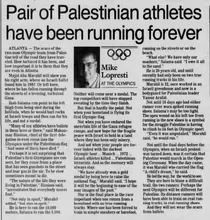
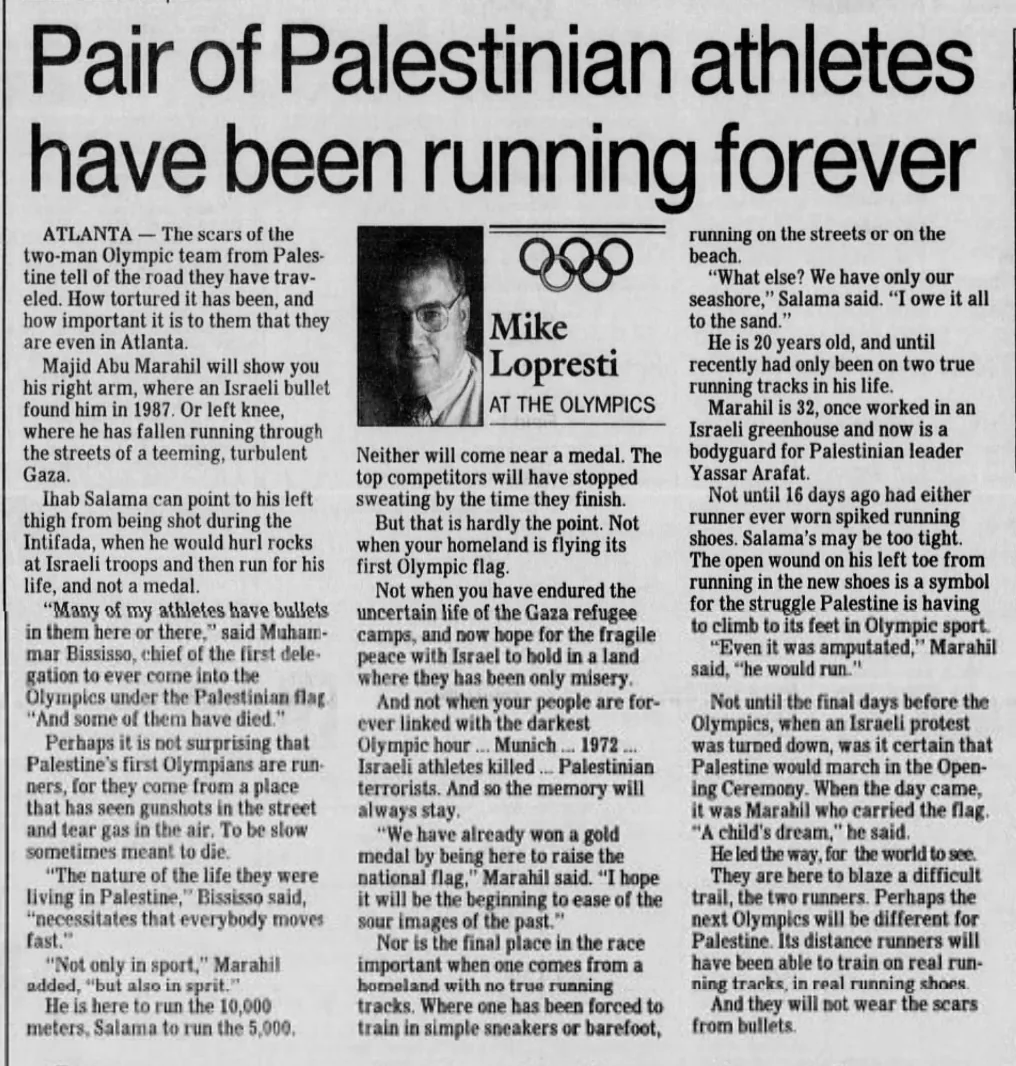
Palestine’s first Olympic team was two men. Majed Abu Maraheel, a 10,000-metre runner, and Ehab Salama, who ran the 5,000. Two American papers sent reporters to talk to them in Atlanta, and both came back with the same subject: not the race, but the training.
“What else? We have only our seashore… I owe it all to the sand.”
Salama, 20, asked how he trained. He had been on two running tracks in his life. He had been shot in the left thigh during the intifada, throwing stones and then running — and not a medal. Neither man had worn spiked shoes until sixteen days before the Games, and Salama ran with an open wound on his toe because the new ones were too tight. Maraheel, 32, carries an Israeli bullet scar in his right arm from 1987 and a bad knee from falling while running through Gaza. He carried the flag at the opening ceremony: a child’s dream.
CP-1996-011“In Gaza, we ran either in sneakers or barefoot.”
The host city’s own paper explains why the team was two men, and gives two reasons in equal parts: there were almost no athletic facilities in the West Bank and Gaza, and Israel would not let Palestinians who give Jerusalem as their address compete at all. A third athlete existed — the boxer Rashid Judeh, barred by boxing officials who said he lacked international experience. The Israeli Olympic delegation pointedly disagreed with its own government’s complaint about the use of the name “Palestine”, then shook hands with the Palestinians at the opening ceremony and swapped pins.
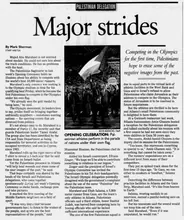 CP-1996-012
The two papers do not spell the runners the same way. One has Marahil and Ihab Salama, the other Maraheel and Ehab. Both print the same sentence from the flagbearer about his teammate’s foot: Even if it was amputated, he would run.
Before the word narrowed
“Palestine Tennis Stars To Compete In England”
The earliest sport clipping here, and it is about a word. In July 1947 Palestinian describes where a person is from rather than which people they belong to: the three players entered for Bristol and Wimbledon by the Federation of Amateur Sports Clubs of Palestine — Gertrude Kornfeld, Yehuda Finkelkraut and Mordecai Apel — are Jewish. Within two years the word had stopped being available to everyone in the country.
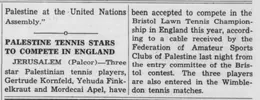 CP-1947-045
Eight years later, a pool with no permit
“It’s not perfect, but it’s made an Olympian of my son.”
Amaal Aweisat, whose son Raad, 17, was training to be the first Palestinian swimmer at an Olympics. The pool is twenty-five metres, in the back yard of several connected houses, built in under a week by residents, family and friends. It has a corrugated tin roof, no ventilation and no temperature control, and his coach watched him swim wearing a wool hat and a winter coat. They asked the reporter not to print where it is, because it has no building permit from the Israelis who control the area. He had swum at the YMCA on the Jewish side of Jerusalem until the YMCA told him to join the Israeli Swimming Federation or swim somewhere else. The pool with no permit is what somewhere else turned out to mean.
 CP-2004-010
A bag, a brother, a blacktop
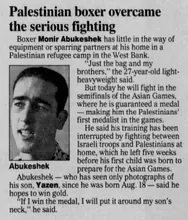
“Just the bag and my brothers.”
Monir Abukeshek, 27, on his training facilities in a refugee camp, the day before he became the first Palestinian to win a medal at the Asian Games. He had left home five weeks before his first child was born and had seen his son Yazen only in photographs. What he meant to do with the medal: If I win the medal, I will put it around my son’s neck.
 CP-2002-031
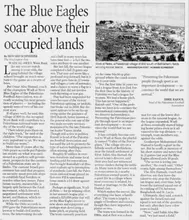
“Presenting the Palestinian people through sport is an important development — to convince the world that we are normal.”
Jibril Rajoub of the Palestinian Football Association. The champion side is a village of 800 called the Valley of the Porcupines, mostly brothers and cousins, whose coach scouts six-year-olds on the same blacktop playground the first team trains on, because there is no pitch. The national squad is ranked 174th, between Bangladesh and St. Lucia. The story ends on what is still missing: ‘Now, we just need a field.’
 CP-2009-029
None of these stories is about politics and all of them are. A reporter asks an athlete a routine question — where do you train — and the answer is a beach, or a pool that has to be kept secret. The occupation turns up not as an argument but as the reason the shoes are new, the track is sand, and the address on a form disqualifies you.
The next time you read that sport and politics should be kept separate, it is worth asking who gets to keep them separate, and what the other side has to do to make the starting line at all.