Tampa Bay Times · St. Petersburg, Florida · 5 July 1996
CP-1996-013
Column One
from 1A
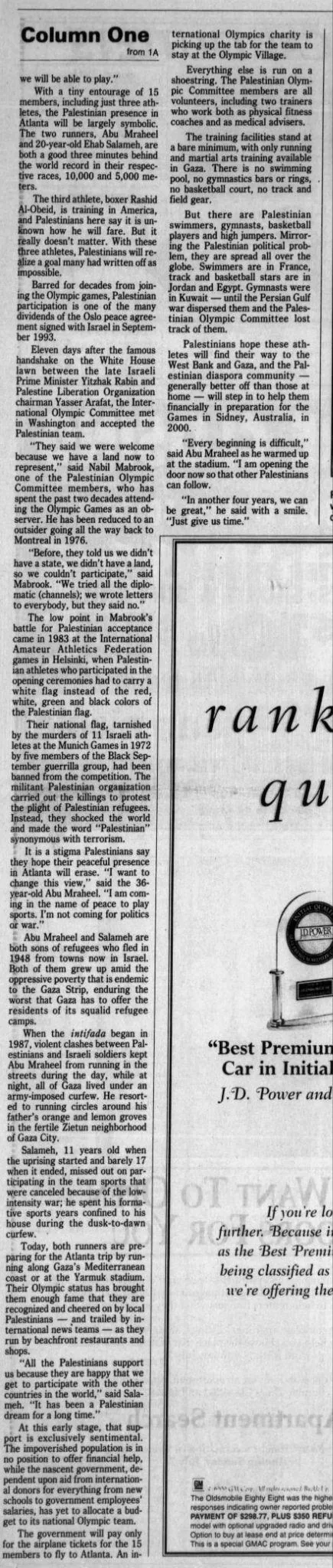
Transcribed from the clipping
… we will be able to play.” With a tiny entourage of 15 members, including just three athletes, the Palestinian presence in Atlanta will be largely symbolic. The two runners, Abu Mraheel and 20-year-old Ehab Salameh, are both a good three minutes behind the world record in their respective races, 10,000 and 5,000 meters.
The third athlete, boxer Rashid Al-Obeid, is training in America, and Palestinians here say it is unknown how he will fare. But it really doesn't matter. With these three athletes, Palestinians will realize a goal many had seen as impossible.
Barred for decades from joining the Olympic games, Palestinian participation is one of the many dividends of the Oslo peace agreement signed with Israel in September 1993.
Eleven days after the famous handshake on the White House lawn between the late Israeli Prime Minister Yitzhak Rabin and Palestine Liberation Organization chairman Yasser Arafat, the International Olympic Committee met in Washington and accepted the Palestinian team.
“They said we were welcome because we have a land now to represent,” said Nabil Mabrook, one of the Palestinian Olympic Committee members, who has spent the past two decades attending the Olympic Games as an observer. He has been reduced to an outsider going all the way back to Montreal in 1976.
“Before, they told us we didn't have a state, we didn't have a land, so we couldn't participate,” said Mabrook. “We tried all the diplomatic (channels); we wrote letters to everybody, but they said no.”
The low point in Mabrook's battle for Palestinian acceptance came in 1983 at the International Amateur Athletics Federation games in Helsinki, when Palestinian athletes who participated in the opening ceremonies had to carry a white flag instead of the red, white, green and black colors of the Palestinian flag.
Their national flag, tarnished by the murders of 11 Israeli athletes at the Munich Games in 1972 by five members of the Black September guerrilla group, had been banned from the competition. The militant Palestinian organization carried out the killings to protest the plight of Palestinian refugees.
Instead, they shocked the world and made the word “Palestinian” synonymous with terrorism. It is a stigma Palestinians say they hope their peaceful presence in Atlanta will erase. “I want to change this view,” said the 36-year-old Abu Mraheel. “I am coming in the name of peace to play sports. I'm not coming for politics or war.”
Abu Mraheel and Salameh are both sons of refugees who fled in 1948 from towns now in Israel. Both of them grew up amid the oppressive poverty that is endemic to the Gaza Strip, enduring the worst that Gaza has to offer the residents of its squalid refugee camps.
When the intifada began in 1987, violent clashes between Palestinians and Israeli soldiers kept Abu Mraheel from running in the streets during the day, while at night, all of Gaza lived under an army-imposed curfew. He resorted to running circles around his father's orange and lemon groves in the fertile Zietun neighborhood of Gaza City.
Salameh, 11 years old when the uprising started and barely 17 when it ended, missed out on participating in the team sports that were canceled because of the low-intensity war; he spent his formative sports years confined to his house during the dusk-to-dawn curfew.
Today, both runners are preparing for the Atlanta trip by running along Gaza's Mediterranean coast or at the Yarmuk stadium. Their Olympic status has brought them enough fame that they are recognized and cheered on by local Palestinians — and trailed by international news teams — as they run by beachfront restaurants and shops.
“All the Palestinians support us because they are happy that we get to participate with the other countries in the world,” said Salameh. “It has been a Palestinian dream for a long time.” At this early stage, that support is exclusively sentimental.
The impoverished population is in no position to offer financial help, while the nascent government, dependent upon aid from international donors for everything from new schools to government employees' salaries, has yet to allocate a budget to its national Olympic team. The government will pay only for the airplane tickets for the 15 members to fly to Atlanta.
An international Olympics charity is picking up the tab for the team to stay at the Olympic Village. Everything else is run on a shoestring. The Palestinian Olympic Committee members are all volunteers, including two trainers who work both as physical fitness coaches and as medical advisers.
The training facilities stand at a bare minimum, with only running and martial arts training available in Gaza. There is no swimming pool, no gymnastics bars or rings, no basketball court, no track and field gear. But there are Palestinian swimmers, gymnasts, basketball players and high jumpers. Mirroring the Palestinian political problem, they are spread all over the globe.
Swimmers are in France, track and basketball stars are in Jordan and Egypt. Gymnasts were in Kuwait — until the Persian Gulf war dispersed them and the Palestinian Olympic Committee lost track of them.
Palestinians hope these athletes will find their way to the West Bank and Gaza, and the Palestinian diaspora community — generally better off than those at home — will step in to help them financially in preparation for the Games in Sidney, Australia, in 2000. “Every beginning is difficult,” said Abu Mraheel as he warmed up at the stadium.
“I am opening the door now so that other Palestinians can follow.” “In another four years, we can be great,” he said with a smile. “Just give us time.”
Context added by this archive
The jump page of a Column One feature; the clipping begins mid-sentence and the front-page opening is not in the scan. This paper names the team's boxer Rashid Al-Obeid and says he is training in America. The Atlanta Journal-Constitution, writing about the same three-athlete team the same month, names him Rashid Judeh and says he was barred from competing.
The discrepancy is logged, not resolved.
Cite this item
"Column One," Tampa Bay Times, 5 July 1996. Covering Palestine archive, CP-1996-013. https://coveringpalestine.org/archive/cp-1996-013
More from Tampa Bay Times
- U. N. Aids Arab RefugeesTampa Bay Times · 5 December 1948
- Israeli Planes Raid Guerrillas In LebanonTampa Bay Times · 17 May 1974
- U.N. report says Israel tortures Arab prisonersTampa Bay Times · 10 November 1977
- Poet’s work inflames cultural divideTampa Bay Times · 11 March 2000
- Israeli siege explodes hopes in RamallahTampa Bay Times · 14 March 2002
- Israeli settlers, seeking revenge, rampage in Palestinian townsTampa Bay Times · 28 February 2023
- 2 more from this paper in the full text →
More from the 1990s
- Israel rejects blanket damagesSan Francisco Examiner · 3 January 1996
- Disabled Palestinians Sue Israelis for InjuriesOmaha World-Herald · 3 January 1996
- Runner on first Palestinian Olympic squadIndex-Journal · 7 April 1996
- Palestinians erasing doubts about sincerity in ending Israeli struggleParis Post-Intelligencer · 25 April 1996
- Family discusses bombing suspectParagould Daily Press · 21 May 1996
- Pair of Palestinian athletes have been running foreverThe Courier News · 25 July 1996
- All 111 clippings from the 1990s →
This record is part of Covering Palestine, an archive of American and Anglophone newspaper clippings about Palestinians, 1799 to 2023. Researched and assembled by Maria Robles.
The clipping belongs to the newspaper that printed it, or to the news agency that supplied the copy. It is reproduced here for research, criticism and commentary. The city is derived from the masthead, not read off the clipping.
Something wrong here, or something you know about this clipping? The archive is still being built and corrections are wanted: maria@rozumstudio.com, quoting CP-1996-013.
See it in the archive reel · Full text of every clipping · Dataset