Tampa Bay Times · St. Petersburg, Florida · 11 March 2000
CP-2000-011
Poet’s work inflames cultural divide
Flore de Preneuf, Times Correspondent, Ramallah
Transcribed from the clipping
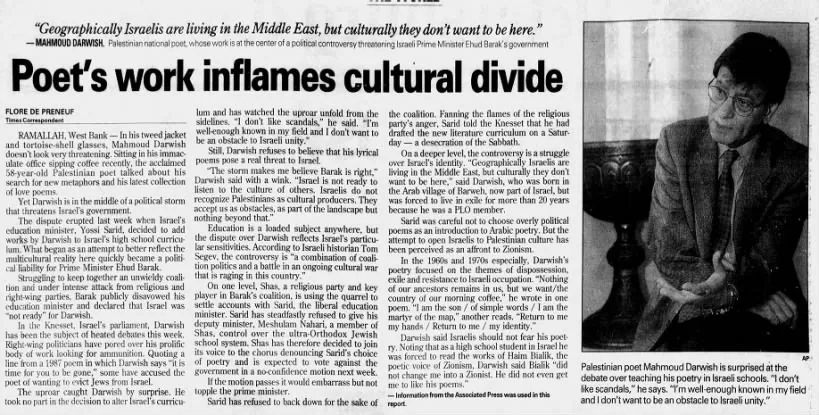
“RAMALLAH, West Bank — In his tweed jacket and tortoise-shell glasses, Mahmoud Darwish doesn’t look very threatening. Sitting in his immaculate office sipping coffee recently, the acclaimed 58-year-old Palestinian poet talked about his search for new metaphors and his latest collection of love poems. Yet Darwish is in the middle of a political storm that threatens Israel’s government. The dispute erupted last week when Israel’s education minister, Yossi Sarid, decided to add works by Darwish to Israel’s high school curriculum. What began as an attempt to better reflect the multicultural reality here quickly became a political liability for Prime Minister Ehud Barak.… In the Knesset, Israel’s parliament, Darwish has been the subject of heated debates this week. Right-wing politicians have pored over his prolific body of work looking for ammunition. Quoting a line from a 1987 poem in which Darwish says ‘it is time for you to be gone,’ some have accused the poet of wanting to evict Jews from Israel. The uproar caught Darwish by surprise. He took no part in the decision to alter Israel’s curriculum and has watched the uproar unfold from the sidelines. ‘I don’t like scandals,’ he said. ‘I’m well-enough known in my field and I don’t want to be an obstacle to Israeli unity.’ ‘The storm makes me believe Barak is right,’ Darwish said with a wink. ‘Israel is not ready to listen to the culture of others. Israelis do not recognize Palestinians as cultural producers. They accept us as obstacles, as part of the landscape but nothing beyond that.’… According to Israeli historian Tom Segev, the controversy is ‘a combination of coalition politics and a battle in an ongoing cultural war that is raging in this country’… Sarid has refused to back down for the sake of the coalition. Fanning the flames of the religious party’s anger, Sarid told the Knesset that he had drafted the new literature curriculum on a Saturday — a desecration of the Sabbath. On a deeper level, the controversy is a struggle over Israel’s identity. ‘Geographically Israelis are living in the Middle East, but culturally they don’t want to be here,’ said Darwish, who was born in the Arab village of Barweh, now part of Israel, but was forced to live in exile for more than 20 years because he was a PLO member. Sarid was careful not to choose overly political poems as an introduction to Arabic poetry. But the attempt to open Israelis to Palestinian culture has been perceived as an affront to Zionism. In the 1960s and 1970s especially, Darwish’s poetry focused on the themes of dispossession, exile and resistance to Israeli occupation. ‘Nothing of our ancestors remains in us, but we want / the country of our morning coffee,’ he wrote in one poem. ‘I am the son / of simple words / I am the martyr of the map,’ another reads. ‘Return to me my hands / Return to me / my identity.’ Darwish said Israelis should not fear his poetry. Noting that as a high school student in Israel he was forced to read the works of Haim Bialik, the poetic voice of Zionism, Darwish said Bialik ‘did not change me into a Zionist. He did not even get me to like his poems.’”
Photograph caption
“Palestinian poet Mahmoud Darwish is surprised at the debate over teaching his poetry in Israeli schools. ‘I don’t like scandals,’ he says. ‘I’m well-enough known in my field and I don’t want to be an obstacle to Israeli unity.’” · Associated Press
Context added by this archive
The line that the 2008 obituaries reduce to one sentence, reported here while it was happening, with the poet interviewed in his own office. He had nothing to do with the decision and watched it from the sidelines. Asked about it, he says Israelis do not recognise Palestinians as cultural producers and accept them as obstacles, as part of the landscape and nothing beyond that — which is this section’s subject, stated by him, in a Florida newspaper, eight years before he died. He also points out that being made to read the poet of Zionism at school did not turn him into a Zionist, and did not even get him to like the poems.
Cite this item
"Poet’s work inflames cultural divide," Tampa Bay Times, 11 March 2000. Covering Palestine archive, CP-2000-011. https://coveringpalestine.org/archive/cp-2000-011
Elsewhere in the archive
- U.N. report says Israel tortures Arab prisonersTampa Bay Times · 10 November 1977 · the same newspaper
- Israeli settlers, seeking revenge, rampage in Palestinian townsTampa Bay Times · 28 February 2023 · the same newspaper
- Violence at Jerusalem holy site raises fears of escalationTampa Bay Times · 6 April 2023 · the same newspaper
- The poetry of Arab pain: Are Israeli students ready?The Bulletin · 7 March 2000 · the same year
- Israelis argue over teaching Palestinian’s verseThe Oregonian · 7 March 2000 · the same year
- An uproar over introduction of poet into curriculumThe News Virginian · 7 March 2000 · the same year
This record is part of Covering Palestine, an archive of American and Anglophone newspaper clippings about Palestinians, 1812 to 2022. Researched and assembled by Maria Robles.
The clipping belongs to the newspaper that printed it, or to the wire service that supplied the copy. It is reproduced here for research, criticism and commentary. The city is derived from the masthead, not read off the clipping.
Something wrong here, or something you know about this clipping? The archive is still being built and corrections are wanted: maria@rozumstudio.com, quoting CP-2000-011.
See it in the archive reel · Full text of every clipping · Dataset