Staten Island Advance · Staten Island, New York · 29 February 2000
CP-2000-038
Symbols, semantics key to Jerusalem peace
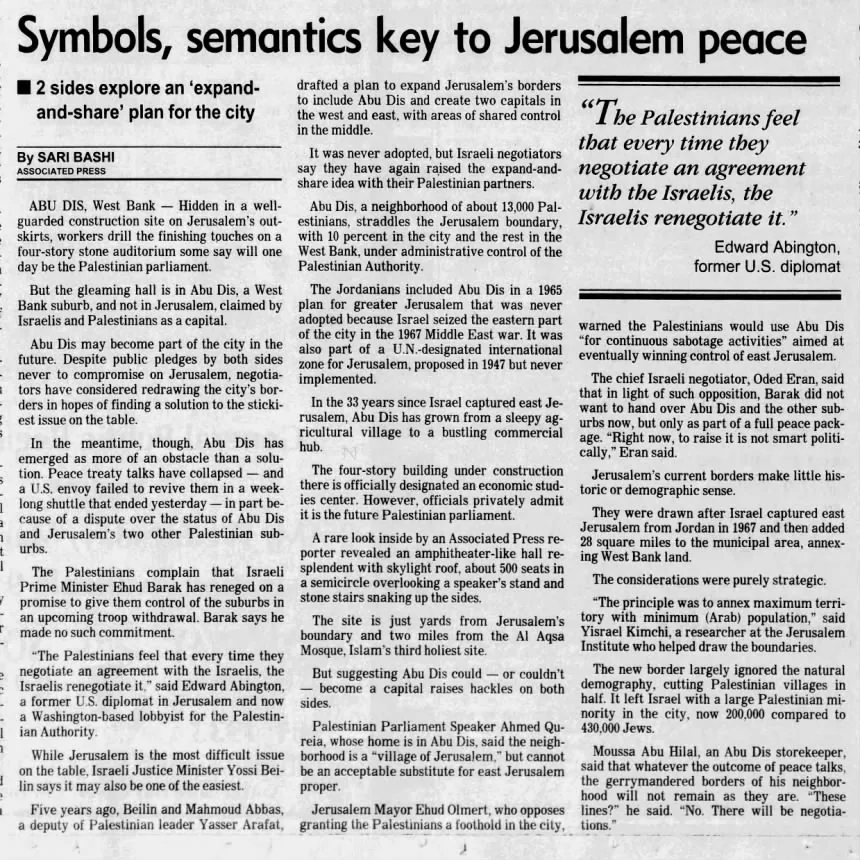
Transcribed from the clipping
• 2 sides explore an 'expandand-share' plan for the city By SARI BASHI ASSOCIATED PRESS ABU DIS, West Bank - Hidden in a well-guarded construction site on Jerusalem's outskirts, workers drill the finishing touches on a four-story stone auditorium some say will one day be the Palestinian parliament.
But the gleaming hall is in Abu Dis, a West Bank suburb, and not in Jerusalem, claimed by Israelis and Palestinians as a capital. Abu Dis may become part of the city in the future. Despite public pledges by both sides never to compromise on Jerusalem, negotiators have considered redrawing the city's borders in hopes of finding a solution to the stickiest issue on the table.
In the meantime, though, Abu Dis has emerged as more of an obstacle than a solution. Peace treaty talks have collapsed - and a U.S. envoy failed to revive them in a weeklong shuttle that ended yesterday - in part because of a dispute over the status of Abu Dis and Jerusalem's two other Palestinian suburbs.
The Palestinians complain that Israeli Prime Minister Ehud Barak has reneged on a promise to give them control of the suburbs in an upcoming troop withdrawal. Barak says he made no such commitment.
"The Palestinians feel that every time they negotiate an agreement with the Israelis, the Israelis renegotiate it." said Edward Abington, a former U.S. diplomat in Jerusalem and now a Washington-based lobbyist for the Palestinian Authority. While Jerusalem is the most difficult issue on the table, Israeli Justice Minister Yossi Beilin says it may also be one of the easiest.
Five years ago, Beilin and Mahmoud Abbas, a deputy of Palestinian leader Yasser Arafat, drafted a plan to expand Jerusalem's borders to include Abu Dis and create two capitals in the west and east, with areas of shared control in the middle. It was never adopted, but Israeli negotiators say they have again raised the expand-and-share idea with their Palestinian partners.
Abu Dis, a neighborhood of about 13,000 Palestinians, straddles the Jerusalem boundary, with 10 percent in the city and the rest in the West Bank, under administrative control of the Palestinian Authority. The Jordanians included Abu Dis in a 1965 plan for greater Jerusalem that was never adopted because Israel seized the eastern part of the city in the 1967 Middle East war.
It was also part of a U.N.-designated international zone for Jerusalem, proposed in 1947 but never implemented. In the 33 years since Israel captured east Jerusalem, Abu Dis has grown from a sleepy agricultural village to a bustling commercial hub. The four-story building under construction there is officially designated an economic studies center.
However, officials privately admit it is the future Palestinian parliament. A rare look inside by an Associated Press reporter revealed an amphitheater-like hall resplendent with skylight roof, about 500 seats in a semicircle overlooking a speaker's stand and stone stairs snaking up the sides.
The site is just yards from Jerusalem's boundary and two miles from the Al Aqsa Mosque, Islam's third holiest site. But suggesting Abu Dis could - or couldn't - become a capital raises hackles on both sides.
Palestinian Parliament Speaker Ahmed Qureia, whose home is in Abu Dis, said the neighborhood is a "village of Jerusalem," but cannot be an acceptable substitute for east Jerusalem proper.
Jerusalem Mayor Ehud Olmert, who opposes granting the Palestinians a foothold in the city, warned the Palestinians would use Abu Dis "for continuous sabotage activities" aimed at eventually winning control of east Jerusalem.
The chief Israeli negotiator, Oded Eran, said that in light of such opposition, Barak did not want to hand over Abu Dis and the other suburbs now, but only as part of a full peace package. "Right now, to raise it is not smart politically," Eran said. Jerusalem's current borders make little historic or demographic sense.
They were drawn after Israel captured east Jerusalem from Jordan in 1967 and then added 28 square miles to the municipal area, annexing West Bank land. The considerations were purely strategic. "The principle was to annex maximum territory with minimum (Arab) population," said Yisrael Kimchi, a researcher at the Jerusalem Institute who helped draw the boundaries.
The new border largely ignored the natural demography, cutting Palestinian villages in half. It left Israel with a large Palestinian minority in the city, now 200,000 compared to 430,000 Jews. Moussa Abu Hilal, an Abu Dis storekeeper, said that whatever the outcome of peace talks, the gerrymandered borders of his neighborhood will not remain as they are.
"These lines?" he said. "No. There will be negotiations."
How this transcription was made
Transcribed by optical character recognition and read back against the scan by hand.
Cite this clipping
"Symbols, semantics key to Jerusalem peace," Staten Island Advance, 29 February 2000. Covering Palestine archive, CP-2000-038. https://coveringpalestine.org/archive/cp-2000-038
More from Staten Island Advance
- Arab Mobs Touch Off Violence In JerusalemStaten Island Advance · 2 December 1947
- Most disapprove of U.N. Zionism proclamationStaten Island Advance · 15 December 1975
- Palestinian youths riotStaten Island Advance · 20 December 1987
- ‘Nothing to lose’ in campsStaten Island Advance · 20 December 1987
- Palestinian refugees head homeStaten Island Advance · 27 June 1991
- Grim first: Woman bomber kills Jerusalem manStaten Island Advance · 28 January 2002
- 5 more from this paper in the full text →
More from the 2000s
- Are refugee camps still temporary?Pittsburgh Post-Gazette · 27 February 2000
- Building, like West Bank peace, still under constructionLansing State Journal · 29 February 2000
- No progress in peace missionLaredo Morning Times · 29 February 2000
- Some Palestinians fed up with ArafatLexington Herald-Leader · 29 February 2000
- The poetry of Arab pain: Are Israeli students ready?The Bulletin · 7 March 2000
- Israelis argue over teaching Palestinian’s verseThe Oregonian · 7 March 2000
- All 527 clippings from the 2000s →
Last updated 17 November 2026
This record is part of Covering Palestine, an archive of American newspaper clippings about Palestinians, 1724 to 2023. Researched and assembled by Maria Robles.
The clipping belongs to the newspaper that printed it, or to the news agency that supplied the copy. It is reproduced here for research, criticism and commentary. A city here is where the newspaper was published, not where the story came from, and on most records it was taken from the masthead.
Something wrong here, or something you know about this clipping? The archive is still being built and corrections are wanted: maria@rozumstudio.com, quoting CP-2000-038.
Everything printed in 2000 · Printed on this day · See it in the archive reel · Full text of every clipping · Dataset