The Oregonian · Portland, Oregon · 7 March 2000
CP-2000-013
Israelis argue over teaching Palestinian’s verse
The education minister is assailed for suggesting Mahmoud Darwish’s poems as optional reading
Susan Sachs, New York Times News Service, Ramallah
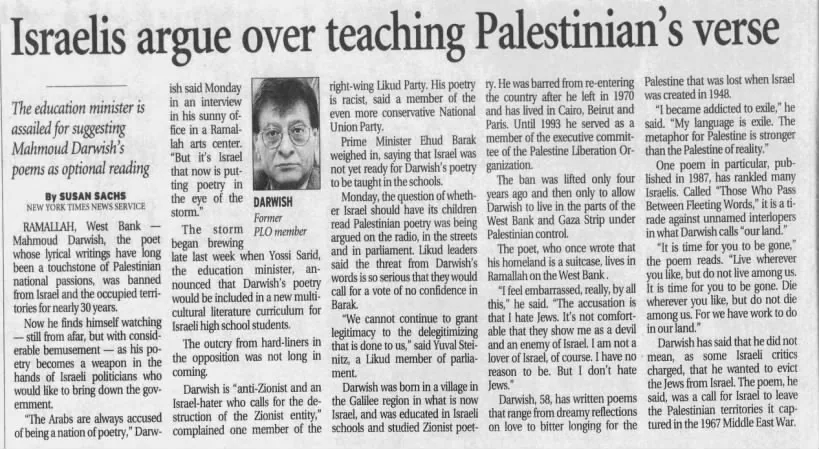
Transcribed from the clipping
“RAMALLAH, West Bank — Mahmoud Darwish, the poet whose lyrical writings have long been a touchstone of Palestinian national passions, was banned from Israel and the occupied territories for nearly 30 years… ‘The Arabs are always accused of being a nation of poetry,’ Darwish said Monday in an interview in his sunny office in a Ramallah arts center. ‘But it’s Israel that now is putting poetry in the eye of the storm.’… Prime Minister Ehud Barak weighed in, saying that Israel was not yet ready for Darwish’s poetry to be taught in the schools… The ban was lifted only four years ago and then only to allow Darwish to live in the parts of the West Bank and Gaza Strip under Palestinian control. The poet, who once wrote that his homeland is a suitcase, lives in Ramallah on the West Bank. ‘I feel embarrassed, really, by all this,’ he said. ‘The accusation is that I hate Jews. It’s not comfortable that they show me as a devil and an enemy of Israel. I am not a lover of Israel, of course. I have no reason to be. But I don’t hate Jews.’ Darwish, 58, has written poems that range from dreamy reflections on love to bitter longing for the Palestine that was lost when Israel was created in 1948. ‘I became addicted to exile,’ he said. ‘My language is exile. The metaphor for Palestine is stronger than the Palestine of reality.’ One poem in particular, published in 1987, has rankled many Israelis. Called ‘Those Who Pass Between Fleeting Words,’ it is a tirade against unnamed interlopers in what Darwish calls ‘our land.’ ‘It is time for you to be gone,’ the poem reads. ‘Live wherever you like, but do not live among us. It is time for you to be gone. Die wherever you like, but do not die among us. For we have work to do in our land.’ Darwish has said that he did not mean, as some Israeli critics charged, that he wanted to evict the Jews from Israel. The poem, he said, was a call for Israel to leave the Palestinian territories it captured in the 1967 Middle East War.”
Photograph caption
“DARWISH — Former PLO member”
Context added by this archive
The third printing of this row in the archive and the third headline, and the only one that prints both the poem and his answer to it. That makes the poem’s whole American life visible: quoted in a wire story in April 1988 as a demand for all of Israel; here in March 2000 with his own explanation that it meant leaving the territories taken in 1967; and again in 2008, in six obituaries, where Yitzhak Shamir is reported reading it aloud in the Knesset and a specialist says it was misunderstood and mistranslated. The correction was in American newspapers eight years before the obituaries repeated the charge.
Cite this item
"Israelis argue over teaching Palestinian’s verse," The Oregonian, 7 March 2000. Covering Palestine archive, CP-2000-013. https://coveringpalestine.org/archive/cp-2000-013
Elsewhere in the archive
- Murders linked to land sales reopen an ugly chapter in Israeli-Palestinian historyThe Oregonian · 4 June 1997 · the same newspaper
- Conflict, paranoia, but little propaganda in ‘Omar’The Oregonian · 21 February 2014 · the same newspaper
- Jewry Leader Sounds CallThe Oregonian · 24 April 1948 · the same newspaper
- The poetry of Arab pain: Are Israeli students ready?The Bulletin · 7 March 2000 · the same year
- An uproar over introduction of poet into curriculumThe News Virginian · 7 March 2000 · the same year
- Poet’s work inflames cultural divideTampa Bay Times · 11 March 2000 · the same year
This record is part of Covering Palestine, an archive of American and Anglophone newspaper clippings about Palestinians, 1812 to 2022. Researched and assembled by Maria Robles.
The clipping belongs to the newspaper that printed it, or to the wire service that supplied the copy. It is reproduced here for research, criticism and commentary. The city is derived from the masthead, not read off the clipping.
Something wrong here, or something you know about this clipping? The archive is still being built and corrections are wanted: maria@rozumstudio.com, quoting CP-2000-013.
See it in the archive reel · Full text of every clipping · Dataset