The Bulletin · Bend, Oregon · 7 March 2000
CP-2000-012
The poetry of Arab pain: Are Israeli students ready?
Susan Sachs, N.Y. Times News Service, Ramallah
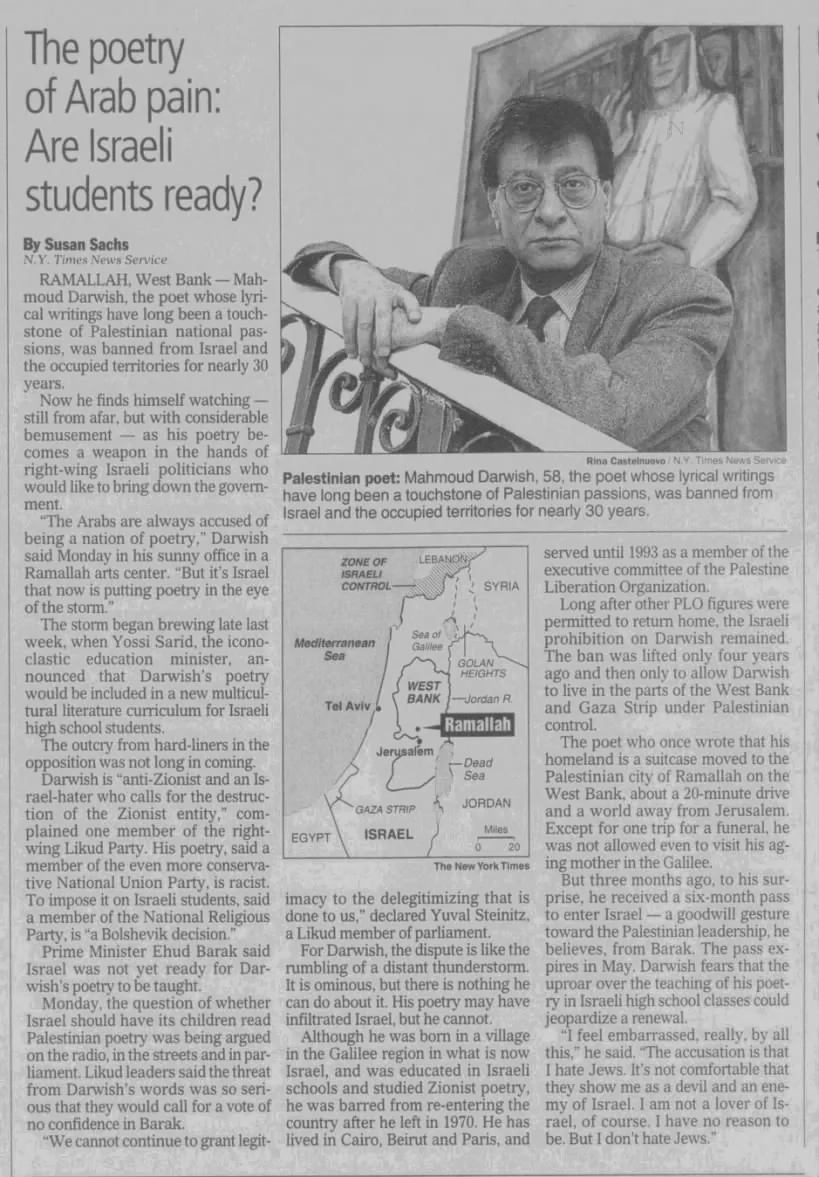
Transcribed from the clipping
“RAMALLAH, West Bank — Mahmoud Darwish, the poet whose lyrical writings have long been a touchstone of Palestinian national passions, was banned from Israel and the occupied territories for nearly 30 years. Now he finds himself watching — still from afar, but with considerable bemusement — as his poetry becomes a weapon in the hands of right-wing Israeli politicians who would like to bring down the government. ‘The Arabs are always accused of being a nation of poetry,’ Darwish said Monday in his sunny office in a Ramallah arts center. ‘But it’s Israel that now is putting poetry in the eye of the storm.’ The storm began brewing late last week, when Yossi Sarid, the iconoclastic education minister, announced that Darwish’s poetry would be included in a new multicultural literature curriculum for Israeli high school students. The outcry from hard-liners in the opposition was not long in coming. Darwish is ‘anti-Zionist and an Israel-hater who calls for the destruction of the Zionist entity,’ complained one member of the right-wing Likud Party. His poetry, said a member of the even more conservative National Union Party, is racist. To impose it on Israeli students, said a member of the National Religious Party, is ‘a Bolshevik decision.’ Prime Minister Ehud Barak said Israel was not yet ready for Darwish’s poetry to be taught… ‘We cannot continue to grant legitimacy to the delegitimizing that is done to us,’ declared Yuval Steinitz, a Likud member of parliament. For Darwish, the dispute is like the rumbling of a distant thunderstorm. It is ominous, but there is nothing he can do about it. His poetry may have infiltrated Israel, but he cannot. Although he was born in a village in the Galilee region in what is now Israel, and was educated in Israeli schools and studied Zionist poetry, he was barred from re-entering the country after he left in 1970. He has lived in Cairo, Beirut and Paris, and served until 1993 as a member of the executive committee of the Palestine Liberation Organization. Long after other PLO figures were permitted to return home, the Israeli prohibition on Darwish remained. The ban was lifted only four years ago and then only to allow Darwish to live in the parts of the West Bank and Gaza Strip under Palestinian control. The poet who once wrote that his homeland was a suitcase moved to the Palestinian city of Ramallah on the West Bank, about a 20-minute drive and a world away from Jerusalem. Except for one trip for a funeral, he was not allowed even to visit his aging mother in the Galilee. But three months ago, to his surprise, he received a six-month pass to enter Israel — a goodwill gesture toward the Palestinian leadership, he believes, from Barak. The pass expires in May. Darwish fears that the uproar over the teaching of his poetry in Israeli high school classes could jeopardize a renewal. ‘I feel embarrassed, really, by all this,’ he said. ‘The accusation is that I hate Jews. It’s not comfortable that they show me as a devil and an enemy of Israel. I am not a lover of Israel, of course. I have no reason to be. But I don’t hate Jews.’”
Photograph caption
“Palestinian poet: Mahmoud Darwish, 58, the poet whose lyrical writings have long been a touchstone of Palestinian passions, was banned from Israel and the occupied territories for nearly 30 years.” · Rina Castelnuovo / N.Y. Times News Service. A map beside it marks the zone of Israeli control and Ramallah.
Context added by this archive
The same week as the St. Petersburg report and a different wire service, with more of him in it. One sentence holds the whole case: his poetry may have infiltrated Israel, but he cannot. Except for a single trip to a funeral he was not permitted to visit his mother in the Galilee — and among the poems of his that the obituaries in this archive list as having been set to music and become anthems is the one called ‘I yearn for my mother’s bread.’ The two facts are printed in different American newspapers eight years apart and neither mentions the other.
Cite this item
"The poetry of Arab pain: Are Israeli students ready?," The Bulletin, 7 March 2000. Covering Palestine archive, CP-2000-012. https://coveringpalestine.org/archive/cp-2000-012
Elsewhere in the archive
- Israelis argue over teaching Palestinian’s verseThe Oregonian · 7 March 2000 · the same year
- An uproar over introduction of poet into curriculumThe News Virginian · 7 March 2000 · the same year
- Poet’s work inflames cultural divideTampa Bay Times · 11 March 2000 · the same year
This record is part of Covering Palestine, an archive of American and Anglophone newspaper clippings about Palestinians, 1812 to 2022. Researched and assembled by Maria Robles.
The clipping belongs to the newspaper that printed it, or to the wire service that supplied the copy. It is reproduced here for research, criticism and commentary. The city is derived from the masthead, not read off the clipping.
Something wrong here, or something you know about this clipping? The archive is still being built and corrections are wanted: maria@rozumstudio.com, quoting CP-2000-012.
See it in the archive reel · Full text of every clipping · Dataset