The Bulletin · Bend, OR · 27 July 2014
CP-2014-061
The death of the two-state solution?
Ishaan Tharoor / The Washington Post
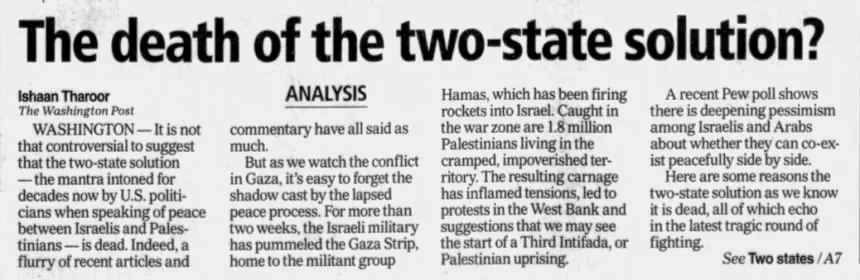
Transcribed from the clipping
WASHINGTON — It is not that controversial to suggest that the two-state solution — the mantra intoned for decades now by U.S. politicians when speaking of peace between Israelis and Palestinians — is dead. Indeed, a flurry of recent articles and commentary have all said as much.
But as we watch the conflict in Gaza, it’s easy to forget the shadow cast by the lapsed peace process. For more than two weeks, the Israeli military has pummeled the Gaza Strip, home to the militant group Hamas, which has been firing rockets into Israel. Caught in the war zone are 1.8 million Palestinians living in the cramped, impoverished territory.
The resulting carnage has inflamed tensions, led to protests in the West Bank and suggestions that we may see the start of a Third Intifada, or Palestinian uprising. A recent Pew poll shows there is deepening pessimism among Israelis and Arabs about whether they can co-exist peacefully side by side.
Here are some reasons the two-state solution as we know it is dead, all of which echo in the latest tragic round of fighting.
See Two states / A7 Two states Continued from A1 Hamas is dominating the conversation The Islamist organization whose militant wing is now locked in combat with Israel, alongside some other jihadist outfits, has never had any real interest in the two-state solution. As Israelis often point out, its founding charter shows no acceptance of the right of Israel to exist.
And Hamas’ refusal to renounce violence — something the PLO of the late Yasser Arafat and current Palestinian president Mahmoud Abbas has done — keeps it firmly in the crosshairs of Israel’s vast security apparatus. [...] Settlements are here to stay Despite being considered illegal under international law, the construction of settlements in the West Bank has continued apace during Netanyahu’s tenure in office.
Settlers form a key constituency for some of the parties in Netanyahu’s ruling coalition, and have led to the rise of far-right politicians like Naftali Bennett, who rejects the idea of an independent Palestinian state.
The settlements are scattered all over the West Bank, as well as in East Jerusalem — which the Palestinians would want as the capital of their independent state — and would pose a permanent challenge to the territorial integrity of a Palestinian state.
The Israelis framed their actions as counter-measures to the Palestinians’ quixotic bids for recognition at the U.N., a symbolic status that speaks to how little leverage Abbas and his negotiators actually have. Much to the ire of the Obama administration, Netanyahu’s government expanded settlement construction even as peace talks were ongoing.
And they unveiled plans to build in areas away from the established “blocks” of settlements that sit not far from the Green Line, the border demarcating the West Bank and Israel.
How this transcription was made
Date and publication rest on the collector's slide label; no masthead, folio or printed dateline appears on this clipping.
Context added by this archive
If Maria reads one clipping from this batch for language, it should be this one. It is the only item in batch B where a U.S. paper says in its own voice, within a few inches of type, that settlements are illegal under international law, that settlers are a governing constituency, that Bennett rejects Palestinian statehood, and that what Netanyahu is describing is occupation.
The vocabulary that is quarantined inside Palestinian quotations everywhere else in this batch is, here, simply the reporting. Note also what it does not do: it never uses the word 'occupied' about Gaza, and its Hamas section adopts the standard framing ('jihadist outfits', 'crosshairs').
The AP photograph and caption on the jump page are the only image in batch B of a named-nothing Palestinian woman walking through what was done to Beit Hanoun.
Cite this clipping
"The death of the two-state solution?," The Bulletin, 27 July 2014, p. A1 and A7. Covering Palestine archive, CP-2014-061. https://coveringpalestine.org/archive/cp-2014-061
More from The Bulletin
- The poetry of Arab pain: Are Israeli students ready?The Bulletin · 7 March 2000
- Israelis threaten to re-invade GazaThe Bulletin · 15 April 2006
- Rare inscribed cup is unearthed near Old JerusalemThe Bulletin · 1 August 2009
- Israeli military invades GazaThe Bulletin · 18 July 2014
- Israel extends cease-fire in Gaza, but not HamasThe Bulletin · 27 July 2014
More from the 2010s
- Roger Waters rips Scarlett Johansson, Neil Young over Israel; SodaStream stock dipsSt. Louis Jewish Light · 5 February 2014
- Palestinian women make strides in high-tech jobsThe Sentinel · 12 February 2014
- Stories in and out of timeStar Tribune · 16 February 2014
- Conflict, paranoia, but little propaganda in ‘Omar’The Oregonian · 21 February 2014
- The front-runnersLos Angeles Times · 23 February 2014
- Masterful ‘Omar’ dives deep into notion of conflictHonolulu Star-Advertiser · 28 February 2014
- All 321 clippings from the 2010s →
Last updated 2 November 2026
This record is part of Covering Palestine, an archive of American newspaper clippings about Palestinians, 1724 to 2023. Researched and assembled by Maria Robles.
The clipping belongs to the newspaper that printed it, or to the news agency that supplied the copy. It is reproduced here for research, criticism and commentary. A city here is where the newspaper was published, not where the story came from, and on most records it was taken from the masthead.
Something wrong here, or something you know about this clipping? The archive is still being built and corrections are wanted: maria@rozumstudio.com, quoting CP-2014-061.
Everything printed in 2014 · Printed on this day · See it in the archive reel · Full text of every clipping · Dataset