The Sentinel · Carlisle, Pennsylvania · 12 February 2014
CP-2014-027
Palestinian women make strides in high-tech jobs
Palestinian women are majority of students in many colleges in the West Bank and the Gaza Strip, but often have trouble transitioning into the job market
By Karin Laub, Associated Press
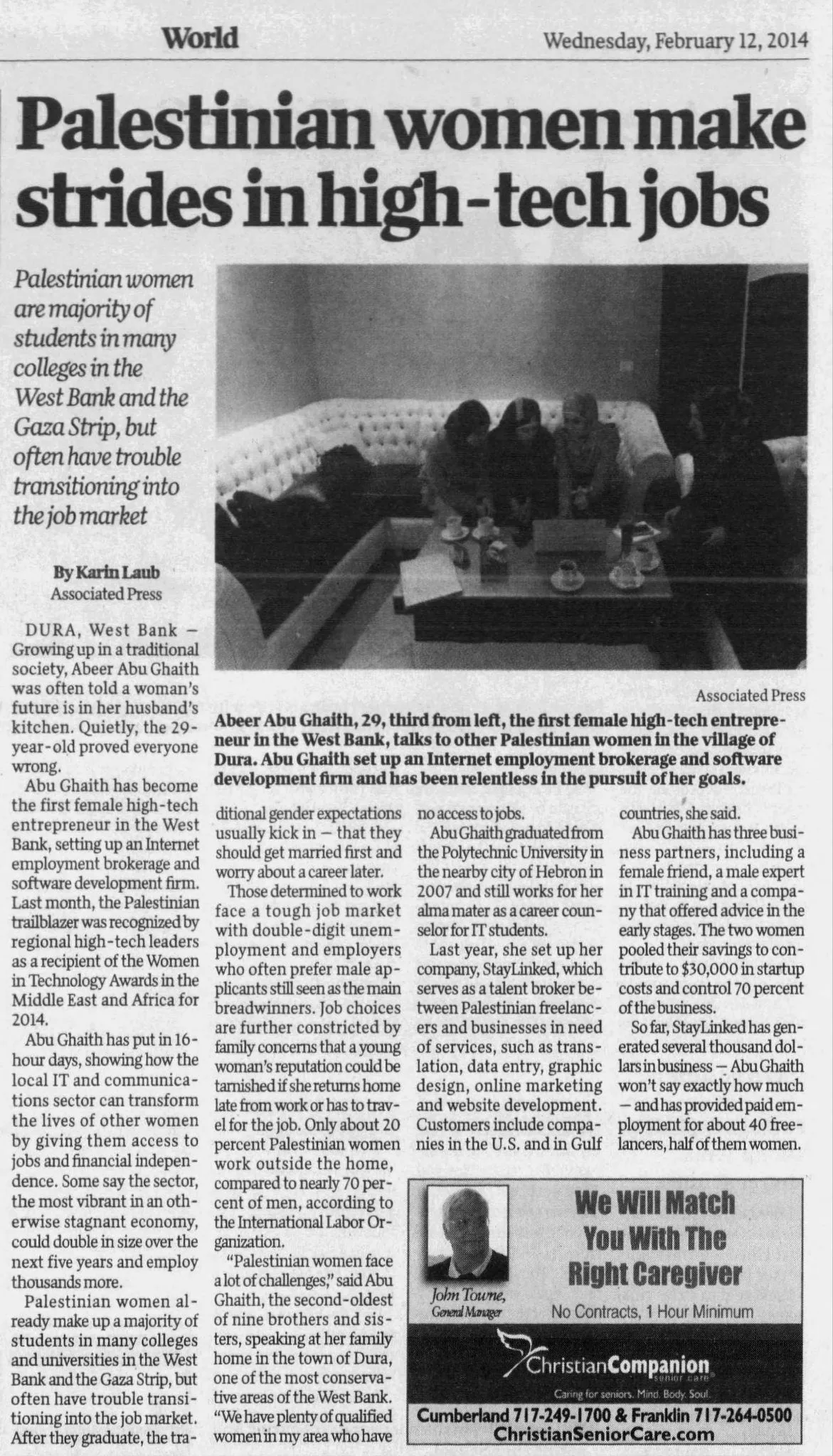
Transcribed from the clipping
DURA, West Bank — Growing up in a traditional society, Abeer Abu Ghaith was often told a woman's future is in her husband's kitchen. Quietly, the 29-year-old proved everyone wrong. Abu Ghaith has become the first female high-tech entrepreneur in the West Bank, setting up an Internet employment brokerage and software development firm.
Last month, the Palestinian trailblazer was recognized by regional high-tech leaders as a recipient of the Women in Technology Awards in the Middle East and Africa for 2014. Abu Ghaith has put in 16-hour days, showing how the local IT and communications sector can transform the lives of other women by giving them access to jobs and financial independence.
Some say the sector, the most vibrant in an otherwise stagnant economy, could double in size over the next five years and employ thousands more. Palestinian women already make up a majority of students in many colleges and universities in the West Bank and the Gaza Strip, but often have trouble transitioning into the job market.
After they graduate, the traditional gender expectations usually kick in — that they should get married first and worry about a career later. Those determined to work face a tough job market with double-digit unemployment and employers who often prefer male applicants still seen as the main breadwinners.
Job choices are further constricted by family concerns that a young woman's reputation could be tarnished if she returns home late from work or has to travel for the job. Only about 20 percent Palestinian women work outside the home, compared to nearly 70 percent of men, according to the International Labor Organization.
“Palestinian women face a lot of challenges,” said Abu Ghaith, the second-oldest of nine brothers and sisters, speaking at her family home in the town of Dura, one of the most conservative areas of the West Bank. “We have plenty of qualified women in my area who have no access to jobs.”
Abu Ghaith graduated from the Polytechnic University in the nearby city of Hebron in 2007 and still works for her alma mater as a career counselor for IT students.
Last year, she set up her company, StayLinked, which serves as a talent broker between Palestinian freelancers and businesses in need of services, such as translation, data entry, graphic design, online marketing and website development. Customers include companies in the U.S. and in Gulf countries, she said.
Abu Ghaith has three business partners, including a female friend, a male expert in IT training and a company that offered advice in the early stages. The two women pooled their savings to contribute to $30,000 in startup costs and control 70 percent of the business.
So far, StayLinked has generated several thousand dollars in business — Abu Ghaith won't say exactly how much — and has provided paid employment for about 40 freelancers, half of them women.
Context added by this archive
Printed on the World page.
Cite this item
"Palestinian women make strides in high-tech jobs," The Sentinel, 12 February 2014. Covering Palestine archive, CP-2014-027. https://coveringpalestine.org/archive/cp-2014-027
More from The Sentinel
- Will We Tolerate Genocide in Israel?The Sentinel · 14 November 1969
More from the 2010s
- Stories in and out of timeStar Tribune · 16 February 2014
- Conflict, paranoia, but little propaganda in ‘Omar’The Oregonian · 21 February 2014
- The front-runnersLos Angeles Times · 23 February 2014
- Masterful ‘Omar’ dives deep into notion of conflictHonolulu Star-Advertiser · 28 February 2014
- A nail-biter after cameras stop rollingLos Angeles Times · 5 March 2014
- OmarSan Francisco Chronicle · 16 March 2014
- All 110 clippings from the 2010s →
This record is part of Covering Palestine, an archive of American and Anglophone newspaper clippings about Palestinians, 1799 to 2023. Researched and assembled by Maria Robles.
The clipping belongs to the newspaper that printed it, or to the news agency that supplied the copy. It is reproduced here for research, criticism and commentary. The city is derived from the masthead, not read off the clipping.
Something wrong here, or something you know about this clipping? The archive is still being built and corrections are wanted: maria@rozumstudio.com, quoting CP-2014-027.
See it in the archive reel · Full text of every clipping · Dataset