 One headline in ten called him a writerOne headline in ten called him a writer · 1972 to 2014
1972 to 2014
One headline in ten called him a writer
On 8 July 1972 a bomb wired to the ignition of a car in Beirut killed Ghassan Kanafani and his niece Lamees, who was seventeen. He had published the novel that made his name four years earlier. Ten papers in this archive carried the killing.
- Explosion kills leader of Arab terrorist group The Star-Ledger
- Arab Militant Leader Dies In Car Explosion Jacksonville Journal
- Palestinian Guerrilla Is Slain Greensboro Daily News
- Israel Accused in Assassination Blast The Flint Journal
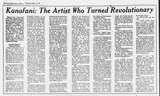
- Kanafani: The Artist Who Turned Revolutionary Anchorage Daily Times
One out of ten. The exception ran in Alaska, and it is the only one of the ten that treats the writing as the reason to run the story at all.
Forty-two years later the Free Lance-Star sent a reporter to artists working in the rubble of Gaza. The slug set above the headline read CONFLICT. Four paragraphs down, the screenwriter Naim al-Khatib explained why he had given up trying to write about anything else.
Naim al-Khatib, screenwriter · The Free Lance-Star, 19 September 2014
The paper printed his complaint above his head, as a category. Between 1972 and 2014 the same sentence keeps arriving, from people who do not know each other.
Kamal Boullata, painter
On crayon drawings by children from Baqa’a camp: In front of the human monumentality of these naked works created by the tiny hands of sincere children, I feel all my best work is now reduced to the size of a postage stamp.
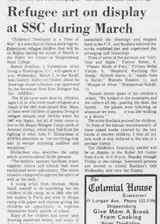 CP-1975-008
Sahar Khalifeh, novelist
At the Iowa writing program, with books banned at home: I am here without a machine gun, but with a pen.
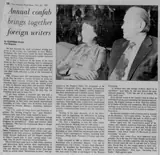 CP-1981-004
Fayez Sirsawi, painter, Gaza
A painting without a reference to Jerusalem, a painting without a Palestinian flag, without any symbol of the cause, would be rejected as not Palestinian art.
One Associated Press dispatch, four papers, four headlines. This one called it political correctness.
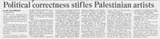 CP-1994-008
Fayez al-Hasni, who paints the dead for their families
It saddens me that they don’t want the painting to reflect the people they were. But I’m obligated to fulfill their wishes.
At least ten of the dead were his own students.
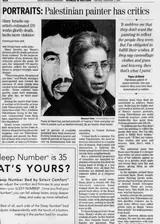 CP-2004-003
In 2000 the Israeli education ministry put five Mahmoud Darwish poems on the syllabus and the government nearly fell over it. Four papers in this archive carried the row, from three different news agencies. Darwish, asked what the objection was: Israelis do not recognize Palestinians as cultural producers. They accept us as obstacles, as part of the landscape but nothing beyond that.
He died after heart surgery in Houston in August 2008. Seven papers here printed it. Five of the seven headlines call him a poet; the other two give his name and his dates. Not one reaches for the word it had used on Kanafani.