The Record · Hackensack, New Jersey · 2 April 1994
CP-1994-008
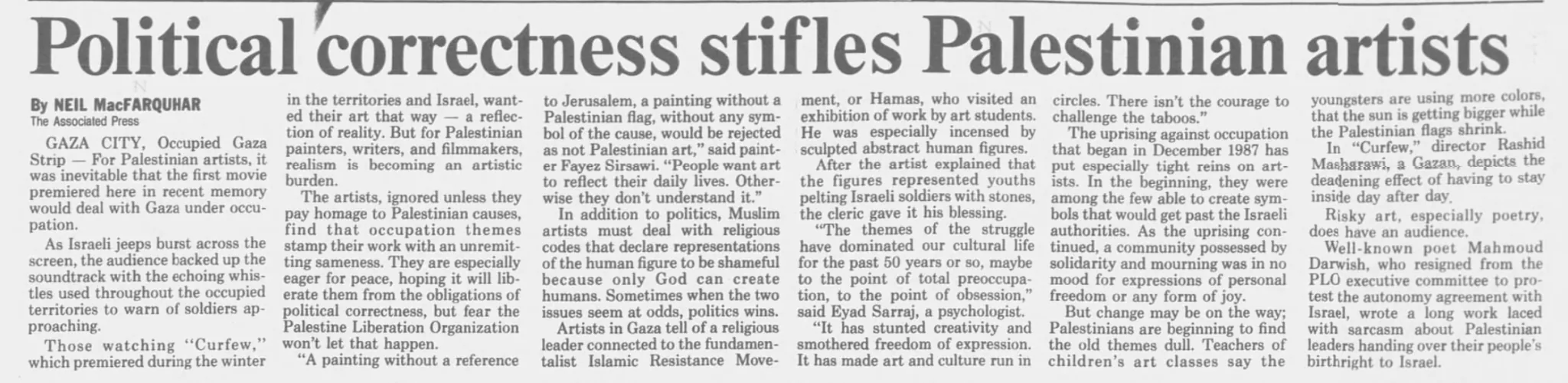
Political correctness stifles Palestinian artists
Neil MacFarquhar, The Associated Press, Gaza City
Transcribed from the clipping
GAZA CITY, Occupied Gaza Strip — For Palestinian artists, it was inevitable that the first movie premiered here in recent memory would deal with Gaza under occupation. As Israeli jeeps burst across the screen, the audience backed up the soundtrack with the echoing whistles used throughout the occupied territories to warn of soldiers approaching.
Those watching “Curfew,” which premiered during the winter in the territories and Israel, wanted their art that way — a reflection of reality. But for Palestinian painters, writers, and filmmakers, realism is becoming an artistic burden.
The artists, ignored unless they pay homage to Palestinian causes, find that occupation themes stamp their work with an unremitting sameness.
They are especially eager for peace, hoping it will liberate them from the obligations of political correctness, but fear the Palestine Liberation Organization won’t let that happen. “A painting without a reference to Jerusalem, a painting without a Palestinian flag, without any symbol of the cause, would be rejected as not Palestinian art,” said painter Fayez Sirsawi.
“People want art to reflect their daily lives. Otherwise they don’t understand it.” In addition to politics, Muslim artists must deal with religious codes that declare representations of the human figure to be shameful because only God can create humans. Sometimes when the two issues seem at odds, politics wins.
Artists in Gaza tell of a religious leader connected to the fundamentalist Islamic Resistance Movement, or Hamas, who visited an exhibition of work by art students. He was especially incensed by sculpted abstract human figures. After the artist explained that the figures represented youths pelting Israeli soldiers with stones, the cleric gave it his blessing.
“The themes of the struggle have dominated our cultural life for the past 50 years or so, maybe to the point of total preoccupation, to the point of obsession,” said Eyad Sarraj, a psychologist. “It has stunted creativity and smothered freedom of expression. It has made art and culture run in circles.
There isn’t the courage to challenge the taboos.” The uprising against occupation that began in December 1987 has put especially tight reins on artists… But change may be on the way; Palestinians are beginning to find the old themes dull.
Teachers of children’s art classes say the youngsters are using more colors, that the sun is getting bigger while the Palestinian flags shrink. In “Curfew,” director Rashid Masharawi, a Gazan, depicts the deadening effect of having to stay inside day after day. Risky art, especially poetry, does have an audience.
Well-known poet Mahmoud Darwish, who resigned from the PLO executive committee to protest the autonomy agreement with Israel, wrote a long work laced with sarcasm about Palestinian leaders handing over their people’s birthright to Israel.
Context added by this archive
One Associated Press dispatch, four papers, four headlines. The Record: “Political correctness stifles Palestinian artists.” The Houston Post: “Palestinian artists hope peace will liberate them.” The Sun: “Palestinian artists bound by their own politics.”
The Kalamazoo Gazette: “Palestinian artists wonder how free new state would be.” The Record and the Kalamazoo Gazette also ran different lengths of it: Kalamazoo cut the Hamas cleric, Mahmoud Darwish’s resignation and Masharawi’s name from the body. All four scans are held.
Cite this clipping
"Political correctness stifles Palestinian artists," The Record, 2 April 1994, p. 1. Covering Palestine archive, CP-1994-008. https://coveringpalestine.org/archive/cp-1994-008
This clipping is read closely in the section below
More from The Record
- Israeli secret police in new controversy over killing cover-upThe Record · 12 November 1987
- Israel cancels credentials of 3 reportersThe Record · 26 October 1988
- Obama: New approach in Middle EastThe Record · 22 March 2013
- Who Owns the “West Bank”?The Record · 28 July 2015
More from the 1990s
- Gaza life after darkThe Town Talk · 8 January 1994
- Building Peace in Palestinian SchoolsThe New York Times · 9 January 1994
- Medicine in Gaza lags behind IsraelThe Houston Post · 16 January 1994
- To Read All About It, Palestinians Scan the WallsThe New York Times · 24 January 1994
- Palestinian photographer beaten by Israeli troopsThe Bay City Times · 29 January 1994
- Israelis shoot 12-year-oldSunday Telegraph · 6 February 1994
- All 383 clippings from the 1990s →
In these collections
Last updated 17 November 2026
This record is part of Covering Palestine, an archive of American newspaper clippings about Palestinians, 1724 to 2023. Researched and assembled by Maria Robles.
The clipping belongs to the newspaper that printed it, or to the news agency that supplied the copy. It is reproduced here for research, criticism and commentary. A city here is where the newspaper was published, not where the story came from, and on most records it was taken from the masthead.
Something wrong here, or something you know about this clipping? The archive is still being built and corrections are wanted: maria@rozumstudio.com, quoting CP-1994-008.
Read in: Only one headline called him an artist
Everything printed in 1994 · Printed on this day · See it in the archive reel · Full text of every clipping · Dataset