The New York Times · New York, New York · 31 March 1994
CP-1994-059
After Hebron, a Fierce Test of Bedouin Loyalty
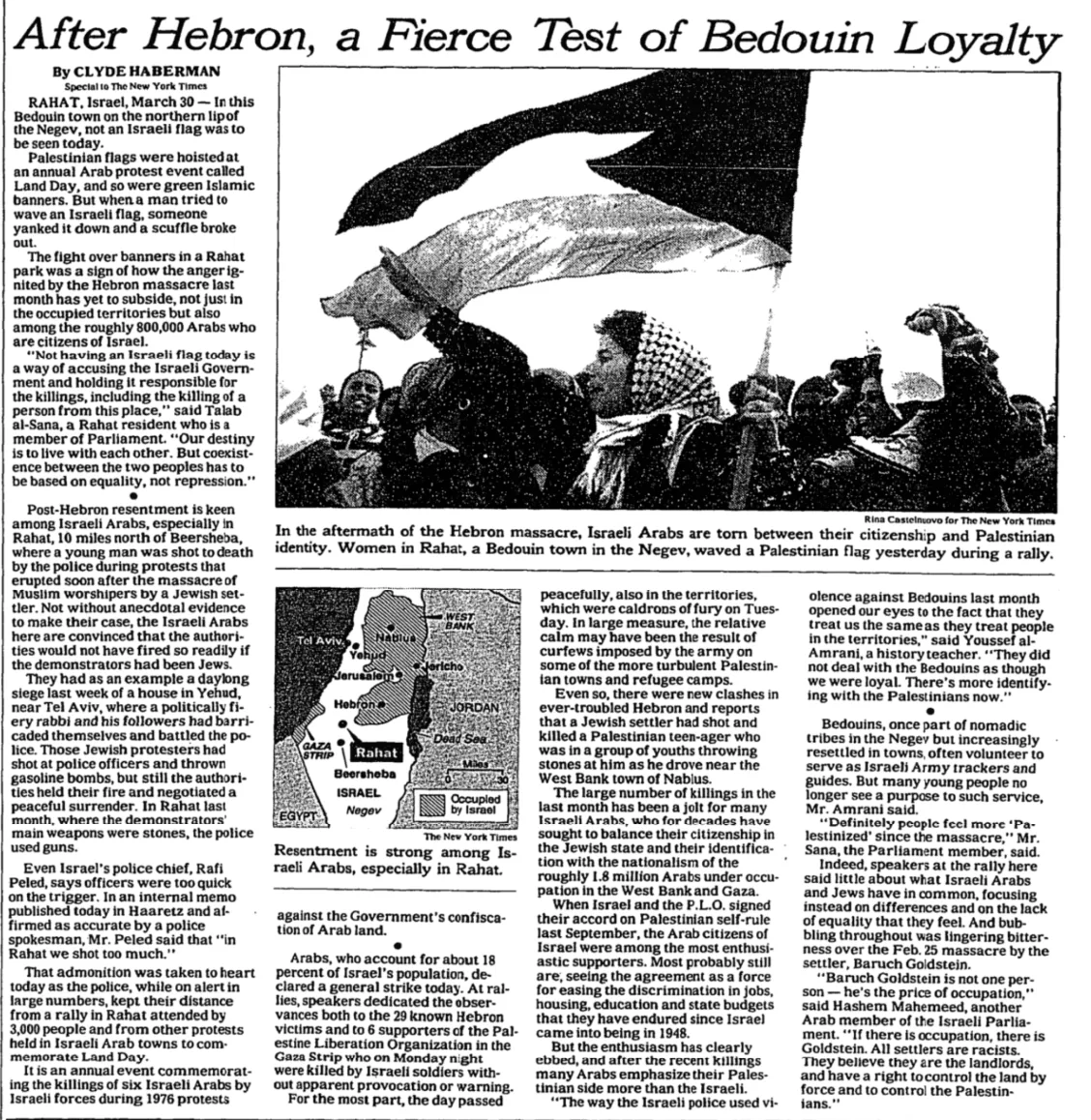
Transcribed from the clipping
RAHAT, Israel, March 30 — In this Bedouin town on the northern lip of the Negev, not an Israeli flag was to be seen today. Palestinian flags were hoisted at an annual Arab protest event called Land Day, and so were green Islamic banners. But when a man tried to wave an Israeli flag, someone yanked it down and a scuffle broke out.
The fight over banners in a Rahat park was a sign of how the anger ignited by the Hebron massacre last month has yet to subside, not just in the occupied territories but also among the roughly 800,000 Arabs who are citizens of Israel.
“Not having an Israeli flag today is a way of accusing the Israeli Government and holding it responsible for the killings, including the killing of a person from this place,” said Talab al-Sana, a Rahat resident who is a member of Parliament. “Our destiny is to live with each other.
But coexistence between the two peoples has to be based on equality, not repression.” Post-Hebron resentment is keen among Israeli Arabs, especially in Rahat, 10 miles north of Beersheba, where a young man was shot to death by the police during protests that erupted soon after the massacre of Muslim worshipers by a Jewish settler.
Not without anecdotal evidence to make their case, the Israeli Arabs here are convinced that the authorities would not have fired so readily if the demonstrators had been Jews. They had as an example a daylong siege last week of a house in Yehud, near Tel Aviv, where a politically fiery rabbi and his followers had barricaded themselves and battled the police.
Those Jewish protesters had shot at police officers and thrown gasoline bombs, but still the authorities held their fire and negotiated a peaceful surrender. In Rahat last month, where the demonstrators’ main weapons were stones, the police used guns. Even Israel’s police chief, Rafi Peled, says officers were too quick on the trigger.
In an internal memo published today in Haaretz and affirmed as accurate by a police spokesman, Mr. Peled said that “in Rahat we shot too much.”
How this transcription was made
Read from the scan by a machine looking at the image of the page, not by optical character recognition and not by a person. The clipping carries no masthead or date line, so its date and newspaper rest on the record it arrived with, not on anything visible in the scan.
Context added by this archive
Date check: No masthead or page date line is visible; the scan is cropped to the article, photograph and map. The dateline reads “RAHAT, Israel, March 30”, consistent with a March 31, 1994 paper, but the printed date could not be read.
Cite this clipping
"After Hebron, a Fierce Test of Bedouin Loyalty," The New York Times, 31 March 1994. Covering Palestine archive, CP-1994-059. https://coveringpalestine.org/archive/cp-1994-059
More from The New York Times
- The Maine Colony in PalestineThe New York Times · 12 November 1866
- Jewish Colonization in PalestineThe New York Times · 9 December 1883
- Jewish State in Palestine OpposedThe New York Times · 9 July 1897
- ZIONIST CONGRESS IN BASELThe New York Times · 31 August 1897
- ROME FEARS THE ZIONISTSThe New York Times · 12 September 1897
- PROGRESS OF ZIONISMThe New York Times · 16 December 1901
- 852 more from this paper in the full text →
More from the 1990s
- Gaza life after darkThe Town Talk · 8 January 1994
- Building Peace in Palestinian SchoolsThe New York Times · 9 January 1994
- Medicine in Gaza lags behind IsraelThe Houston Post · 16 January 1994
- To Read All About It, Palestinians Scan the WallsThe New York Times · 24 January 1994
- Palestinian photographer beaten by Israeli troopsThe Bay City Times · 29 January 1994
- Israelis shoot 12-year-oldSunday Telegraph · 6 February 1994
- All 374 clippings from the 1990s →
Last updated 2 November 2026
This record is part of Covering Palestine, an archive of American newspaper clippings about Palestinians, 1724 to 2023. Researched and assembled by Maria Robles.
The clipping belongs to the newspaper that printed it, or to the news agency that supplied the copy. It is reproduced here for research, criticism and commentary. A city here is where the newspaper was published, not where the story came from, and on most records it was taken from the masthead.
Something wrong here, or something you know about this clipping? The archive is still being built and corrections are wanted: maria@rozumstudio.com, quoting CP-1994-059.
Everything printed in 1994 · Printed on this day · See it in the archive reel · Full text of every clipping · Dataset