The New York Times · 28 March 1994
CP-1994-063
Massacre and Redemption
By Emile Habibi
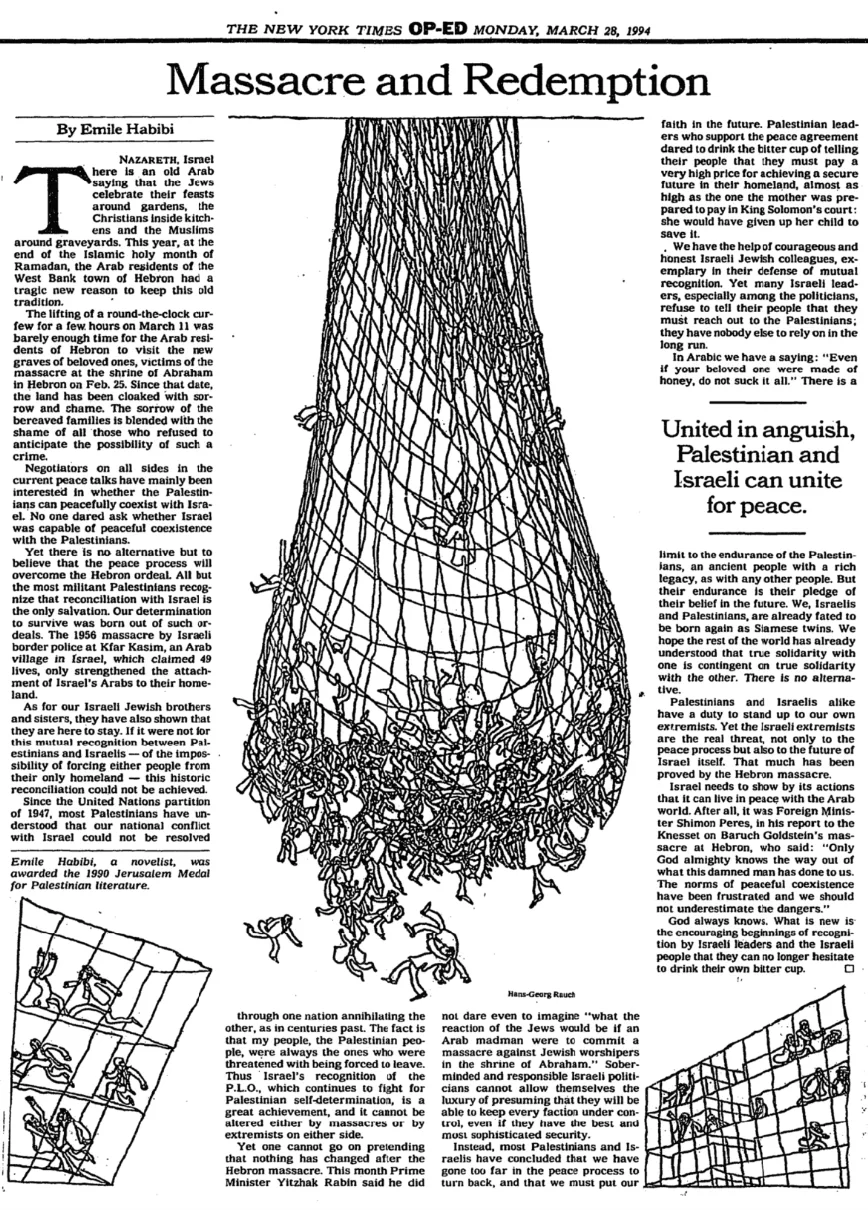
Transcribed from the clipping
NAZARETH, Israel — There is an old Arab saying that the Jews celebrate their feasts around gardens, the Christians inside kitchens and the Muslims around graveyards. This year, at the end of the Islamic holy month of Ramadan, the Arab residents of the West Bank town of Hebron had a tragic new reason to keep this old tradition.
The lifting of a round-the-clock curfew for a few hours on March 11 was barely enough time for the Arab residents of Hebron to visit the new graves of beloved ones, victims of the massacre at the shrine of Abraham in Hebron on Feb. 25. Since that date, the land has been cloaked with sorrow and shame.
The sorrow of the bereaved families is blended with the shame of all those who refused to anticipate the possibility of such a crime. Negotiators on all sides in the current peace talks have mainly been interested in whether the Palestinians can peacefully coexist with Israel. No one dared ask whether Israel was capable of peaceful coexistence with the Palestinians.
Yet there is no alternative but to believe that the peace process will overcome the Hebron ordeal. All but the most militant Palestinians recognize that reconciliation with Israel is the only salvation. Our determination to survive was born out of such ordeals.
The 1956 massacre by Israeli border police at Kfar Kasim, an Arab village in Israel, which claimed 49 lives, only strengthened the attachment of Israel’s Arabs to their homeland. As for our Israeli Jewish brothers and sisters, they have also shown that they are here to stay.
If it were not for this mutual recognition between Palestinians and Israelis — of the impossibility of forcing either people from their only homeland — this historic reconciliation could not be achieved.
Since the United Nations partition of 1947, most Palestinians have understood that our national conflict with Israel could not be resolved through one nation annihilating the other, as in centuries past. The fact is that my people, the Palestinian people, were always the ones who were threatened with being forced to leave.
Thus Israel’s recognition of the P.L.O., which continues to fight for Palestinian self-determination, is a great achievement, and it cannot be altered either by massacres or by extremists on either side. Yet one cannot go on pretending that nothing has changed after the Hebron massacre.
This month Prime Minister Yitzhak Rabin said he did not dare even to imagine “what the reaction of the Jews would be if an Arab madman were to commit a massacre against Jewish worshipers in the shrine of Abraham.”
Sober-minded and responsible Israeli politicians cannot allow themselves the luxury of presuming that they will be able to keep every faction under control, even if they have the best and most sophisticated security. Instead, most Palestinians and Israelis have concluded that we have gone too far in the peace process to turn back, and that we must put our faith in the future.
Palestinian leaders who support the peace agreement dared to drink the bitter cup of telling their people that they must pay a very high price for achieving a secure future in their homeland, almost as high as the one the mother was prepared to pay in King Solomon’s court: she would have given up her child to save it.
We have the help of courageous and honest Israeli Jewish colleagues, exemplary in their defense of mutual recognition. Yet many Israeli leaders, especially among the politicians, refuse to tell their people that they must reach out to the Palestinians; they have nobody else to rely on in the long run.
In Arabic we have a saying: “Even if your beloved one were made of honey, do not suck it all.” There is a limit to the endurance of the Palestinians, an ancient people with a rich legacy, as with any other people. But their endurance is their pledge of their belief in the future. We, Israelis and Palestinians, are already fated to be born again as Siamese twins.
We hope the rest of the world has already understood that true solidarity with one is contingent on true solidarity with the other. There is no alternative. Palestinians and Israelis alike have a duty to stand up to our own extremists. Yet the Israeli extremists are the real threat, not only to the peace process but also to the future of Israel itself.
That much has been proved by the Hebron massacre. Israel needs to show by its actions that it can live in peace with the Arab world. After all, it was Foreign Minister Shimon Peres, in his report to the Knesset on Baruch Goldstein’s massacre at Hebron, who said: “Only God almighty knows the way out of what this damned man has done to us.
The norms of peaceful coexistence have been frustrated and we should not underestimate the dangers.” God always knows. What is new is the encouraging beginnings of recognition by Israeli leaders and the Israeli people that they can no longer hesitate to drink their own bitter cup.
Cite this clipping
"Massacre and Redemption," The New York Times, 28 March 1994. Covering Palestine archive, CP-1994-063. https://coveringpalestine.org/archive/cp-1994-063
More from The New York Times
- The Maine Colony in PalestineThe New York Times · 12 November 1866
- Jewish Colonization in PalestineThe New York Times · 9 December 1883
- Jewish State in Palestine OpposedThe New York Times · 9 July 1897
- ZIONIST CONGRESS IN BASELThe New York Times · 31 August 1897
- ROME FEARS THE ZIONISTSThe New York Times · 12 September 1897
- PROGRESS OF ZIONISMThe New York Times · 16 December 1901
- 852 more from this paper in the full text →
More from the 1990s
- Gaza life after darkThe Town Talk · 8 January 1994
- Building Peace in Palestinian SchoolsThe New York Times · 9 January 1994
- Medicine in Gaza lags behind IsraelThe Houston Post · 16 January 1994
- To Read All About It, Palestinians Scan the WallsThe New York Times · 24 January 1994
- Palestinian photographer beaten by Israeli troopsThe Bay City Times · 29 January 1994
- Israelis shoot 12-year-oldSunday Telegraph · 6 February 1994
- All 374 clippings from the 1990s →
Last updated 2 November 2026
This record is part of Covering Palestine, an archive of American newspaper clippings about Palestinians, 1724 to 2023. Researched and assembled by Maria Robles.
The clipping belongs to the newspaper that printed it, or to the news agency that supplied the copy. It is reproduced here for research, criticism and commentary. A city here is where the newspaper was published, not where the story came from, and on most records it was taken from the masthead.
Something wrong here, or something you know about this clipping? The archive is still being built and corrections are wanted: maria@rozumstudio.com, quoting CP-1994-063.
Everything printed in 1994 · Printed on this day · See it in the archive reel · Full text of every clipping · Dataset