The New York Times · 23 March 1994
CP-1994-068
First Arabs to Address Hebron Hearing Say They Heard Explosions
By JOEL GREENBERG / Special to The New York Times
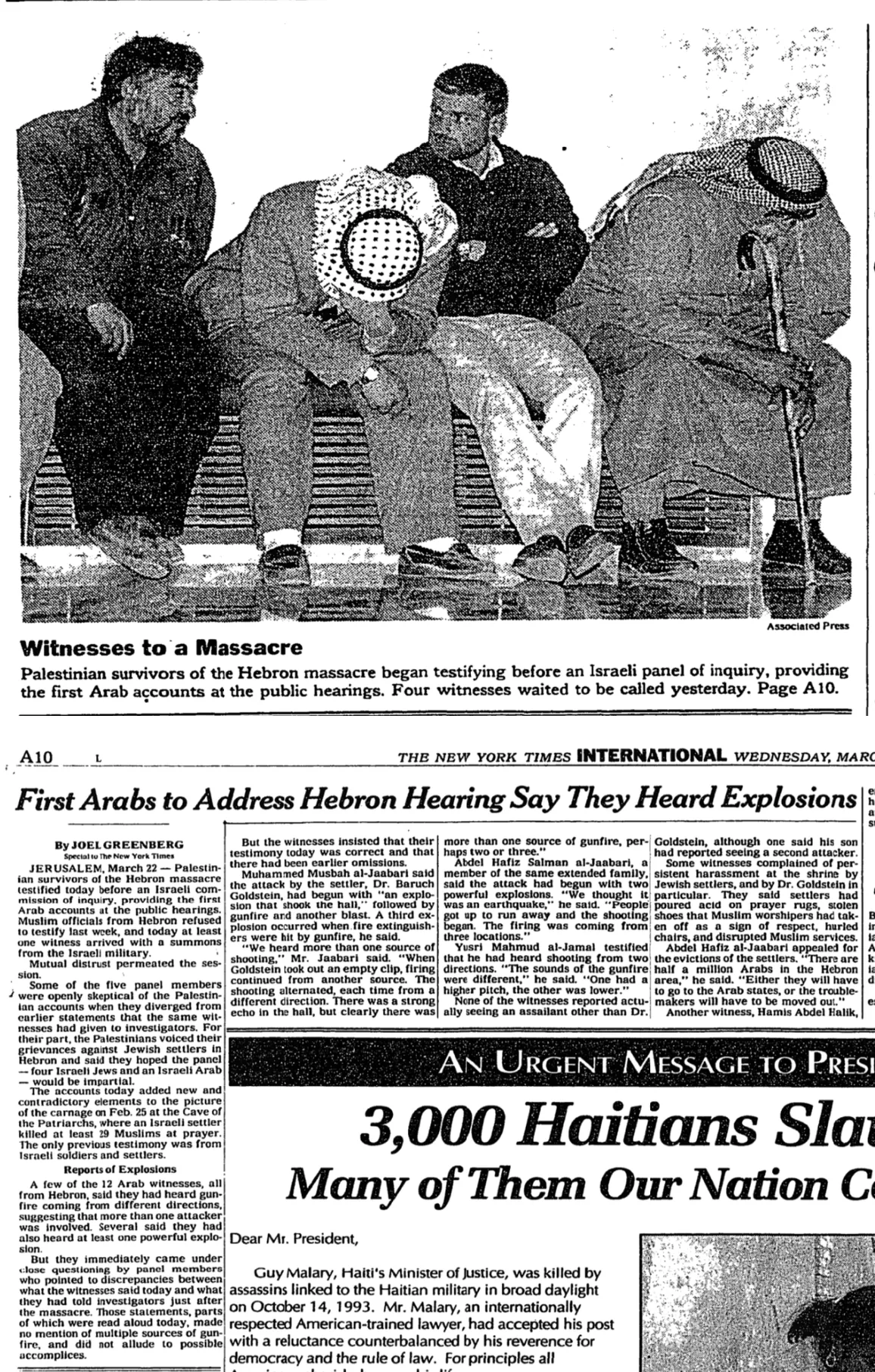
Transcribed from the clipping
JERUSALEM, March 22 — Palestinian survivors of the Hebron massacre testified today before an Israeli commission of inquiry, providing the first Arab accounts at the public hearings. Muslim officials from Hebron refused to testify last week, and today at least one witness arrived with a summons from the Israeli military. Mutual distrust permeated the session.
Some of the five panel members were openly skeptical of the Palestinian accounts when they diverged from earlier statements that the same witnesses had given to investigators. For their part, the Palestinians voiced their grievances against Jewish settlers in Hebron and said they hoped the panel — four Israeli Jews and an Israeli Arab — would be impartial.
The accounts today added new and contradictory elements to the picture of the carnage on Feb. 25 at the Cave of the Patriarchs, where an Israeli settler killed at least 29 Muslims at prayer. The only previous testimony was from Israeli soldiers and settlers.
Reports of Explosions A few of the 12 Arab witnesses, all from Hebron, said they had heard gunfire coming from different directions, suggesting that more than one attacker was involved. Several said they had also heard at least one powerful explosion.
But they immediately came under close questioning by panel members who pointed to discrepancies between what the witnesses said today and what they had told investigators just after the massacre. Those statements, parts of which were read aloud today, made no mention of multiple sources of gunfire, and did not allude to possible accomplices.
But the witnesses insisted that their testimony today was correct and that there had been earlier omissions. Muhammed Musbah al-Jaabari said the attack by the settler, Dr. Baruch Goldstein, had begun with “an explosion that shook the hall,” followed by gunfire and another blast. A third explosion occurred when fire extinguishers were hit by gunfire, he said.
“We heard more than one source of shooting,” Mr. Jaabari said. “When Goldstein took out an empty clip, firing continued from another source. The shooting alternated, each time from a different direction. There was a strong echo in the hall, but clearly there was more than one source of gunfire, perhaps two or three.”
Abdel Hafiz Salman al-Jaabari, a member of the same extended family, said the attack had begun with two powerful explosions. “We thought it was an earthquake,” he said. “People got up to run away and the shooting began. The firing was coming from three locations.” Yusri Mahmud al-Jamal testified that he had heard shooting from two directions.
“The sounds of the gunfire were different,” he said. “One had a higher pitch, the other was lower.” None of the witnesses reported actually seeing an assailant other than Dr. Goldstein, although one said his son had reported seeing a second attacker. Some witnesses complained of persistent harassment at the shrine by Jewish settlers, and by Dr. Goldstein in particular.
They said settlers had poured acid on prayer rugs, stolen shoes that Muslim worshipers had taken off as a sign of respect, hurled chairs, and disrupted Muslim services. Abdel Hafiz al-Jaabari appealed for the evictions of the settlers. “There are half a million Arabs in the Hebron area,” he said.
“Either they will have to go to the Arab states, or the troublemakers will have to be moved out.”
How this transcription was made
Assembled from 2 scans, as Maria's label directs. Scan 1 is the front-page photograph and its caption (four Palestinian men seated on steps, waiting; one with his head bowed into a keffiyeh, one elderly man with a cane), with the pointer "Page A10." Scan 2 is the A10 article itself. Read at 7x-10x. The A10 masthead strip reads "A10 L THE NEW YORK TIMES INTERNATIONAL WEDNESDAY, MARC[H...]" — the day number is cut off at the right edge of the scan, but the printed WEDNESDAY plus the dateline "JERUSALEM, March 22" fixes the date: March 22 1994 was a Tuesday, so the Wednesday on which the paper reported it as "today" is March 23. Date confirmed from the page on that reasoning, not from a printed numeral. IMPORTANT LIMIT: the A10 scan is cut off at the right edge. A fifth column exists and is sliced away. The article's last readable words are "Another witness, Hamis Abdel Halik," — his testimony is lost to the scan, as is whatever follows. A large advertisement ("AN URGENT MESSAGE TO PRESI[DENT]... 3,000 Haitians Slau[ghtered]... Many of Them Our Nation['s]") occupies the lower right of the page and is not part of the article. — Two clippings of one article, joined into a single image for the record (s058_1.png, s058_2.png).
Cite this clipping
"First Arabs to Address Hebron Hearing Say They Heard Explosions," The New York Times, 23 March 1994, p. A10. Covering Palestine archive, CP-1994-068. https://coveringpalestine.org/archive/cp-1994-068
More from The New York Times
- The Maine Colony in PalestineThe New York Times · 12 November 1866
- Jewish Colonization in PalestineThe New York Times · 9 December 1883
- Jewish State in Palestine OpposedThe New York Times · 9 July 1897
- ZIONIST CONGRESS IN BASELThe New York Times · 31 August 1897
- ROME FEARS THE ZIONISTSThe New York Times · 12 September 1897
- PROGRESS OF ZIONISMThe New York Times · 16 December 1901
- 852 more from this paper in the full text →
More from the 1990s
- Gaza life after darkThe Town Talk · 8 January 1994
- Building Peace in Palestinian SchoolsThe New York Times · 9 January 1994
- Medicine in Gaza lags behind IsraelThe Houston Post · 16 January 1994
- To Read All About It, Palestinians Scan the WallsThe New York Times · 24 January 1994
- Palestinian photographer beaten by Israeli troopsThe Bay City Times · 29 January 1994
- Israelis shoot 12-year-oldSunday Telegraph · 6 February 1994
- All 374 clippings from the 1990s →
Last updated 2 November 2026
This record is part of Covering Palestine, an archive of American newspaper clippings about Palestinians, 1724 to 2023. Researched and assembled by Maria Robles.
The clipping belongs to the newspaper that printed it, or to the news agency that supplied the copy. It is reproduced here for research, criticism and commentary. A city here is where the newspaper was published, not where the story came from, and on most records it was taken from the masthead.
Something wrong here, or something you know about this clipping? The archive is still being built and corrections are wanted: maria@rozumstudio.com, quoting CP-1994-068.
Everything printed in 1994 · Printed on this day · See it in the archive reel · Full text of every clipping · Dataset