Austin American Statesman · Austin, Texas · 2 September 2004
CP-2004-003
PORTRAITS: Palestinian painter has critics
Many Israelis say artist’s estimated 170 works glorify death, incite more violence
Margaret Coker, International Staff
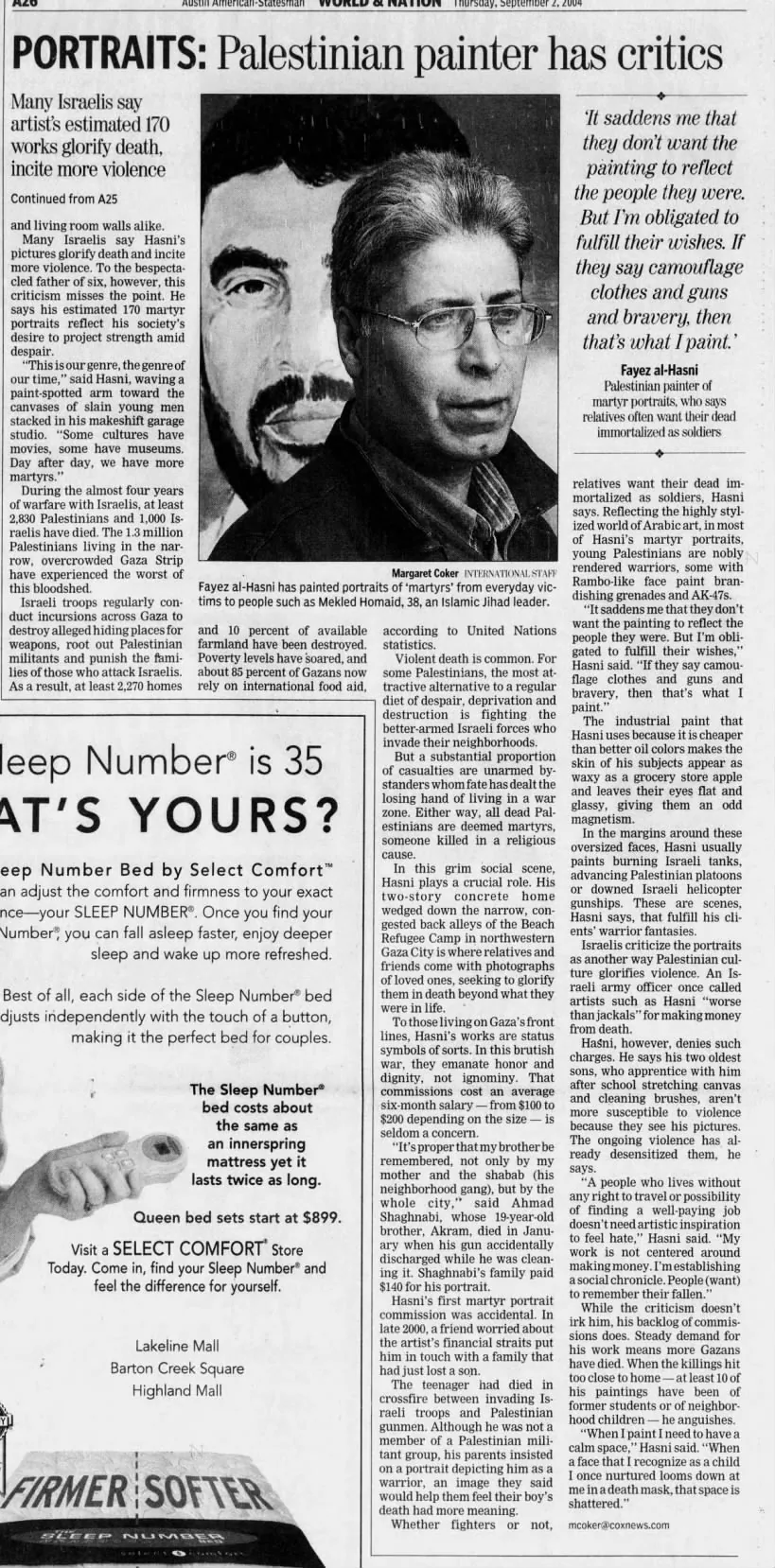
Transcribed from the clipping
“Many Israelis say Hasni’s pictures glorify death and incite more violence. To the bespectacled father of six, however, this criticism misses the point. He says his estimated 170 martyr portraits reflect his society’s desire to project strength amid despair. ‘This is our genre, the genre of our time,’ said Hasni, waving a paint-spotted arm toward the canvases of slain young men stacked in his makeshift garage studio. ‘Some cultures have movies, some have museums. Day after day, we have more martyrs.’… In this grim social scene, Hasni plays a crucial role. His two-story concrete home wedged down the narrow, congested back alleys of the Beach Refugee Camp in northwestern Gaza City is where relatives and friends come with photographs of loved ones, seeking to glorify them in death beyond what they were in life… That commissions cost an average six-month salary — from $100 to $200 depending on the size — is seldom a concern. ‘It’s proper that my brother be remembered, not only by my mother and the shabab (his neighborhood gang), but by the whole city,’ said Ahmad Shaghnabi, whose 19-year-old brother, Akram, died in January when his gun accidentally discharged while he was cleaning it. Shaghnabi’s family paid $140 for his portrait… ‘It saddens me that they don’t want the painting to reflect the people they were. But I’m obligated to fulfill their wishes,’ Hasni said. ‘If they say camouflage clothes and guns and bravery, then that’s what I paint.’ The industrial paint that Hasni uses because it is cheaper than better oil colors makes the skin of his subjects appear as waxy as a grocery store apple and leaves their eyes flat and glassy, giving them an odd magnetism… Israelis criticize the portraits as another way Palestinian culture glorifies violence. An Israeli army officer once called artists such as Hasni ‘worse than jackals’ for making money from death. Hasni, however, denies such charges… ‘A people who lives without any right to travel or possibility of finding a well-paying job doesn’t need artistic inspiration to feel hate,’ Hasni said. ‘My work is not centered around making money. I’m establishing a social chronicle. People (want) to remember their fallen.’ While the criticism doesn’t irk him, his backlog of commissions does. Steady demand for his work means more Gazans have died. When the killings hit too close to home — at least 10 of his paintings have been of former students or of neighborhood children — he anguishes. ‘When I paint I need to have a calm space,’ Hasni said. ‘When a face that I recognize as a child I once nurtured looms down at me in a death mask, that space is shattered.’”
Context added by this archive
An arts story whose headline is about his critics and whose deck leads with what Israelis say. The painter is identified in the pull quote as Fayez al-Hasni and in the body as Hasni. Photo credit: Margaret Coker / International Staff.
Cite this item
"PORTRAITS: Palestinian painter has critics," Austin American Statesman, 2 September 2004. Covering Palestine archive, CP-2004-003. https://coveringpalestine.org/archive/cp-2004-003
Elsewhere in the archive
- The story of a 2,000-year crisisAustin American Statesman · 5 August 1967 · the same newspaper
- Refugee camp in Gaza hitThe Times Leader · 18 May 2004 · the same year
- U.N. wants Israel to avow nukesWaco Tribune-Herald · 7 July 2004 · the same year
This record is part of Covering Palestine, an archive of American and Anglophone newspaper clippings about Palestinians, 1812 to 2022. Researched and assembled by Maria Robles.
The clipping belongs to the newspaper that printed it, or to the wire service that supplied the copy. It is reproduced here for research, criticism and commentary. The city is derived from the masthead, not read off the clipping.
Something wrong here, or something you know about this clipping? The archive is still being built and corrections are wanted: maria@rozumstudio.com, quoting CP-2004-003.
See it in the archive reel · Full text of every clipping · Dataset