The Houston Post · Houston, Texas · 26 October 1981
CP-1981-004
Annual confab brings together foreign writers
Clifford Pugh, Post Reporter
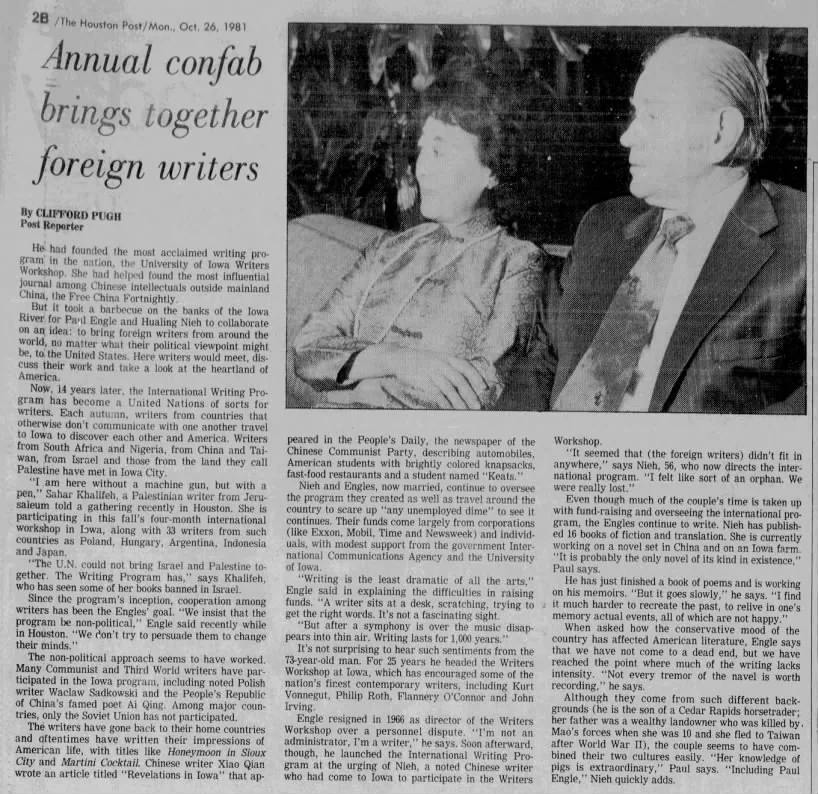
Transcribed from the clipping
“He had founded the most acclaimed writing program in the nation, the University of Iowa Writers Workshop. She had helped found the most influential journal among Chinese intellectuals outside mainland China, the Free China Fortnightly. But it took a barbecue on the banks of the Iowa River for Paul Engle and Hualing Nieh to collaborate on an idea: to bring foreign writers from around the world, no matter what their political viewpoint might be, to the United States… Now, 14 years later, the International Writing Program has become a United Nations of sorts for writers. Each autumn, writers from countries that otherwise don’t communicate with one another travel to Iowa to discover each other and America. Writers from South Africa and Nigeria, from China and Taiwan, from Israel and those from the land they call Palestine have met in Iowa City. ‘I am here without a machine gun, but with a pen,’ Sahar Khalifeh, a Palestinian writer from Jerusalem told a gathering recently in Houston. She is participating in this fall’s four-month international workshop in Iowa, along with 33 writers from such countries as Poland, Hungary, Argentina, Indonesia and Japan. ‘The U.N. could not bring Israel and Palestine together. The Writing Program has,’ says Khalifeh, who has seen some of her books banned in Israel. Since the program’s inception, cooperation among writers has been the Engles’ goal. ‘We insist that the program be non-political,’ Engle said recently while in Houston. ‘We don’t try to persuade them to change their minds.’ The non-political approach seems to have worked. Many Communist and Third World writers have participated in the Iowa program, including noted Polish writer Waclaw Sadkowski and the People’s Republic of China’s famed poet Ai Qing. Among major countries, only the Soviet Union has not participated… ‘Writing is the least dramatic of all the arts,’ Engle said in explaining the difficulties in raising funds. ‘A writer sits at a desk, scratching, trying to get the right words. It’s not a fascinating sight. But after a symphony is over the music disappears into thin air. Writing lasts for 1,000 years.’”
Context added by this archive
The archive’s third clipping of this novelist in three years: her fiction printed in Des Moines in 1979, this in Houston in 1981, and the Baltimore Sun in 1980 on her books being banned. The paper writes “the land they call Palestine,” and two paragraphs later she is a Palestinian writer from Jerusalem. The deck this scan came in dates it 1991; the masthead reads Monday, Oct. 26, 1981, and the date here follows the masthead.
Cite this item
"Annual confab brings together foreign writers," The Houston Post, 26 October 1981. Covering Palestine archive, CP-1981-004. https://coveringpalestine.org/archive/cp-1981-004
Elsewhere in the archive
- Representatives of six Sioux City Jewish organizations raised $2,500 for the development of colonization in PalestineSioux City Journal · 15 March 1981 · the same year
- Israel Soldiers Patrol Town; Shops ClosedHonolulu Star-Bulletin · 10 November 1981 · the same year
- Israel's 'America': Colonists pass century markChicago Tribune · 10 November 1981 · the same year
This record is part of Covering Palestine, an archive of American and Anglophone newspaper clippings about Palestinians, 1812 to 2022. Researched and assembled by Maria Robles.
The clipping belongs to the newspaper that printed it, or to the wire service that supplied the copy. It is reproduced here for research, criticism and commentary. The city is derived from the masthead, not read off the clipping.
Something wrong here, or something you know about this clipping? The archive is still being built and corrections are wanted: maria@rozumstudio.com, quoting CP-1981-004.
See it in the archive reel · Full text of every clipping · Dataset