The Columbian · Vancouver, Washington · 14 August 2004
CP-2004-011
Athens and Adversity
Some athletes travel bumpy road the Games
By Niko Price, Associated Press
Transcribed from the clipping
“A swimmer who sat idle for months because U.S. soldiers took over the pool where he trained. A judo competitor who practices in a small room because she can’t go out in public without a veil. A runner who jogs on the sand because the streets are too dangerous. The road to Athens is tough for any athlete, but for some it is lined with land mines.
For those representing war-torn countries, training can mean risking bombs and bullets to reach the stadium, and making do without the barest essentials of equipment and coaching. But many say the adversity they face has strengthened their resolve to push themselves. Some even dare to dream of a medal.
‘All people who live a hard life can do good things,’ said Palestinian swimmer Raad Aweisat, 17. ‘People who have everything just go to sleep. You must make yourself by yourself.’ Many athletes have followed that philosophy.
Friba Razayee, 18, describes herself as ‘the only girl in all of Afghanistan who loves boxing,’ but since she didn’t have a coach she tried her hand at judo.
One year later, she is an Olympian… Swimmer Mohammed Abbas, 26, had a different problem with his training regimen: He had to spend a month cowering in his house while bombs rained down on Baghdad; and when the war ended, U.S. troops commandeered the pool where he trains for soldiers’ R&R in the hot Iraqi summer.
Gaza Strip residents horrified by the sight of Sanaa Abu Bkeet running down the street in shorts threw stones at her, and Israeli security measures made it impossible for her to get to a proper track, so she trained barefoot on a sand path.
The 19-year-old came to Athens to run in the 800-meter event, but said she has spent most of her time getting used to running in spikes — and on asphalt. ‘I know of other athletes who trained for four years for the Olympics. I trained only one month,’ she said. ‘It was so difficult to run on the sand. It is very soft and your feet can sink down.
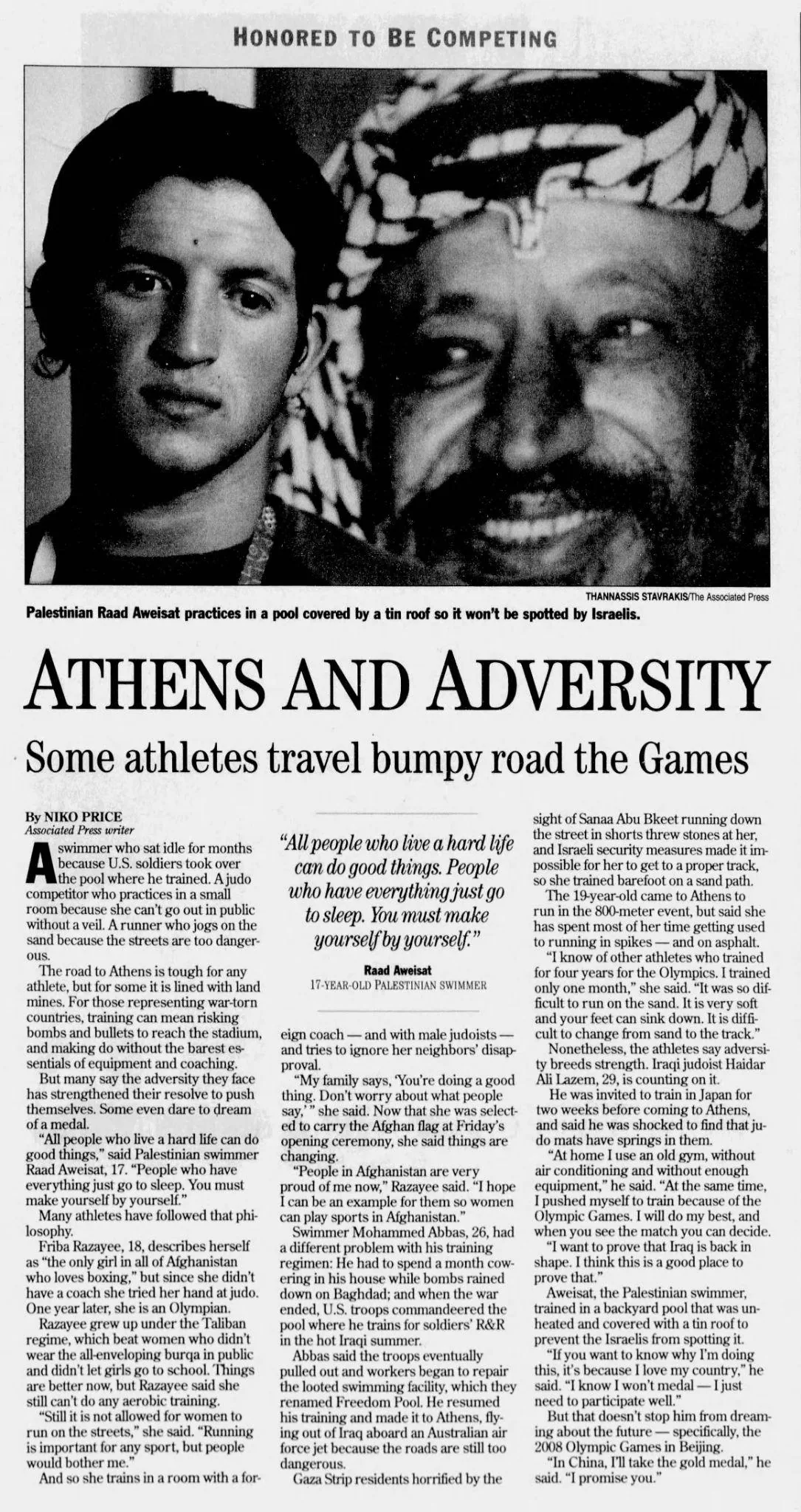
It is difficult to change from sand to the track.’ Nonetheless, the athletes say adversity breeds strength… Aweisat, the Palestinian swimmer, trained in a backyard pool that was unheated and covered with a tin roof to prevent the Israelis from spotting it. ‘If you want to know why I’m doing this, it’s because I love my country,’ he said.
‘I know I won’t medal — I just need to participate well.’ But that doesn’t stop him from dreaming about the future — specifically, the 2008 Olympic Games in Beijing. ‘In China, I’ll take the gold medal,’ he said. ‘I promise you.’”
Context added by this archive
The only Palestinian sportswoman in this archive appears here.
Sanaa Abu Bkeet, 19, ran the 800 metres at Athens on one month’s training, and the story gives both reasons she had no track. Gaza residents horrified by the sight of her running in shorts threw stones at her; Israeli security measures made a proper track unreachable. So she trained barefoot on sand, and then had to learn to run on asphalt in spikes.
The photograph caption states outright what the earlier report about Aweisat’s pool only implied: it is covered by a tin roof so it won’t be spotted by Israelis. He supplies the line the page is built around, set in large type beside his photograph:
‘All people who live a hard life can do good things. People who have everything just go to sleep. You must make yourself by yourself.’ And then a promise about Beijing four years later: In China, I’ll take the gold medal. I promise you.
Cite this item
"Athens and Adversity," The Columbian, 14 August 2004. Covering Palestine archive, CP-2004-011. https://coveringpalestine.org/archive/cp-2004-011
More from The Columbian
- Arab Government Is Reorganized at GazaThe Columbian · 14 October 1948
- Contested holy sitesThe Columbian · 8 September 2000
More from the 2000s
- Against all oddsNews Herald · 10 January 2004
- Palestinian athlete is forced to be resourcefulThe Daily Progress · 10 January 2004
- Swimmer braves weather for dreamThe Times · 10 January 2004
- For Israelis a lifesaver; for Palestinians a curseCasper Star-Tribune · 22 February 2004
- The wall is about hate, not securityChicago Tribune · 22 February 2004
- Palestinian runner trains for OlympicsSarasota Herald-Tribune · 6 March 2004
- All 160 clippings from the 2000s →
This record is part of Covering Palestine, an archive of American and Anglophone newspaper clippings about Palestinians, 1799 to 2023. Researched and assembled by Maria Robles.
The clipping belongs to the newspaper that printed it, or to the news agency that supplied the copy. It is reproduced here for research, criticism and commentary. The city is derived from the masthead, not read off the clipping.
Something wrong here, or something you know about this clipping? The archive is still being built and corrections are wanted: maria@rozumstudio.com, quoting CP-2004-011.
See it in the archive reel · Full text of every clipping · Dataset