USA Today · 20 July 2004
CP-2004-049
To Israelis, good fence is good sense
Nation willing to defy international demands to gain sense of security
By Arieh O'Sullivan / Special For USA TODAY
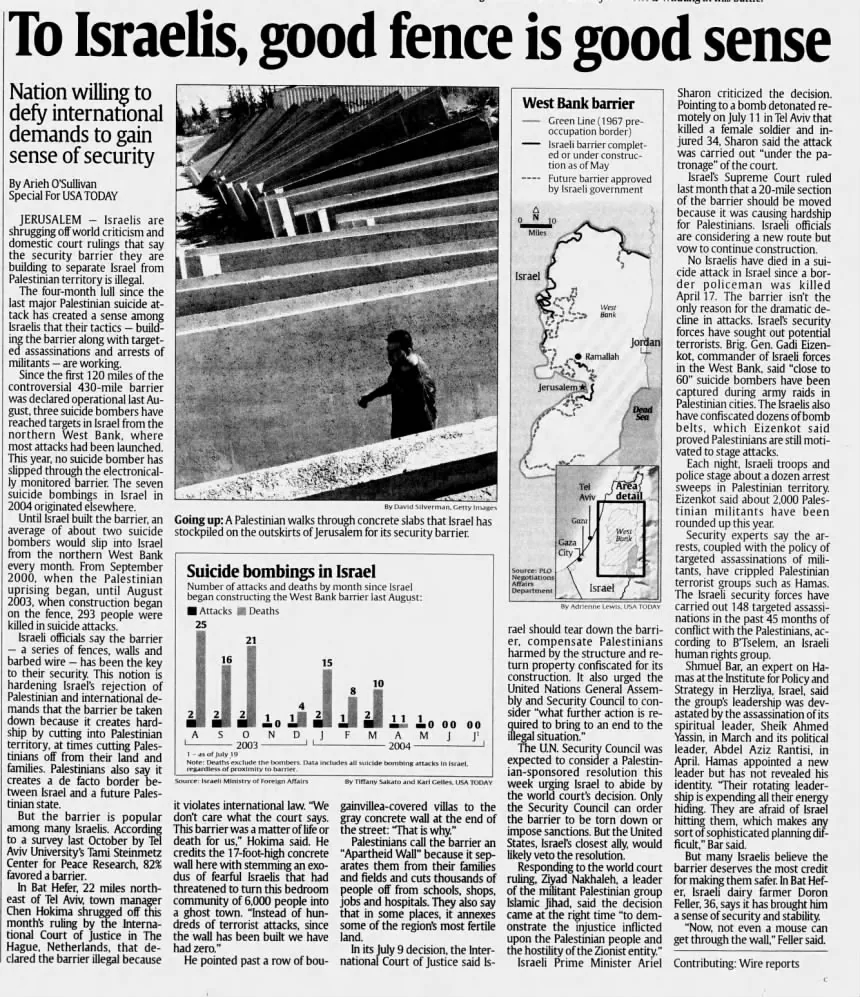
Transcribed from the clipping
JERUSALEM — Israelis are shrugging off world criticism and domestic court rulings that say the security barrier they are building to separate Israel from Palestinian territory is illegal.
The four-month lull since the last major Palestinian suicide attack has created a sense among Israelis that their tactics — building the barrier along with targeted assassinations and arrests of militants — are working.
Since the first 120 miles of the controversial 430-mile barrier was declared operational last August, three suicide bombers have reached targets in Israel from the northern West Bank, where most attacks had been launched. This year, no suicide bomber has slipped through the electronically monitored barrier. The seven suicide bombings in Israel in 2004 originated elsewhere.
Until Israel built the barrier, an average of about two suicide bombers would slip into Israel from the northern West Bank every month. From September 2000, when the Palestinian uprising began, until August 2003, when construction began on the fence, 293 people were killed in suicide attacks.
Israeli officials say the barrier — a series of fences, walls and barbed wire — has been the key to their security.
This notion is hardening Israel’s rejection of Palestinian and international demands that the barrier be taken down because it creates hardship by cutting into Palestinian territory, at times cutting Palestinians off from their land and families. Palestinians also say it creates a de facto border between Israel and a future Palestinian state.
But the barrier is popular among many Israelis. According to a survey last October by Tel Aviv University’s Tami Steinmetz Center for Peace Research, 82% favored a barrier.
In Bat Hefer, 22 miles northeast of Tel Aviv, town manager Chen Hokima shrugged off this month’s ruling by the International Court of Justice in The Hague, Netherlands, that declared the barrier illegal because it violates international law. “We don’t care what the court says. This barrier was a matter of life or death for us,” Hokima said.
He credits the 17-foot-high concrete wall here with stemming an exodus of fearful Israelis that had threatened to turn this bedroom community of 6,000 people into a ghost town. “Instead of hundreds of terrorist attacks, since the wall has been built we have had zero.”
He pointed past a row of bougainvillea-covered villas to the gray concrete wall at the end of the street: “That is why.” Palestinians call the barrier an “Apartheid Wall” because it separates them from their families and fields and cuts thousands of people off from schools, shops, jobs and hospitals.
They also say that in some places, it annexes some of the region’s most fertile land. In its July 9 decision, the International Court of Justice said Israel should tear down the barrier, compensate Palestinians harmed by the structure and return property confiscated for its construction.
It also urged the United Nations General Assembly and Security Council to consider “what further action is required to bring to an end to the illegal situation.” The U.N. Security Council was expected to consider a Palestinian-sponsored resolution this week urging Israel to abide by the world court’s decision.
Only the Security Council can order the barrier to be torn down or impose sanctions. But the United States, Israel’s closest ally, would likely veto the resolution.
Responding to the world court ruling, Ziyad Nakhaleh, a leader of the militant Palestinian group Islamic Jihad, said the decision came at the right time “to demonstrate the injustice inflicted upon the Palestinian people and the hostility of the Zionist entity.” Israeli Prime Minister Ariel Sharon criticized the decision.
Pointing to a bomb detonated remotely on July 11 in Tel Aviv that killed a female soldier and injured 34, Sharon said the attack was carried out “under the patronage” of the court. Israel’s Supreme Court ruled last month that a 20-mile section of the barrier should be moved because it was causing hardship for Palestinians.
Israeli officials are considering a new route but vow to continue construction. No Israelis have died in a suicide attack in Israel since a border policeman was killed April 17. The barrier isn’t the only reason for the dramatic decline in attacks. Israel’s security forces have sought out potential terrorists. Brig. Gen.
Gadi Eizenkot, commander of Israeli forces in the West Bank, said “close to 60” suicide bombers have been captured during army raids in Palestinian cities. The Israelis also have confiscated dozens of bomb belts, which Eizenkot said proved Palestinians are still motivated to stage attacks.
Each night, Israeli troops and police stage about a dozen arrest sweeps in Palestinian territory. Eizenkot said about 2,000 Palestinian militants have been rounded up this year. Security experts say the arrests, coupled with the policy of targeted assassinations of militants, have crippled Palestinian terrorist groups such as Hamas.
The Israeli security forces have carried out 148 targeted assassinations in the past 45 months of conflict with the Palestinians, according to B’Tselem, an Israeli human rights group.
Shmuel Bar, an expert on Hamas at the Institute for Policy and Strategy in Herzliya, Israel, said the group’s leadership was devastated by the assassination of its spiritual leader, Sheik Ahmed Yassin, in March and its political leader, Abdel Aziz Rantisi, in April. Hamas appointed a new leader but has not revealed his identity.
“Their rotating leadership is expending all their energy hiding. They are afraid of Israel hitting them, which makes any sort of sophisticated planning difficult,” Bar said. But many Israelis believe the barrier deserves the most credit for making them safer.
In Bat Hefer, Israeli dairy farmer Doron Feller, 36, says it has brought him a sense of security and stability. “Now, not even a mouse can get through the wall,” Feller said. Contributing: Wire reports
How this transcription was made
Date and publication rest on the collector's slide label; no masthead, folio or printed dateline appears on this clipping.
Context added by this archive
Photo caption: "Going up: A Palestinian walks through concrete slabs that Israel has stockpiled on the outskirts of Jerusalem for its security barrier." Credit: By David Silverman, Getty Images.
The page also carries a map ("West Bank barrier", source: PLO Negotiations Affairs Department, by Adrienne Lewis, USA TODAY) and a bar chart ("Suicide bombings in Israel", source: Israeli Ministry of Foreign Affairs, by Tiffany Sakato and Karl Gelles, USA TODAY) — both are graphics on the same story, not separate clippings.
Also quoted: Ziyad Nakhaleh, a leader of the militant Palestinian group Islamic Jihad, who called the barrier an "Apartheid Wall" and said it separates families and annexes the region's most fertile land; and Shmuel Bar of the Institute for Policy and Strategy in Herzliya.
Cite this clipping
"To Israelis, good fence is good sense," USA Today, 20 July 2004. Covering Palestine archive, CP-2004-049. https://coveringpalestine.org/archive/cp-2004-049
More from USA Today
- ‘Our enemies want our annihilation, not peace’USA Today · 11 June 1990
- Israeli settlers attack road project in HebronUSA Today · 3 September 1997
- Palestinian gunmen use Manger Square for coverUSA Today · 12 March 2002
- Palestinians see cruelty, pettiness in damageUSA Today · 25 April 2002
- Hamas pledges to keep fighting, as does IsraelUSA Today · 24 March 2004
- Pressured, Arafat shuffles security leadersUSA Today · 20 July 2004
- 5 more from this paper in the full text →
More from the 2000s
- Against all oddsNews Herald · 10 January 2004
- Palestinian athlete is forced to be resourcefulThe Daily Progress · 10 January 2004
- Swimmer braves weather for dreamThe Times · 10 January 2004
- Two-State Solution Sells Palestinians ShortLos Angeles Times · 27 January 2004
- In 1948, Israel did what it had to do to surviveOakland Tribune · 1 February 2004
- For Israelis a lifesaver; for Palestinians a curseCasper Star-Tribune · 22 February 2004
- All 516 clippings from the 2000s →
Last updated 2 November 2026
This record is part of Covering Palestine, an archive of American newspaper clippings about Palestinians, 1724 to 2023. Researched and assembled by Maria Robles.
The clipping belongs to the newspaper that printed it, or to the news agency that supplied the copy. It is reproduced here for research, criticism and commentary. A city here is where the newspaper was published, not where the story came from, and on most records it was taken from the masthead.
Something wrong here, or something you know about this clipping? The archive is still being built and corrections are wanted: maria@rozumstudio.com, quoting CP-2004-049.
Everything printed in 2004 · Printed on this day · See it in the archive reel · Full text of every clipping · Dataset