 We shall overcome, in BeirutArafat quoted the anthem back · September to October 1979
26 September to 5 October 1979
We shall overcome, in Beirut
In the autumn of 1979 an American civil rights leader carried the vocabulary of the Black American movement to Nablus, to a refugee camp outside Tyre and to a small room in Beirut, and Palestinians answered him in it. Seven papers in this archive carried the two weeks. On each of the three days they carried, no two of them agreed on what had happened.
Jesse Jackson went to Nablus town hall on 26 September, spoke through an interpreter, and told the crowd to take the black struggle for civil rights in America as their model. Some of them shook their heads at him. Then he led them in a cheer and they carried him out of the building on their shoulders.
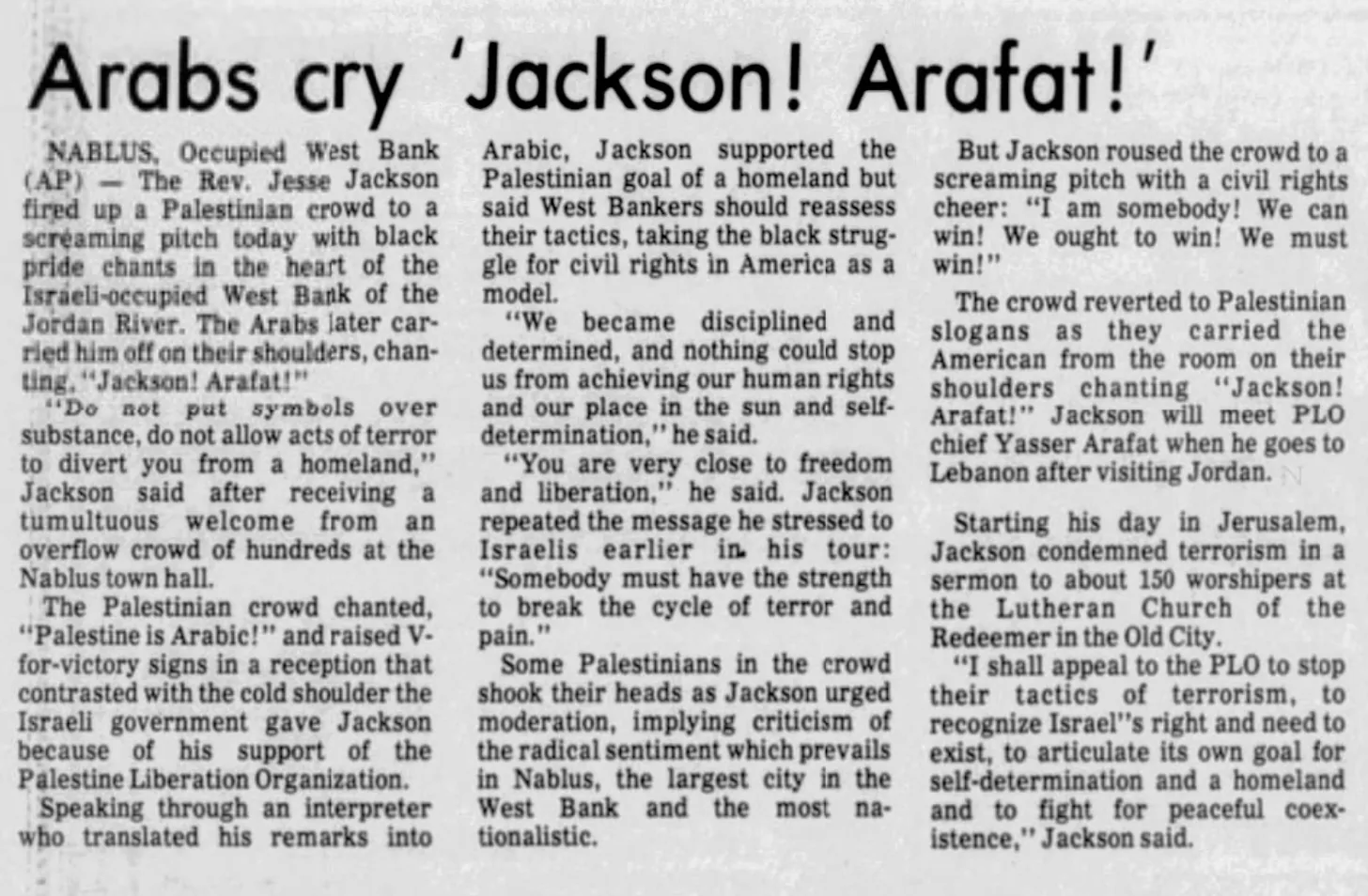
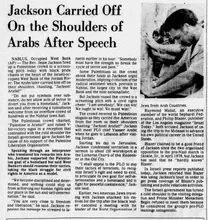
“But Jackson roused the crowd to a screaming pitch with a civil rights cheer: ‘I am somebody! We can win! We ought to win! We must win!’ The crowd reverted to Palestinian slogans as they carried the American from the room on their shoulders chanting ‘Jackson! Arafat!’”
The Grand Rapids Press, under the headline Jackson Carried Off On the Shoulders of Arabs After Speech. A news agency dispatch from Nablus.
 CP-1979-011
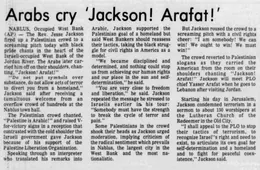
“Arabs cry ‘Jackson! Arafat!’”
The Daily News of Longview, the same dispatch that morning under a headline made out of the chant. This paper stops the copy at the Jerusalem sermon and leaves out the two American Jewish travelers who accused Jackson of careerism, and Begin’s refusal to meet the delegation.
CP-1979-016Four days later, Beirut
On the way to the meeting Jackson stopped at Rashidiyeh camp outside Tyre, and the crowd there lifted him onto their shoulders too. What they shouted is in the copy: Jackson, Arafat, brothers in the struggle for freedom. He sat up there with his palms resting on their heads.
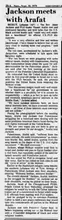
“Palestinians, Arafat said, ‘suffered from the same attitude, the same circumstances’ as American blacks. But, added Arafat, quoting from the song known as the theme of the U.S. civil rights movement: ‘We shall overcome.’”
The Times of Shreveport, headlined Jackson meets with Arafat.
 CP-1979-013
“Jackson talks with PLO chief”
The Philadelphia Inquirer, the same dispatch, cut differently. This paper keeps the line about Jackson possibly carrying a message from President Carter and drops the closing paragraph about a new peace conference. The photograph above it is captioned A warm embrace.
 CP-1979-014
“Jesse Jackson Fails to Get Arafat To Accept Israel, Quit Terrorism”
The Atlanta Journal and Constitution, which had sent its own reporter to Beirut rather than take the dispatch. Same morning, same meeting, and the headline is a failure.
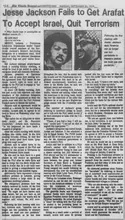 CP-1979-015
The Atlanta piece is the longest printed record in this archive of Arafat speaking English to Americans, and it is the one that catches him greeting them: We might not have known each other before, but you are here as old friends of my people. Our hearts will be together until victory. We will overcome. Two papers on two mornings, and in both of them he reaches for the same song.
The same piece carries what he did with the word terrorism when Americans put it to him. He pointed at his advisers around the room and noted that none of them held a passport from the country he was born in. Then he asked his guests a question back: Why were you resisting? Why did you not accept the British Empire occupation?
And the last day
“Jackson, Arafat Meet in Lebanon”
The Lexington Herald, with a photograph of the embrace above the headline. Jackson was in hospital with food poisoning and could not come, so Arafat went to the hospital.
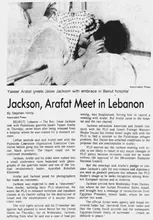 CP-1979-012
“Jackson, Arafat speak privately”
The Argus-Leader of Sioux Falls, the same dispatch with a different last paragraph: this one ends on Jackson being snubbed by Israeli leaders. The photograph shows him handing a patient the flowers Palestinian leaders had brought him.
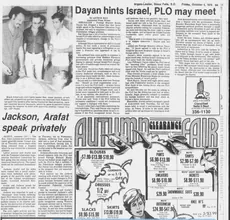 CP-1979-017
Three days, seven papers. On two of the days it is one news agency dispatch, filed once and set twice: a reader in Longview got a chant for a headline and a reader in Grand Rapids got a man being carried; a reader in Lexington got two men meeting and a reader in Sioux Falls got two men speaking privately. On the third day the same dispatch ran in Shreveport and Philadelphia while Atlanta, which had paid to send its own reporter to Beirut, printed a failure. None of these readers was told what the others were reading.
What survives every version is the part the headlines had no room for. Palestinians in Nablus chanted a name; Palestinians at Rashidiyeh called an American brother; and the man the papers called a guerrilla chieftain quoted two bars of an American hymn at a delegation of American church leaders. The next time somebody tells you the two struggles have nothing to do with each other, the papers that printed it are on this page.