The Times · Shreveport, Louisiana · 30 September 1979
CP-1979-013
Jackson meets with Arafat
Associated Press
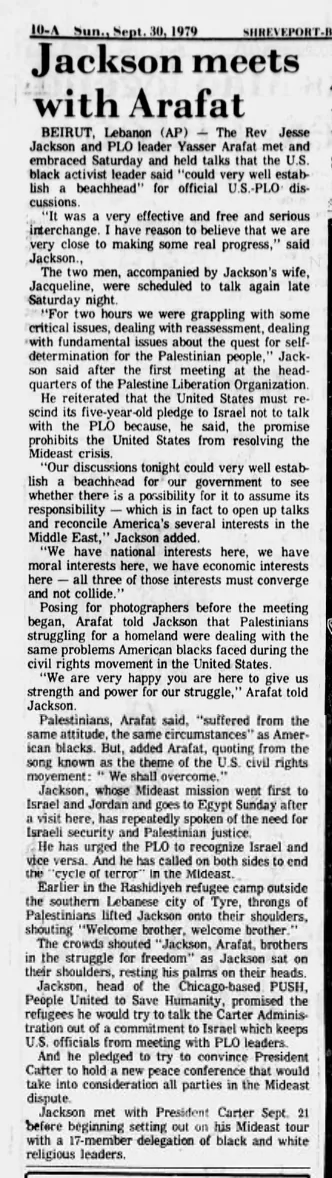
Shown from the top. The whole column — 3.5 times taller than it is wide — is in the enlargement.
Transcribed from the clipping
BEIRUT, Lebanon (AP) — The Rev Jesse Jackson and PLO leader Yasser Arafat met and embraced Saturday and held talks that the U.S. black activist leader said “could very well establish a beachhead” for official U.S.-PLO discussions. “It was a very effective and free and serious interchange.
I have reason to believe that we are very close to making some real progress,” said Jackson. The two men, accompanied by Jackson’s wife, Jacqueline, were scheduled to talk again late Saturday night.
“For two hours we were grappling with some critical issues, dealing with reassessment, dealing with fundamental issues about the quest for self-determination for the Palestinian people,” Jackson said after the first meeting at the headquarters of the Palestine Liberation Organization.
He reiterated that the United States must rescind its five-year-old pledge to Israel not to talk with the PLO because, he said, the promise prohibits the United States from resolving the Mideast crisis.
“Our discussions tonight could very well establish a beachhead for our government to see whether there is a possibility for it to assume its responsibility — which is in fact to open up talks and reconcile America’s several interests in the Middle East,” Jackson added.
“We have national interests here, we have moral interests here, we have economic interests here — all three of those interests must converge and not collide.”
Posing for photographers before the meeting began, Arafat told Jackson that Palestinians struggling for a homeland were dealing with the same problems American blacks faced during the civil rights movement in the United States. “We are very happy you are here to give us strength and power for our struggle,” Arafat told Jackson.
Palestinians, Arafat said, “suffered from the same attitude, the same circumstances” as American blacks. But, added Arafat, quoting from the song known as the theme of the U.S. civil rights movement: “We shall overcome.”
Jackson, whose Mideast mission went first to Israel and Jordan and goes to Egypt Sunday after a visit here, has repeatedly spoken of the need for Israeli security and Palestinian justice. He has urged the PLO to recognize Israel and vice versa. And he has called on both sides to end the “cycle of terror” in the Mideast.
Earlier in the Rashidiyeh refugee camp outside the southern Lebanese city of Tyre, throngs of Palestinians lifted Jackson onto their shoulders, shouting “Welcome brother, welcome brother.” The crowds shouted “Jackson, Arafat, brothers in the struggle for freedom” as Jackson sat on their shoulders, resting his palms on their heads.
Jackson, head of the Chicago-based PUSH, People United to Save Humanity, promised the refugees he would try to talk the Carter Administration out of a commitment to Israel which keeps U.S. officials from meeting with PLO leaders.
And he pledged to try to convince President Carter to hold a new peace conference that would take into consideration all parties in the Mideast dispute. Jackson met with President Carter Sept. 21 before beginning setting out on his Mideast tour with a 17-member delegation of black and white religious leaders.
How this transcription was made
Transcribed in full from the scan, including the paper’s The Rev Jesse Jackson without a period and its before beginning setting out on his Mideast tour.
Context added by this archive
Arafat quotes the American civil rights anthem back to an American delegation: Palestinians, he says, ‘suffered from the same attitude, the same circumstances’ as American blacks, and then — We shall overcome. Three papers carried this meeting on 30 September 1979 under three different headlines.
Cite this clipping
"Jackson meets with Arafat," The Times, 30 September 1979, p. 10-A. Covering Palestine archive, CP-1979-013. https://coveringpalestine.org/archive/cp-1979-013
This clipping is read closely in the section below
More from The Times
- Arab Village Attacked by Bomb SquadsThe Times · 16 February 1948
- Jews Kill ‘Foreign’ Arabs in Mass PushThe Times · 18 February 1948
- ARAB REFUGEE CHILDREN are helped across the wrecked Allenby BridgeThe Times · 24 June 1967
- Refugees Urged Not to Quit IsraelThe Times · 4 July 1967
- (newspaper clipping, West Germany)The Times · 20 August 1969
- Beirut Moves Against Guerrillas To Quell Israeli RaidsThe Times · 29 February 1972
- 8 more from this paper in the full text →
More from the 1970s
- Dayan warns Arabs in Israel and the territoriesThe New York Times · 24 January 1979
- SIX ARAB STUDENTS IN ISRAEL CONFINEDThe New York Times · 27 January 1979
- Are Israelis guilty of systematic torture? Perhaps, U.S. reports cautiously suggestHonolulu Advertiser · 7 February 1979
- Colony for U.S. Jews Is Approved by IsraelThe New York Times · 8 February 1979
- Israel Denies Torture of ArabsThe New York Times · 8 February 1979
- WritersDes Moines Register · 11 March 1979
- All 353 clippings from the 1970s →
The same copy, in 1 other paper
Most of the shorter text appears in the longer one. Found by comparing transcriptions, not by reading them side by side, so this establishes that the text overlaps and not that these papers ran the same dispatch. How this was done.
Last updated 17 November 2026
This record is part of Covering Palestine, an archive of American newspaper clippings about Palestinians, 1724 to 2023. Researched and assembled by Maria Robles.
The clipping belongs to the newspaper that printed it, or to the news agency that supplied the copy. It is reproduced here for research, criticism and commentary. A city here is where the newspaper was published, not where the story came from, and on most records it was taken from the masthead.
Something wrong here, or something you know about this clipping? The archive is still being built and corrections are wanted: maria@rozumstudio.com, quoting CP-1979-013.
Read in: We shall overcome, in Beirut
Everything printed in 1979 · Printed on this day · See it in the archive reel · Full text of every clipping · Dataset