Honolulu Advertiser · Honolulu, Hawaii · 7 February 1979
CP-1979-001
Are Israelis guilty of systematic torture? Perhaps, U.S. reports cautiously suggest
Perhaps, U.S. reports cautiously suggest · Three Arabs tell tales of brutality and humiliation
T. R. Reid and Edward Cody, Washington Post Service
Transcribed from the clipping
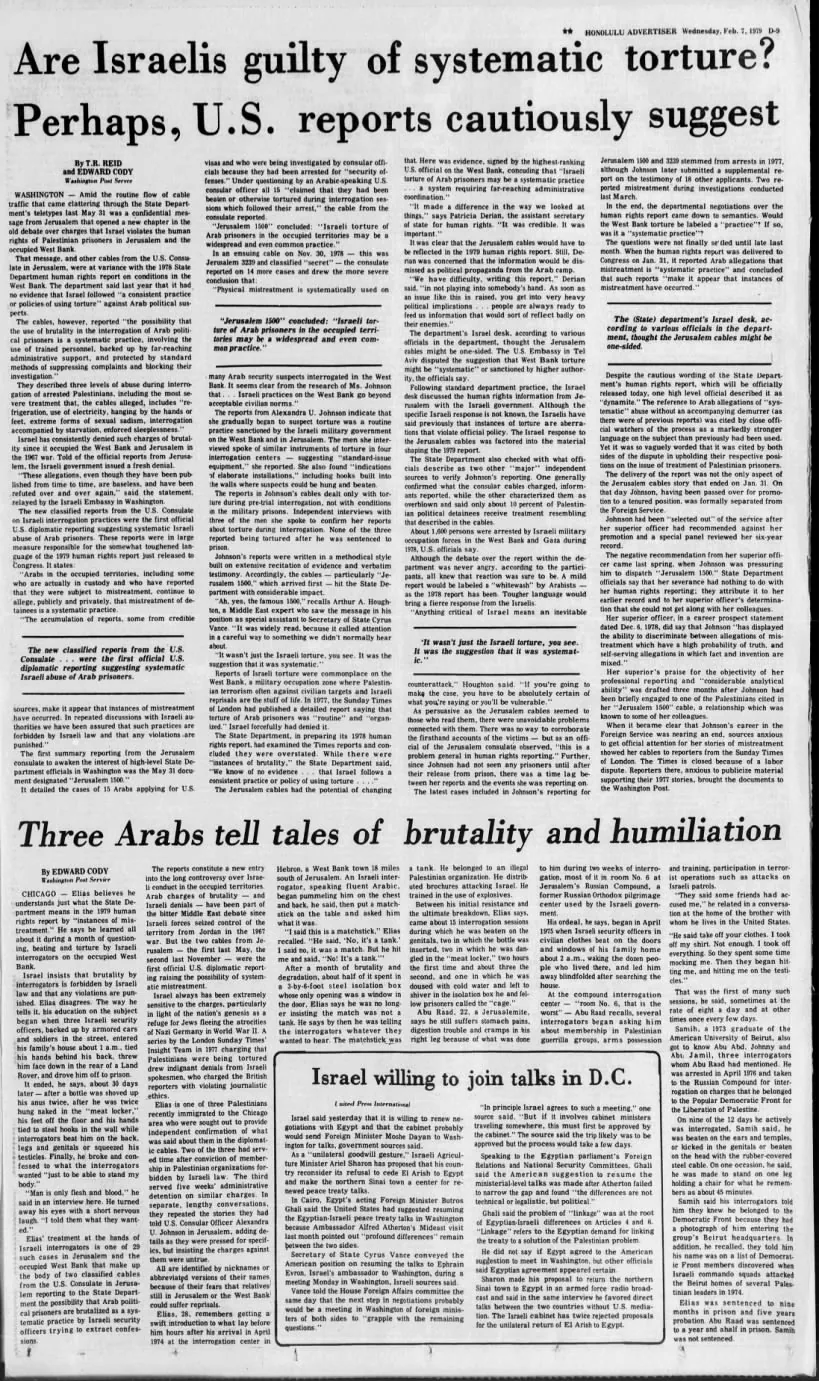
“Are Israelis guilty of systematic torture?
Perhaps, U.S. reports cautiously suggest. WASHINGTON — Amid the routine flow of cable traffic that came clattering through the State Department’s teletypes last May 31 was a confidential message from Jerusalem that opened a new chapter in the old debate over charges that Israel violates the human rights of Palestinian prisoners in Jerusalem and the occupied West Bank… ‘Jerusalem 1500’ concluded: ‘Israeli torture of Arab prisoners in the occupied territories may be a widespread and even common practice.’
In an ensuing cable on Nov. 30, 1978 — this was Jerusalem 3239 and classified ‘secret’ — the consulate reported on 14 more cases and drew the more severe conclusion that: ‘Physical mistreatment is systematically used on many Arab security suspects interrogated in the West Bank.’ It seems clear from the research of Ms.
Johnson that… Israeli practices on the West Bank go beyond acceptable civilian norms…
Three Arabs tell tales of brutality and humiliation. CHICAGO — Elias believes he understands just what the State Department means in the 1979 human rights report by ‘instances of mistreatment.’ He says he learned all about it during a month of questioning, beating and torture by Israeli interrogators on the occupied West Bank.
Israel insists that brutality by interrogators is forbidden by Israeli law and that any violations are punished. Elias disagrees.
The way he tells it, his education on the subject began when three Israeli security officers, backed up by armored cars and soldiers in the street, entered his family’s house about 1 a.m., tied his hands behind his back, threw him face down in the rear of a Land Rover, and drove him off to prison.
It ended, he says, about 30 days later — after a bottle was shoved up his anus twice, after he was twice hung naked in the ‘meat locker,’ his feet off the floor and his hands tied to steel hooks in the wall while interrogators beat him on the back, legs and genitals or squeezed his testicles.
Finally, he broke and confessed to what the interrogators wanted ‘just to be able to stand my body.’ ‘Man is only flesh and blood,’ he said in an interview here. He turned away his eyes with a short nervous laugh. ‘I told them what they wanted.’
Elias’ treatment at the hands of Israeli interrogators is one of 29 such cases in Jerusalem and the occupied West Bank that make up the body of two classified cables from the U.S.
Consulate in Jerusalem… All are identified by nicknames or abbreviated versions of their names because of their fears that relatives still in Jerusalem or the West Bank could suffer reprisals… Abu Raad, 32, a Palestinian, says he still suffers stomach pains, digestion trouble and cramps in his right leg because of what was done to him during two weeks of interrogation… Samih, a 1975 graduate of the American University of Beirut, also got to know Abu Ariel, Johnny and Abu Jamil, three interrogators whom Abu Raad had mentioned.
He was arrested in April 1976 and taken to the Russian Compound for interrogation… That was the first of many such sessions, he said, sometimes at the rate of eight a day and at other times once every few days.”
Context added by this archive
Three Palestinians describing what was done to them, and the paper explaining in its own voice why none of them is fully named: their relatives in Jerusalem and the West Bank could suffer for it. The Israeli position — that brutality is forbidden and violations are punished — is in the same paragraph as the first account.
Cite this clipping
"Are Israelis guilty of systematic torture? Perhaps, U.S. reports cautiously suggest," Honolulu Advertiser, 7 February 1979, p. 1. Covering Palestine archive, CP-1979-001. https://coveringpalestine.org/archive/cp-1979-001
This clipping is read closely in the section below
More from Honolulu Advertiser
- Allon's plan for peace in MideastHonolulu Advertiser · 6 June 1973
More from the 1970s
- Dayan warns Arabs in Israel and the territoriesThe New York Times · 24 January 1979
- SIX ARAB STUDENTS IN ISRAEL CONFINEDThe New York Times · 27 January 1979
- Colony for U.S. Jews Is Approved by IsraelThe New York Times · 8 February 1979
- Israel Denies Torture of ArabsThe New York Times · 8 February 1979
- WritersDes Moines Register · 11 March 1979
- Arab-Americans Attack Treaty Over Issue of Palestinian RightsThe New York Times · 23 March 1979
- All 338 clippings from the 1970s →
In these collections
Last updated 2 November 2026
This record is part of Covering Palestine, an archive of American newspaper clippings about Palestinians, 1724 to 2023. Researched and assembled by Maria Robles.
The clipping belongs to the newspaper that printed it, or to the news agency that supplied the copy. It is reproduced here for research, criticism and commentary. A city here is where the newspaper was published, not where the story came from, and on most records it was taken from the masthead.
Something wrong here, or something you know about this clipping? The archive is still being built and corrections are wanted: maria@rozumstudio.com, quoting CP-1979-001.
Read in: Where the confirmation came from
Everything printed in 1979 · Printed on this day · See it in the archive reel · Full text of every clipping · Dataset