Des Moines Register · Des Moines, Iowa · 11 March 1979
CP-1979-008
Writers
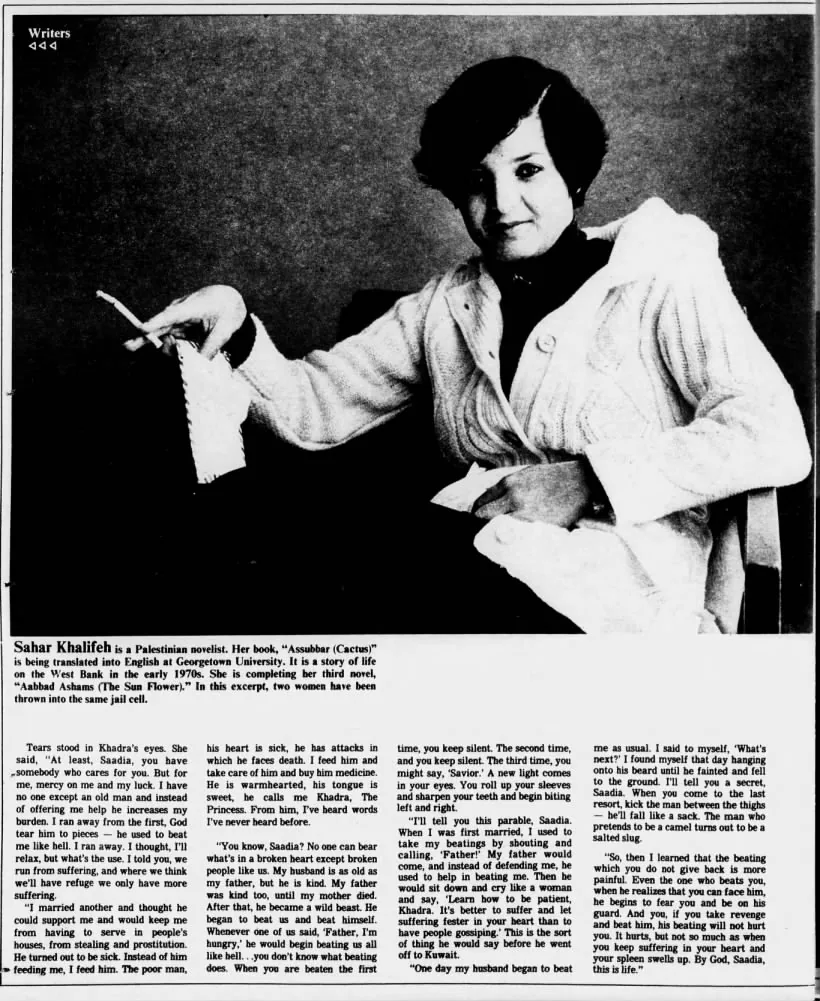
Sahar Khalifeh
Transcribed from the clipping
“Sahar Khalifeh is a Palestinian novelist. Her book, ‘Assubbar (Cactus),’ is being translated into English at Georgetown University. It is a story of life on the West Bank in the early 1970s. She is completing her third novel, ‘Aabbad Ashams (The Sun Flower).’ In this excerpt, two women have been thrown into the same jail cell.… Tears stood in Khadra’s eyes. She said, ‘At least, Saadia, you have somebody who cares for you. But for me, mercy on me and my luck. I have no one except an old man and instead of offering me help he increases my burden. I ran away from the first, God tear him to pieces — he used to beat me like hell. I ran away. I thought, I’ll relax, but what’s the use. I told you, we run from suffering, and where we think we’ll have refuge we only have more suffering.… I married another and thought he could support me and would keep me from having to serve in people’s houses, from stealing and prostitution. He turned out to be sick. Instead of him feeding me, I feed him. The poor man, his heart is sick, he has attacks in which he faces death. I feed him and take care of him and buy him medicine. He is warmhearted, his tongue is sweet, he calls me Khadra, The Princess. From him, I’ve heard words I’ve never heard before.’ ‘You know, Saadia? No one can bear what’s in a broken heart except broken people like us. My husband is as old as my father, but he is kind. My father was kind too, until my mother died. After that, he became a wild horse. Whenever one of us said, “Father, I’m hungry,” he would begin beating us all like hell… you don’t know what beating does. When you are beaten the first time, you keep silent. The second time, you keep silent. The third time, you might say, “Savior.” A new light comes in your eyes. You roll up your sleeves and sharpen your teeth and begin biting left and right.’… ‘So, then I learned that the beating which you do not give back is more painful. Even the one who beats you, when he realizes that you can face him, he begins to fear you and be on his guard. And you, if you take revenge and beat him, his beating will not hurt you. It hurts, but not so much as when you keep suffering in your heart and your spleen swells up. By God, Saadia, this is life.’”
Context added by this archive
An American daily gives most of a page to a Palestinian woman’s fiction, with a studio portrait, under a standing head that reads Writers. The excerpt is about two poor women in a cell talking about their husbands. The occupation is not in it. A year later the same novelist appears in this archive in the Baltimore Sun, spelled Kalifeh, describing how an Israeli government pamphlet cited her as evidence of the freedom she was being allowed.
Cite this item
"Writers," Des Moines Register, 11 March 1979. Covering Palestine archive, CP-1979-008. https://coveringpalestine.org/archive/cp-1979-008
Elsewhere in the archive
- Editorial didn't help Israel/PalestineDes Moines Register · 25 September 2003 · the same newspaper
- What Zionist Idea ProposesDes Moines Register · 24 October 1938 · the same newspaper
- Are Israelis guilty of systematic torture? Perhaps, U.S. reports cautiously suggestHonolulu Advertiser · 7 February 1979 · the same year
- ClosedAnn Arbor News · 24 May 1979 · the same year
- The Closing of Bir Zeit University Ought To Be ReconsideredThe Baltimore Sun · 15 June 1979 · the same year
This record is part of Covering Palestine, an archive of American and Anglophone newspaper clippings about Palestinians, 1812 to 2022. Researched and assembled by Maria Robles.
The clipping belongs to the newspaper that printed it, or to the wire service that supplied the copy. It is reproduced here for research, criticism and commentary. The city is derived from the masthead, not read off the clipping.
Something wrong here, or something you know about this clipping? The archive is still being built and corrections are wanted: maria@rozumstudio.com, quoting CP-1979-008.
See it in the archive reel · Full text of every clipping · Dataset