 Where the confirmation came fromAlmost every confirmation came from their own institutions · 1977 to 2020
1977 to 2020
Where the confirmation came from
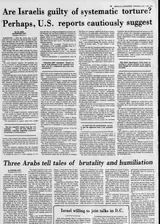
Yasser Faour had been in Beersheba prison nine years when his body was sent back to Lebanon in December 1979. The PLO said he was tortured to death. An Israeli police spokesman said the death was not the result of violence. The paper printed both, and then printed a third thing, which neither side had any reason to dispute: Faour’s father had died while visiting him in that prison.
This section is about the forty-three years of American newspaper reports that the Faour story sits inside, and about one thing those reports have in common. The allegation is old — it is being made in these pages in 1977, which is forty-six years before most arguments about it started. What is worth noticing is not that the charge recurs. It is who keeps confirming it.
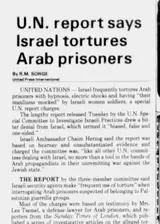
“Israel frequently tortures Arab prisoners with hypnosis, electric shocks and having ‘their manliness mocked’ by Israeli women soldiers.”
A United Nations special committee reports it and Israel’s ambassador, Chaim Herzog, calls the report “biased, false and one-sided,” built on hearsay and the work of “Arab propagandists.” Then the news agency lists where the committee’s evidence came from: an Israeli defense lawyer, the Sunday Times of London, the Red Cross and the Jerusalem Post. Not one of those four is Palestinian.
 CP-1977-003
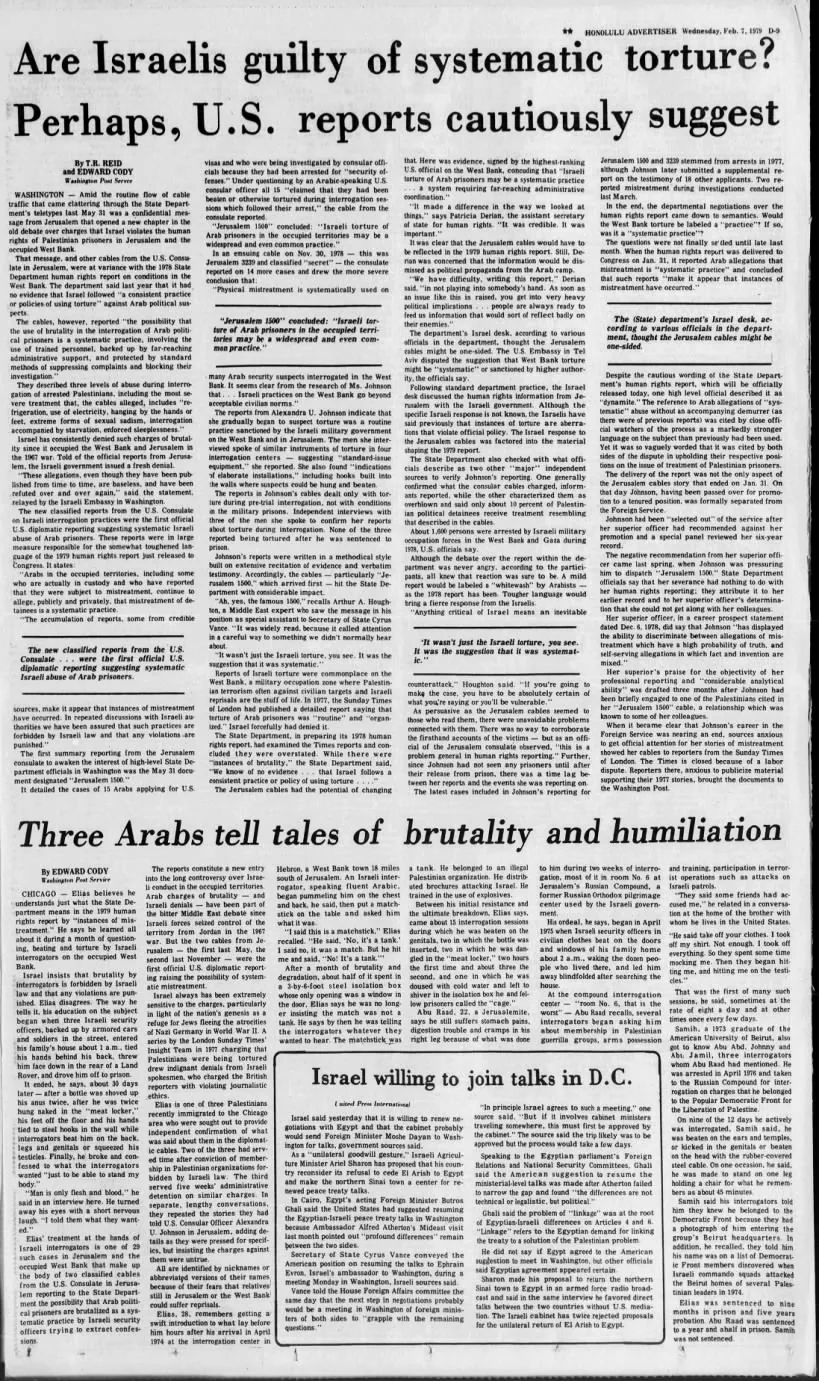
“Israeli torture of Arab prisoners in the occupied territories may be a widespread and even common practice.”
That sentence is not an accusation made by anybody in this story. It is the conclusion of a confidential United States State Department cable, filed from Jerusalem on 31 May 1978 and known by its number, Jerusalem 1500. An American newspaper printed its own government’s cable traffic. Three Palestinians describe what was done to them, and the paper explains in its own voice why it will not fully name them: their relatives in Jerusalem and the West Bank could suffer for it.
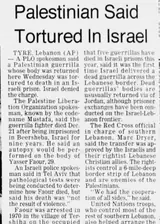
CP-1979-001“Pathological tests were being conducted to determine how Faour died, but his death was ‘not the result of violence.’”
Yasser Faour had been in Beersheba prison for nine years when his body was returned to Tyre. The PLO says he was tortured to death; an Israeli police spokesman says he was not. The paper prints both, and then one more fact that neither side disputes: Faour’s father had died while visiting him in that same prison.
 CP-1979-002
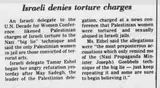
“The most preposterous accusations, which only remind me of the Nazi propaganda technique of the big lie.”
May Sadegh, leading the Palestinian delegation at the United Nations Decade for Women conference, said Palestinian women were tortured and sexually abused in Israeli jails. Her charge is summarized in a single clause; the rest of the item is Tamar Eshel’s refutation of it. The headline is Israeli denies torture charges — the denial is the news, and the charge survives only as its object.
 CP-1980-001
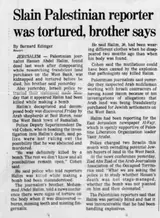
“Halim’s decapitated and decomposed body was discovered Friday by Arab shepherds at Beit Horon.”
Hassan Abdel Halim disappeared while researching fraudulent land purchases in the West Bank. His brother says he was kidnapped and tortured before he died. On the Monday the police said it appeared he had been killed making a bomb; by the Tuesday they had retracted it. His brother, his colleagues and the police are all quoted, and they do not agree.
 CP-1988-017
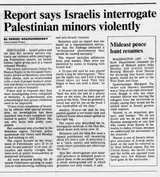
“Israeli police and the Shin Bet security service routinely use violence while interrogating Palestinian minors.”
The finding is B’Tselem’s — an Israeli human rights organization, reporting on Israeli practice. The children in it are quoted and unnamed, and again the paper says why: Israeli law. The police answer that every complaint is investigated, and a spokeswoman acknowledges that prison conditions need to be improved.
 CP-1990-008
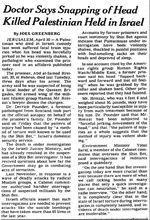
“Palestinians under interrogation have been violently shaken, shackled in painful positions with foul-smelling sacks on their heads and deprived of sleep.”
Abd al-Samed Hreizat, 30, of Hebron, died in Israeli custody; a pathologist’s affidavit says his head was snapped. Read the sentence above again for where the Times says it comes from. Not a human rights report, and not the family: accounts by former prisoners, and court testimony given by Shin Bet agents themselves.
 CP-1995-006
“The worst thing about his 40-day imprisonment wasn’t that he was in solitary confinement in a one-by-two-meter cell. It was that the clothes they gave him smelled like urine.”
Mamdouh Al-Aker, a doctor from Ramallah, held in 1991. He never saw papers saying what he was charged with and was never brought to trial. He is named, he is quoted at length, and he is speaking to a Wisconsin newspaper eleven years after the fact — which is roughly how long it takes for a Palestinian to describe this in his own name.
 CP-2002-046
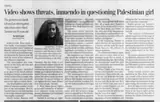
“The interrogator also comments on her body, fair skin and ‘eyes of an angel.’”
Ahed Tamimi was sixteen. Her family released the video; an American paper printed what the interrogator said to her, including the threat to arrest her relatives if she would not cooperate. She asserts her right to remain silent and does not answer. The Israeli military says the complaint is being thoroughly examined.
 CP-2018-003
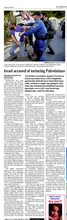
“One of the men was hospitalized with kidney failure and 11 broken ribs. Another was nearly unrecognizable to his wife when he was wheeled into a courtroom.”
A third had been stitched up after a security dog attacked him. All three were then returned to their interrogators. Forty-three years after the United Nations committee, the wire copy still arrives in the shape it arrived in 1977: what was done, who says so, and the official answer, in that order. The same dispatch ran in the Telegraph the same morning.
 CP-2020-011
Read the sources down the left-hand side. A United Nations committee citing an Israeli defense lawyer and the Red Cross. A confidential cable from the American embassy in Jerusalem. An Israeli human rights organization. Sworn court testimony from Shin Bet agents. An Israeli pathologist’s affidavit. Israel’s own Supreme Court, invoked as the standard in 2020. In forty-three years of these clippings, almost every corroboration an American reader was given came from an American or an Israeli institution, reporting on itself.
The second pattern is who gets a name. Faour is named because he is dead. Hreizat is named because he is dead. The three men in 1979 are not named, and the paper says why: their families could suffer for it. The children in 1990 are not named, and the paper says why: Israeli law. Nobody who conducted an interrogation is named in any of these clippings. The officials who issue the denials are named in all of them — Chaim Herzog, Tamar Eshel, a police spokesman, a military spokeswoman.
One document is missing from this archive, and it is the one that matters most. In 1987 an Israeli judicial commission chaired by a former Supreme Court president examined these interrogation methods and concluded that a measure of physical pressure was permissible. Searching all {{N_ITEMS}} clippings for that commission, and for the phrase it is remembered by, returns nothing. The same is true of the 1999 Israeli Supreme Court ruling that restricted those methods, which appears here only as a passing clause inside a wire story filed twenty-one years later. Both were covered in the American press. Neither has been collected yet. That is a gap in this collection, not a gap in the record.
The next time this is described as a recent allegation, or as something only Palestinians say, the question worth asking is a narrow one: who was the source. In these clippings, for forty-three years, it was almost never a Palestinian. It was a cable, a commission, a courtroom, or a pathologist.