The Atlanta Journal and Constitution · Atlanta, Georgia · 30 September 1979
CP-1979-015
Jesse Jackson Fails to Get Arafat To Accept Israel, Quit Terrorism
By Lee May, Constitution Staff Writer
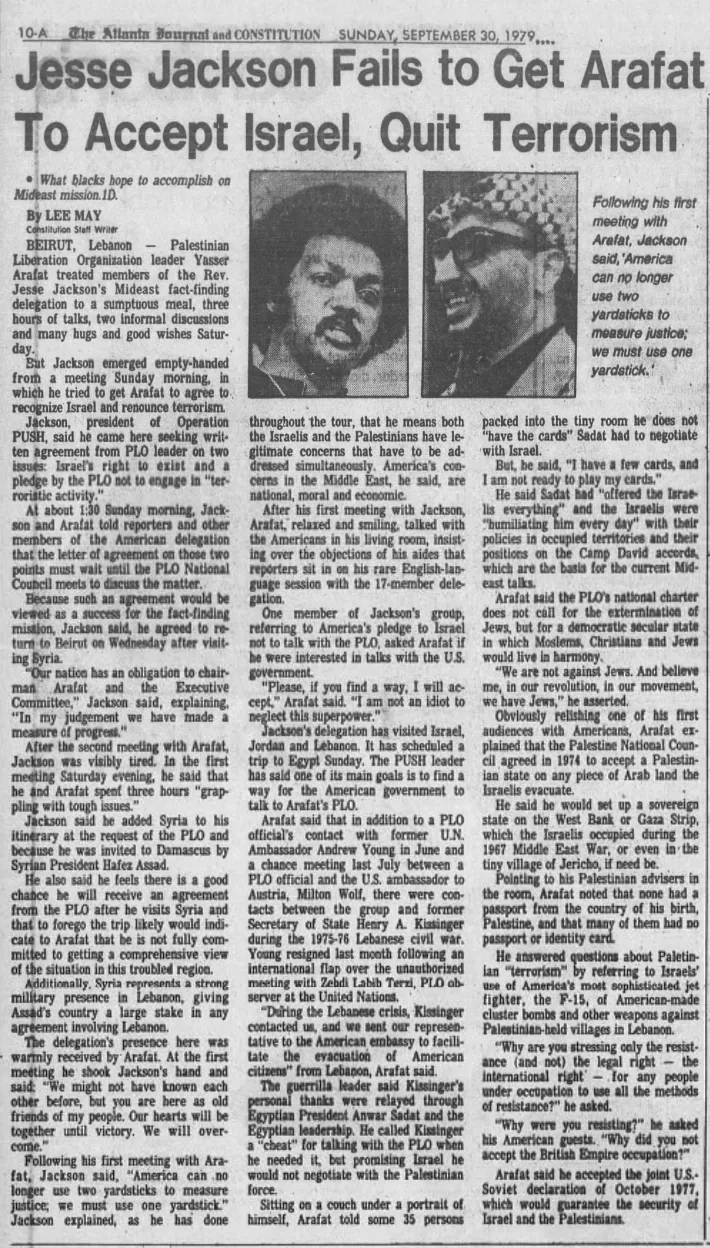
Transcribed from the clipping
“BEIRUT, Lebanon — Palestinian Liberation Organization leader Yasser Arafat treated members of the Rev. Jesse Jackson’s Mideast fact-finding delegation to a sumptuous meal, three hours of talks, two informal discussions and many hugs and good wishes Saturday.
But Jackson emerged empty-handed from a meeting Sunday morning, in which he tried to get Arafat to agree to recognize Israel and renounce terrorism. Jackson, president of Operation PUSH, said he came here seeking written agreement from PLO leader on two issues: Israel’s right to exist and a pledge by the PLO not to engage in ‘terroristic activity.’
At about 1:30 Sunday morning, Jackson and Arafat told reporters and other members of the American delegation that the letter of agreement on those two points must wait until the PLO National Council meets to discuss the matter.
Because such an agreement would be viewed as a success for the fact-finding mission, Jackson said, he agreed to return to Beirut on Wednesday after visiting Syria. ‘Our nation has an obligation to chairman Arafat and the Executive Committee,’ Jackson said, explaining, ‘In my judgement we have made a measure of progress.’
After the second meeting with Arafat, Jackson was visibly tired. In the first meeting Saturday evening, he said that he and Arafat spent three hours ‘grappling with tough issues.’ Jackson said he added Syria to his itinerary at the request of the PLO and because he was invited to Damascus by Syrian President Hafez Assad.
He also said he feels there is a good chance he will receive an agreement from the PLO after he visits Syria and that to forego the trip likely would indicate to Arafat that he is not fully committed to getting a comprehensive view of the situation in this troubled region.
Additionally, Syria represents a strong military presence in Lebanon, giving Assad’s country a large stake in any agreement involving Lebanon. The delegation’s presence here was warmly received by Arafat. At the first meeting he shook Jackson’s hand and said: ‘We might not have known each other before, but you are here as old friends of my people.
Our hearts will be together until victory. We will overcome.’ Following his first meeting with Arafat, Jackson said, ‘America can no longer use two yardsticks to measure justice; we must use one yardstick.’
Jackson explained, as he has done throughout the tour, that he means both the Israelis and the Palestinians have legitimate concerns that have to be addressed simultaneously. America’s concerns in the Middle East, he said, are national, moral and economic.
After his first meeting with Jackson, Arafat, relaxed and smiling, talked with the Americans in his living room, insisting over the objections of his aides that reporters sit in on his rare English-language session with the 17-member delegation.
One member of Jackson’s group, referring to America’s pledge to Israel not to talk with the PLO, asked Arafat if he were interested in talks with the U.S. government. ‘Please, if you find a way, I will accept,’ Arafat said. ‘I am not an idiot to neglect this superpower.’ Jackson’s delegation has visited Israel, Jordan and Lebanon.
It has scheduled a trip to Egypt Sunday. The PUSH leader has said one of its main goals is to find a way for the American government to talk to Arafat’s PLO. Arafat said that in addition to a PLO official’s contact with former U.N.
Ambassador Andrew Young in June and a chance meeting last July between a PLO official and the U.S. ambassador to Austria, Milton Wolf, there were contacts between the group and former Secretary of State Henry A. Kissinger during the 1975-76 Lebanese civil war.
Young resigned last month following an international flap over the unauthorized meeting with Zehdi Labib Terzi, PLO observer at the United Nations. ‘During the Lebanese crisis, Kissinger contacted us, and we sent our representative to the American embassy to facilitate the evacuation of American citizens’ from Lebanon, Arafat said.
The guerrilla leader said Kissinger’s personal thanks were relayed through Egyptian President Anwar Sadat and the Egyptian leadership. He called Kissinger a ‘cheat’ for talking with the PLO when he needed it, but promising Israel he would not negotiate with the Palestinian force.
Sitting on a couch under a portrait of himself, Arafat told some 35 persons packed into the tiny room he does not ‘have the cards’ Sadat had to negotiate with Israel. But, he said, ‘I have a few cards, and I am not ready to play my cards.’
He said Sadat had ‘offered the Israelis everything’ and the Israelis were ‘humiliating him every day’ with their policies in occupied territories and their positions on the Camp David accords, which are the basis for the current Mideast talks.
Arafat said the PLO’s national charter does not call for the extermination of Jews, but for a democratic secular state in which Moslems, Christians and Jews would live in harmony. ‘We are not against Jews. And believe me, in our revolution, in our movement, we have Jews,’ he asserted.
Obviously relishing one of his first audiences with Americans, Arafat explained that the Palestine National Council agreed in 1974 to accept a Palestinian state on any piece of Arab land the Israelis evacuate.
He said he would set up a sovereign state on the West Bank or Gaza Strip, which the Israelis occupied during the 1967 Middle East War, or even in the tiny village of Jericho, if need be. Pointing to his Palestinian advisers in the room, Arafat noted that none had a passport from the country of his birth, Palestine, and that many of them had no passport or identity card.
He answered questions about Paletinian ‘terrorism’ by referring to Israels’ use of America’s most sophisticated jet fighter, the F-15, of American-made cluster bombs and other weapons against Palestinian-held villages in Lebanon.
‘Why are you stressing only the resistance (and not) the legal right — the international right — for any people under occupation to use all the methods of resistance?’ he asked. ‘Why were you resisting?’ he asked his American guests. ‘Why did you not accept the British Empire occupation?’
Arafat said he accepted the joint U.S.-Soviet declaration of October 1977, which would guarantee the security of Israel and the Palestinians.”
Context added by this archive
Not a news agency dispatch: this paper sent its own reporter to Beirut, and the headline it wrote calls the trip a failure on the same morning two other papers called it a meeting.
The piece carries the longest printed record in this archive of Arafat speaking English to Americans — the passport none of his advisers hold, and the question he puts back to his guests about the British Empire.
Cite this item
"Jesse Jackson Fails to Get Arafat To Accept Israel, Quit Terrorism," The Atlanta Journal and Constitution, 30 September 1979. Covering Palestine archive, CP-1979-015. https://coveringpalestine.org/archive/cp-1979-015
More from The Atlanta Journal and Constitution
- ‘A hellish sight . . . like Jonestown’The Atlanta Journal and Constitution · 19 September 1982
More from the 1970s
- Are Israelis guilty of systematic torture? Perhaps, U.S. reports cautiously suggestHonolulu Advertiser · 7 February 1979
- WritersDes Moines Register · 11 March 1979
- Israeli Bombers Retaliate After PLO Kills 3Press of Atlantic City · 24 May 1979
- ClosedAnn Arbor News · 24 May 1979
- The Closing of Bir Zeit University Ought To Be ReconsideredThe Baltimore Sun · 15 June 1979
- Radical Bir Zeit Unversity ‘Berkeley of the West Bank’The Daily Comet · 2 July 1979
- All 118 clippings from the 1970s →
This record is part of Covering Palestine, an archive of American and Anglophone newspaper clippings about Palestinians, 1799 to 2023. Researched and assembled by Maria Robles.
The clipping belongs to the newspaper that printed it, or to the news agency that supplied the copy. It is reproduced here for research, criticism and commentary. The city is derived from the masthead, not read off the clipping.
Something wrong here, or something you know about this clipping? The archive is still being built and corrections are wanted: maria@rozumstudio.com, quoting CP-1979-015.
See it in the archive reel · Full text of every clipping · Dataset