The Atlanta Journal and Constitution · Atlanta, Georgia · 5 November 1978
CP-1978-011
Palestinian Dance Performance Turns Into Political Event Here
By Mary Jo Padgett, Journal-Constitution Dance Critic
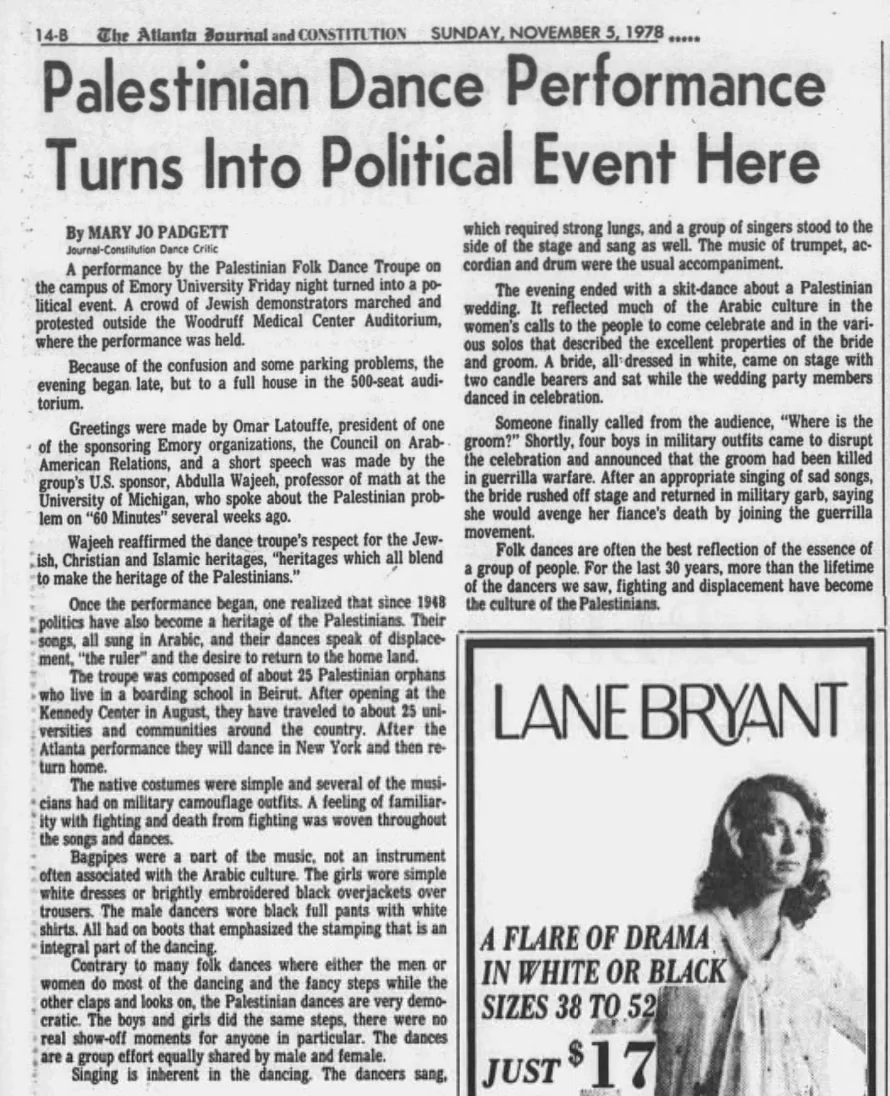
Transcribed from the clipping
“A performance by the Palestinian Folk Dance Troupe on the campus of Emory University Friday night turned into a political event. A crowd of Jewish demonstrators marched and protested outside the Woodruff Medical Center Auditorium, where the performance was held.
Because of the confusion and some parking problems, the evening began late, but to a full house in the 500-seat auditorium.
Greetings were made by Omar Latouffe, president of one of the sponsoring Emory organizations, the Council on Arab-American Relations, and a short speech was made by the group’s U.S. sponsor, Abdulla Wajeeh, professor of math at the University of Michigan, who spoke about the Palestinian problem on ‘60 Minutes’ several weeks ago.
Wajeeh reaffirmed the dance troupe’s respect for the Jewish, Christian and Islamic heritages, ‘heritages which all blend to make the heritage of the Palestinians.’ Once the performance began, one realized that since 1948 politics have also become a heritage of the Palestinians.
Their songs, all sung in Arabic, and their dances speak of displacement, ‘the ruler’ and the desire to return to the home land. The troupe was composed of about 25 Palestinian orphans who live in a boarding school in Beirut. After opening at the Kennedy Center in August, they have traveled to about 25 universities and communities around the country.
After the Atlanta performance they will dance in New York and then return home. The native costumes were simple and several of the musicians had on military camouflage outfits. A feeling of familiarity with fighting and death from fighting was woven throughout the songs and dances. Bagpipes were a part of the music, not an instrument often associated with the Arabic culture.
The girls wore simple white dresses or brightly embroidered black overjackets over trousers. The male dancers wore black full pants with white shirts. All had on boots that emphasized the stamping that is an integral part of the dancing.
Contrary to many folk dances where either the men or women do most of the dancing and the fancy steps while the other claps and looks on, the Palestinian dances are very democratic. The boys and girls did the same steps, there were no real show-off moments for anyone in particular. The dances are a group effort equally shared by male and female.
Singing is inherent in the dancing. The dancers sang, which required strong lungs, and a group of singers stood to the side of the stage and sang as well. The music of trumpet, accordian and drum were the usual accompaniment. The evening ended with a skit-dance about a Palestinian wedding.
It reflected much of the Arabic culture in the women’s calls to the people to come celebrate and in the various solos that described the excellent properties of the bride and groom. A bride, all dressed in white, came on stage with two candle bearers and sat while the wedding party members danced in celebration.
Someone finally called from the audience, ‘Where is the groom?’ Shortly, four boys in military outfits came to disrupt the celebration and announced that the groom had been killed in guerrilla warfare.
After an appropriate singing of sad songs, the bride rushed off stage and returned in military garb, saying she would avenge her fiance’s death by joining the guerrilla movement. Folk dances are often the best reflection of the essence of a group of people.
For the last 30 years, more than the lifetime of the dancers we saw, fighting and displacement have become the culture of the Palestinians.”
Context added by this archive
A newspaper’s dance critic reviews twenty-five Palestinian orphans from a boarding school in Beirut, and files the only piece in this archive that treats Palestinian performance as performance. She notices the choreography: the Palestinian dances are very democratic.
The boys and girls did the same steps, there were no real show-off moments for anyone in particular. She notices the bagpipes. The troupe’s American sponsor tells the audience the company respects
‘the Jewish, Christian and Islamic heritages, heritages which all blend to make the heritage of the Palestinians.’ The closing number is a wedding. A bride in white comes on with two candle bearers, the party dances, and then somebody in the audience calls out asking where the groom is. Four boys in military dress arrive to say he has been killed.
The bride leaves and comes back in military clothes. The critic’s last sentence is the review: For the last 30 years, more than the lifetime of the dancers we saw, fighting and displacement have become the culture of the Palestinians.
Cite this item
"Palestinian Dance Performance Turns Into Political Event Here," The Atlanta Journal and Constitution, 5 November 1978. Covering Palestine archive, CP-1978-011. https://coveringpalestine.org/archive/cp-1978-011
More from The Atlanta Journal and Constitution
- Jesse Jackson Fails to Get Arafat To Accept Israel, Quit TerrorismThe Atlanta Journal and Constitution · 30 September 1979
- ‘A hellish sight . . . like Jonestown’The Atlanta Journal and Constitution · 19 September 1982
More from the 1970s
- 3 Israeli Settlements On West Bank ApprovedLos Angeles Herald Examiner · 11 January 1978
- A land so sacred to all who have held itThe Philadelphia Inquirer · 5 February 1978
- Israeli SettlementsThe Times · 13 February 1978
- E. Jerusalem Guides Probed For PLO PropagandaSt. Louis Jewish Light · 30 August 1978
- Four Million Palestinian Refugees ‘Alienated, Dispossessed, Amputated’Omaha World-Herald · 22 October 1978
- Soviets, Arabs attack Nobel Prize decisionWilmington Morning Star · 29 October 1978
- All 119 clippings from the 1970s →
This record is part of Covering Palestine, an archive of American and Anglophone newspaper clippings about Palestinians, 1799 to 2023. Researched and assembled by Maria Robles.
The clipping belongs to the newspaper that printed it, or to the news agency that supplied the copy. It is reproduced here for research, criticism and commentary. The city is derived from the masthead, not read off the clipping.
Something wrong here, or something you know about this clipping? The archive is still being built and corrections are wanted: maria@rozumstudio.com, quoting CP-1978-011.
See it in the archive reel · Full text of every clipping · Dataset