The New York Times · 27 November 1978
CP-1978-025
Arrest of 15 on West Bank Raises Crackdown Issue
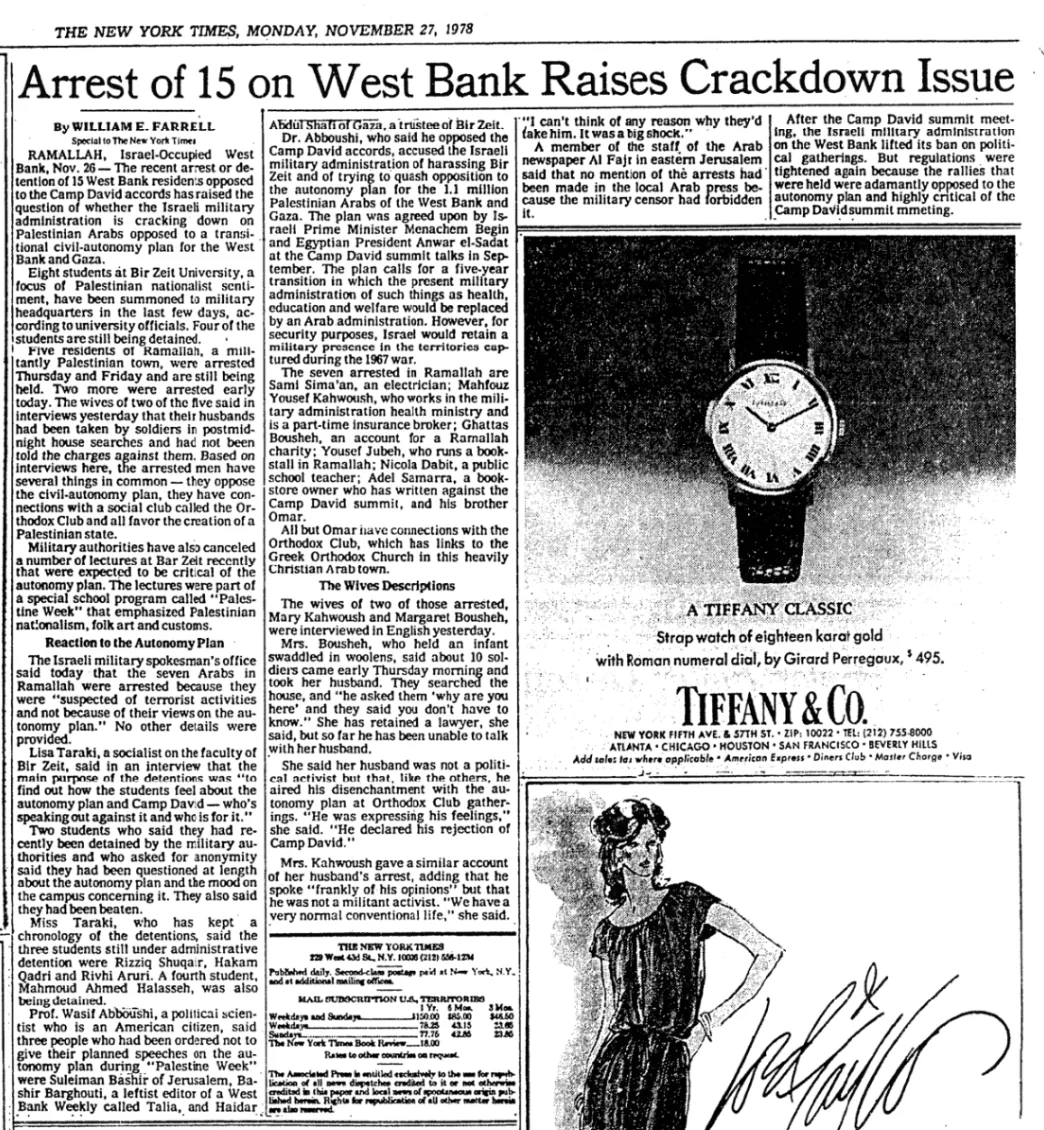
Transcribed from the clipping
RAMALLAH, Israel-Occupied West Bank, Nov. 26 — The recent arrest or detention of 15 West Bank residents opposed to the Camp David accords has raised the question of whether the Israeli military administration is cracking down on Palestinian Arabs opposed to a transitional civil-autonomy plan for the West Bank and Gaza.
Eight students at Bir Zeit University, a focus of Palestinian nationalist sentiment, have been summoned to military headquarters in the last few days, according to university officials. Four of the students are still being detained. Five residents of Ramallah, a militantly Palestinian town, were arrested Thursday and Friday and are still being held.
Two more were arrested early today. The wives of two of the five said in interviews yesterday that their husbands had been taken by soldiers in postmidnight house searches and had not been told the charges against them.
Based on interviews here, the arrested men have several things in common — they oppose the civil-autonomy plan, they have connections with a social club called the Orthodox Club and all favor the creation of a Palestinian state. Military authorities have also canceled a number of lectures at Bar Zeit recently that were expected to be critical of the autonomy plan.
The lectures were part of a special school program called “Palestine Week” that emphasized Palestinian nationalism, folk art and customs. Reaction to the Autonomy Plan The Israeli military spokesman’s office said today that the seven Arabs in Ramallah were arrested because they were “suspected of terrorist activities and not because of their views on the autonomy plan.”
No other details were provided. Lisa Taraki, a socialist on the faculty of Bir Zeit, said in an interview that the main purpose of the detentions was “to find out how the students feel about the autonomy plan and Camp David — who’s speaking out against it and who is for it.”
Two students who said they had recently been detained by the military authorities and who asked for anonymity said they had been questioned at length about the autonomy plan and the mood on the campus concerning it. They also said they had been beaten.
Miss Taraki, who has kept a chronology of the detentions, said the three students still under administrative detention were Rizziq Shuqair, Hakam Qadri and Rivhi Aruri. A fourth student, Mahmoud Ahmed Halasseh, was also being detained. Prof.
Wasif Abboushi, a political scientist who is an American citizen, said three people who had been ordered not to give their planned speeches on the autonomy plan during “Palestine Week” were Suleiman Bashir of Jerusalem, Bashir Barghouti, a leftist editor of a West Bank Weekly called Talia, and Haidar Abdul Shafi of Gaza, a trustee of Bir Zeit. Dr.
Abboushi, who said he opposed the Camp David accords, accused the Israeli military administration of harassing Bir Zeit and of trying to quash opposition to the autonomy plan for the 1.1 million Palestinian Arabs of the West Bank and Gaza.
The plan was agreed upon by Israeli Prime Minister Menachem Begin and Egyptian President Anwar el-Sadat at the Camp David summit talks in September. The plan calls for a five-year transition in which the present military administration of such things as health, education and welfare would be replaced by an Arab administration.
However, for security purposes, Israel would retain a military presence in the territories captured during the 1967 war.
The seven arrested in Ramallah are Sami Sima’an, an electrician; Mahfouz Yousef Kahwoush, who works in the military administration health ministry and is a part-time insurance broker; Ghattas Bousheh, an account for a Ramallah charity; Yousef Jubeh, who runs a bookstall in Ramallah; Nicola Dabit, a public school teacher; Adel Samarra, a bookstore owner who has written against the Camp David summit, and his brother Omar.
All but Omar have connections with the Orthodox Club, which has links to the Greek Orthodox Church in this heavily Christian Arab town. The Wives Descriptions The wives of two of those arrested, Mary Kahwoush and Margaret Bousheh, were interviewed in English yesterday. Mrs.
Bousheh, who held an infant swaddled in woolens, said about 10 soldiers came early Thursday morning and took her husband. They searched the house, and “he asked them ‘why are you here’ and they said you don’t have to know.” She has retained a lawyer, she said, but so far he has been unable to talk with her husband.
She said her husband was not a political activist but that, like the others, he aired his disenchantment with the autonomy plan at Orthodox Club gatherings. “He was expressing his feelings,” she said. “He declared his rejection of Camp David.” Mrs.
Kahwoush gave a similar account of her husband’s arrest, adding that he spoke “frankly of his opinions” but that he was not a militant activist. “We have a very normal conventional life,” she said. “I can’t think of any reason why they’d take him. It was a big shock.”
A member of the staff of the Arab newspaper Al Fajr in eastern Jerusalem said that no mention of the arrests had been made in the local Arab press because the military censor had forbidden it. After the Camp David summit meeting, the Israeli military administration on the West Bank lifted its ban on political gatherings.
But regulations were tightened again because the rallies that were held were adamantly opposed to the autonomy plan and highly critical of the Camp David summit mmeting.
How this transcription was made
Single scan of a full page top-left corner: masthead folio, headline across four columns, four columns of text, and to the right a Tiffany & Co. advertisement and part of a Lord & Taylor advertisement, both excluded from the transcription. The paper's own publication and mail-subscription box sits at the foot of column one and is also excluded. Read at 7x–8x magnification throughout, with two phrases taken to 16x and 20x. The excerpt is the complete article, dateline to final sentence; the two crossheads (Reaction to the Autonomy Plan, The Wives Descriptions) are reproduced on their own lines. Nothing required summarizing for graphic content; the only violence reported is the six-word statement that two students said they had been beaten. — The masthead folio is intact at the top of the clipping: THE NEW YORK TIMES, MONDAY, NOVEMBER 27, 1978. 27 November 1978 was a Monday, so the day name and the date agree. The dispatch is datelined RAMALLAH, Israel-Occupied West Bank, Nov. 26 — a next-day run. The paper's own publication box, printed in the lower part of the first column, repeats THE NEW YORK TIMES / 229 West 43d St., N.Y. 10036 (212) 556-1234. Maria's label matches the page. — Maria's slide label reads “New York TImes March 15 1982 / New York TImes Nov 27 1978,” but the two images run the other way round: s076_1 is the November 1978 page and s076_2 is the March 1982 page. The labels are correct; their order is reversed relative to the images. Flagged because an agent matching label 1 to image 1 would misdate both records. — Three printed readings I checked and kept as printed: “Lisa Taraki, a socialist on the faculty of Bir Zeit” — I magnified this phrase to 20x to be sure. The word has nine letters and reads s-o-c-i-a-l-i-s-t; there is no “olog” in it. Given that she is quoted on campus opinion and keeps a chronology of detentions, “sociologist” is the likelier intended word, but the page says socialist and I have not changed it. “Ghattas Bousheh, an account for a Ramallah charity” — read at 8x. The word is “account,” not “accountant”; there is no second “an.” Kept as printed. “highly critical of the Camp David summit mmeting” — the last word of the article, read at 8x, is set with a doubled m. Kept as printed. The crosshead “The Wives Descriptions” is also printed without an apostrophe. One attribution is genuinely ambiguous on the page and I have not resolved it: the two-line paragraph “I can’t think of any reason why they’d take him. It was a big shock.” opens the third column and carries no speaker tag. It follows directly on Mrs. Kahwoush's paragraph, so it is almost certainly hers, but the page does not say so.
Cite this clipping
"Arrest of 15 on West Bank Raises Crackdown Issue," The New York Times, 27 November 1978. Covering Palestine archive, CP-1978-025. https://coveringpalestine.org/archive/cp-1978-025
More from The New York Times
- The Maine Colony in PalestineThe New York Times · 12 November 1866
- Jewish Colonization in PalestineThe New York Times · 9 December 1883
- Jewish State in Palestine OpposedThe New York Times · 9 July 1897
- ZIONIST CONGRESS IN BASELThe New York Times · 31 August 1897
- ROME FEARS THE ZIONISTSThe New York Times · 12 September 1897
- PROGRESS OF ZIONISMThe New York Times · 16 December 1901
- 852 more from this paper in the full text →
More from the 1970s
- PLO ridicules Carter's Palestine standWest Bend News · 4 January 1978
- U.S. Woman Starts Israel Prison TermHuntsville Times · 10 January 1978
- American Gets Five Year Term As Spy for ArabsThe Missoulian · 10 January 1978
- American Woman Jailed In Israel as Spy for Arabs(newspaper unidentified) · 10 January 1978
- Woman begins sentence for aiding Arabs(newspaper unidentified) · 10 January 1978
- 3 Israeli Settlements On West Bank ApprovedLos Angeles Herald Examiner · 11 January 1978
- All 338 clippings from the 1970s →
Last updated 2 November 2026
This record is part of Covering Palestine, an archive of American newspaper clippings about Palestinians, 1724 to 2023. Researched and assembled by Maria Robles.
The clipping belongs to the newspaper that printed it, or to the news agency that supplied the copy. It is reproduced here for research, criticism and commentary. A city here is where the newspaper was published, not where the story came from, and on most records it was taken from the masthead.
Something wrong here, or something you know about this clipping? The archive is still being built and corrections are wanted: maria@rozumstudio.com, quoting CP-1978-025.
Everything printed in 1978 · Printed on this day · See it in the archive reel · Full text of every clipping · Dataset