 Her name was FalestineOne dispatch, three papers, one sister · 4 October 2000
4 October 2000
Her name was Falestine
On one Wednesday morning in October 2000, three American newspapers printed the same Associated Press dispatch from Gaza. How much of one family you were told about depended entirely on which paper you happened to buy.
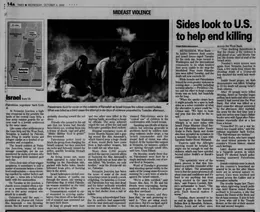
Laura King filed it from Netzarim Junction, a crossroads in the central Gaza Strip where an army outpost guarded the road to a settlement. Six days earlier a twelve-year-old boy had been shot dead at the same junction while his father tried to shield him. On the Tuesday she was writing about, a 28-year-old man named Fahmi Abu Amounah was hit on a warehouse roof. Onlookers said he was throwing stones. The army said he was probably shooting.
Every printing carries his death. What happens after it is where they part.
“Fighting fire with firepower”
The Journal Star stops at the hospital. It also prints the week’s dead as more than 50 people have died… Most of the rest were Palestinians. What it gives instead, and no other paper here does, is the whole top of the page to a nineteen-year-old: ‘It’s our land, and if I die, my death is a good one’, in italic across the full width, with Yasser Abu Assi’s name beneath it.
 CP-2000-015
“Mideast clashes pit guns against stones”
The Spokesman-Review keeps the count Lincoln rounded off: 56 dead, of whom 43 were Palestinians and 10 were Israeli Arabs. It keeps the funeral too, two thousand people in the narrow concrete alleys of Nusseirat an hour after he was killed. Its line under the headline gives Israel’s explanation where Lincoln’s gives the criticism.
 CP-2000-016
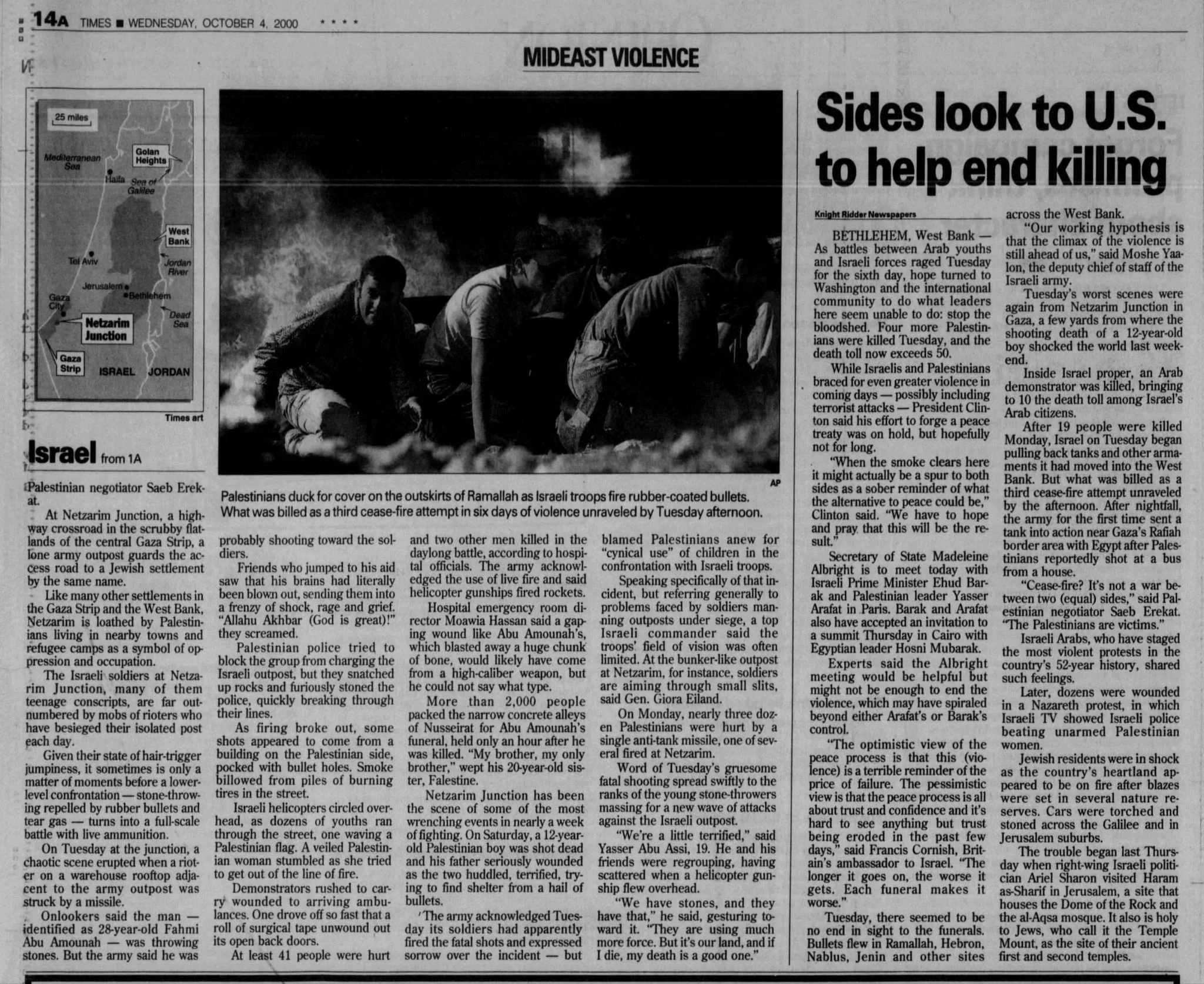
“My brother, my only brother,” wept his 20-year-old sister, Falestine.
One sentence further than Spokane, at the end of a paragraph about a funeral, on a jump page inside the paper. It is the only place in the three printings where anyone in that family speaks, and the only place the sister exists at all.
CP-2000-017Nobody censored anything here. No editor set out to remove a grieving sister from a story. A dispatch arrives longer than the hole on the page, somebody cuts from the bottom, and the bottom is where the funeral was. That is all it takes. The count of the Palestinian dead goes first, then the two thousand mourners, then the woman saying the only thing she says.
Her name was Falestine. It is the name of the country, and it survived in one American newspaper out of three because that paper had four more column-inches than the others did.
The next time you read that someone was killed and that the army disputes how, look at where the story stops. Whatever is nearest the end was nearest to being cut, and it is usually the part with a family in it.