Lincoln Journal Star · Lincoln, Nebraska · 4 October 2000
CP-2000-015
Fighting fire with firepower
Israel criticized for using deadly force to quash riots
By Laura King, The Associated Press
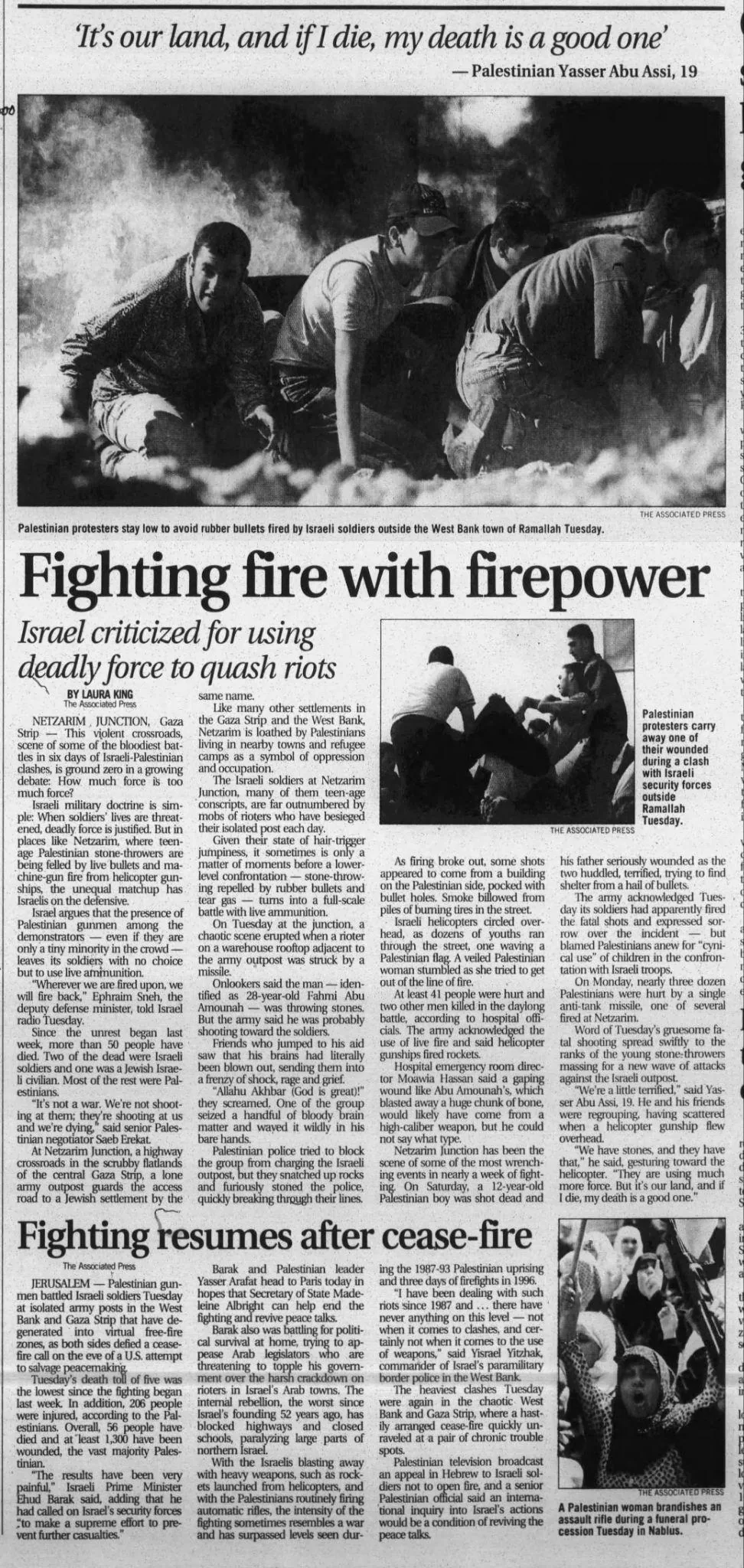
Transcribed from the clipping
“NETZARIM JUNCTION, Gaza Strip — This violent crossroads, scene of some of the bloodiest battles in six days of Israeli-Palestinian clashes, is ground zero in a growing debate: How much force is too much force? Israeli military doctrine is simple: When soldiers’ lives are threatened, deadly force is justified.
But in places like Netzarim, where teen-age Palestinian stone-throwers are being felled by live bullets and machine-gun fire from helicopter gunships, the unequal matchup has Israelis on the defensive.
Israel argues that the presence of Palestinian gunmen among the demonstrators — even if they are only a tiny minority in the crowd — leaves its soldiers with no choice but to use live ammunition. ‘Wherever we are fired upon, we will fire back,’ Ephraim Sneh, the deputy defense minister, told Israel radio Tuesday.
Since the unrest began last week, more than 50 people have died. Two of the dead were Israeli soldiers and one was a Jewish Israeli civilian. Most of the rest were Palestinians. ‘It’s not a war. We’re not shooting at them; they’re shooting at us and we’re dying,’ said senior Palestinian negotiator Saeb Erekat.
At Netzarim Junction, a highway crossroads in the scrubby flatlands of the central Gaza Strip, a lone army outpost guards the access road to a Jewish settlement by the same name. Like many other settlements in the Gaza Strip and the West Bank, Netzarim is loathed by Palestinians living in nearby towns and refugee camps as a symbol of oppression and occupation.
The Israeli soldiers at Netzarim Junction, many of them teen-age conscripts, are far outnumbered by mobs of rioters who have besieged their isolated post each day.
Given their state of hair-trigger jumpiness, it sometimes is only a matter of moments before a lower-level confrontation — stone-throwing repelled by rubber bullets and tear gas — turns into a full-scale battle with live ammunition.
On Tuesday at the junction, a chaotic scene erupted when a rioter on a warehouse rooftop adjacent to the army outpost was struck by a missile. Onlookers said the man — identified as 28-year-old Fahmi Abu Amounah — was throwing stones. But the army said he was probably shooting toward the soldiers.
Friends who jumped to his aid saw that his brains had literally been blown out, sending them into a frenzy of shock, rage and grief. ‘Allahu Akhbar (God is great)!’ they screamed. One of the group seized a handful of bloody brain matter and waved it wildly in his bare hands.
Palestinian police tried to block the group from charging the Israeli outpost, but they snatched up rocks and furiously stoned the police, quickly breaking through their lines. As firing broke out, some shots appeared to come from a building on the Palestinian side, pocked with bullet holes. Smoke billowed from piles of burning tires in the street.
Israeli helicopters circled overhead, as dozens of youths ran through the street, one waving a Palestinian flag. A veiled Palestinian woman stumbled as she tried to get out of the line of fire. At least 41 people were hurt and two other men killed in the daylong battle, according to hospital officials.
The army acknowledged the use of live fire and said helicopter gunships fired rockets. Hospital emergency room director Moawia Hassan said a gaping wound like Abu Amounah’s, which blasted away a huge chunk of bone, would likely have come from a high-caliber weapon, but he could not say what type.
Netzarim Junction has been the scene of some of the most wrenching events in nearly a week of fighting. On Saturday, a 12-year-old Palestinian boy was shot dead and his father seriously wounded as the two huddled, terrified, trying to find shelter from a hail of bullets.
The army acknowledged Tuesday its soldiers had apparently fired the fatal shots and expressed sorrow over the incident — but blamed Palestinians anew for ‘cynical use’ of children in the confrontation with Israeli troops. On Monday, nearly three dozen Palestinians were hurt by a single anti-tank missile, one of several fired at Netzarim.
Word of Tuesday’s gruesome fatal shooting spread swiftly to the ranks of the young stone-throwers massing for a new wave of attacks against the Israeli outpost. ‘We’re a little terrified,’ said Yasser Abu Assi, 19. He and his friends were regrouping, having scattered when a helicopter gunship flew overhead.
‘We have stones, and they have that,’ he said, gesturing toward the helicopter. ‘They are using much more force. But it’s our land, and if I die, my death is a good one.’”
Context added by this archive
The paper gives a nineteen-year-old the top of the page. Above the photograph, above the headline, in italic across the full width, it prints what Yasser Abu Assi said and puts his name under it:
‘It’s our land, and if I die, my death is a good one’. That placement is rare in this archive. A Palestinian sentence is almost never the largest type on a page.
Three Palestinians are named in the copy, which is also unusual: Abu Assi, Fahmi Abu Amounah, who was 28 and whose death the story describes, and Moawia Hassan, the hospital emergency room director asked what weapon makes a wound like that. The twelve-year-old shot at this same junction the previous Saturday is in the story but not named. He was Muhammad al-Durrah.
Cite this item
"Fighting fire with firepower," Lincoln Journal Star, 4 October 2000. Covering Palestine archive, CP-2000-015. https://coveringpalestine.org/archive/cp-2000-015
More from Lincoln Journal Star
- Nebraskans Visit Old PalestineLincoln Journal Star · 22 January 1911
- Palestine Riots Up Fez IndustryLincoln Journal Star · 14 December 1947
- Genocide against Palestinians with U.S. supportLincoln Journal Star · 8 August 2014
- Palestinian trespasser killedLincoln Journal Star · 27 May 2023
More from the 2000s
- The poetry of Arab pain: Are Israeli students ready?The Bulletin · 7 March 2000
- Israelis argue over teaching Palestinian’s verseThe Oregonian · 7 March 2000
- An uproar over introduction of poet into curriculumThe News Virginian · 7 March 2000
- Poet’s work inflames cultural divideTampa Bay Times · 11 March 2000
- Arafat rejected $30 billion for refugee relocation, aide saysIndianapolis Star · 11 August 2000
- Contested holy sitesThe Columbian · 8 September 2000
- All 141 clippings from the 2000s →
This record is part of Covering Palestine, an archive of American and Anglophone newspaper clippings about Palestinians, 1799 to 2023. Researched and assembled by Maria Robles.
The clipping belongs to the newspaper that printed it, or to the news agency that supplied the copy. It is reproduced here for research, criticism and commentary. The city is derived from the masthead, not read off the clipping.
Something wrong here, or something you know about this clipping? The archive is still being built and corrections are wanted: maria@rozumstudio.com, quoting CP-2000-015.
See it in the archive reel · Full text of every clipping · Dataset