 The copy was the sameOne story, four papers, four headlines · 1933 to 2013
Read this clipping in full →
One story, four papers
The copy was the same
The facts usually got printed. What got printed on top of them is what people kept.
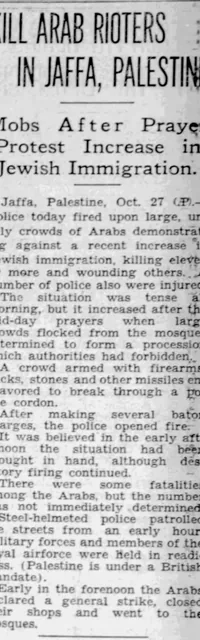
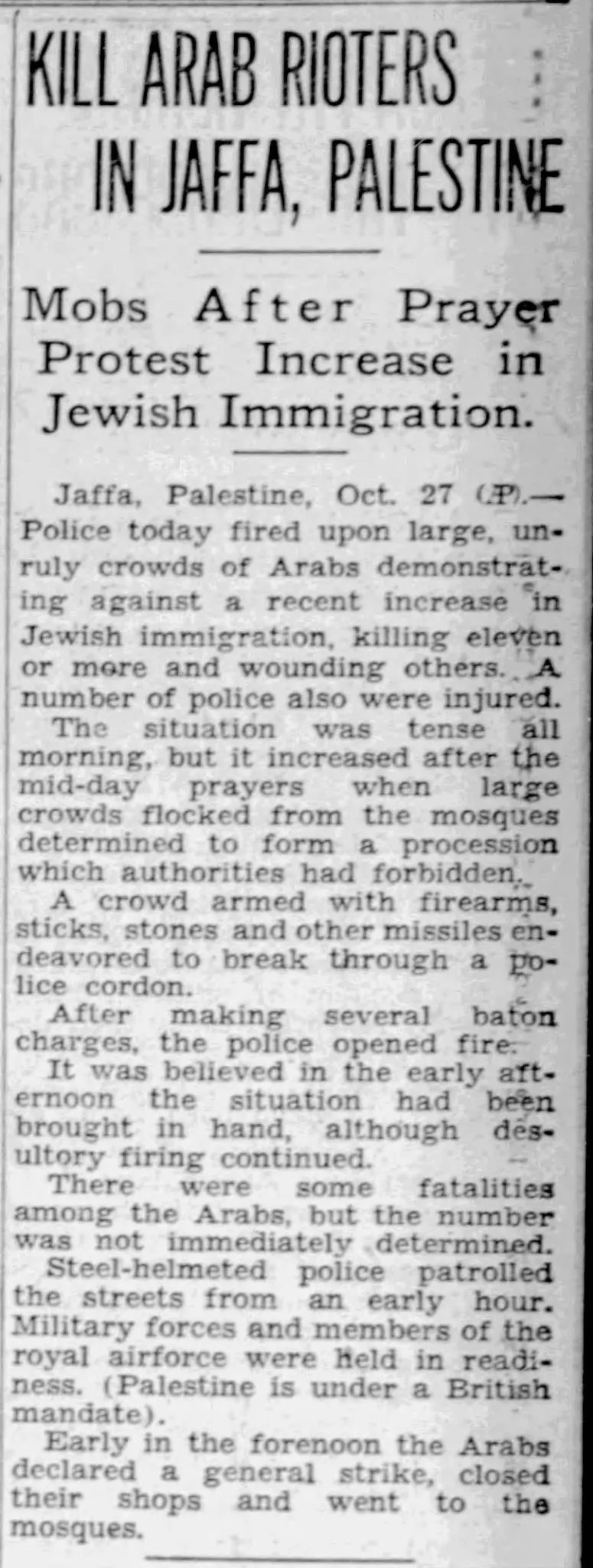
On 27 October 1933 the Associated Press filed one story from Jaffa. Three American papers ran it that day, and the words underneath are identical in all three, down to the punctuation.
Police today fired upon large unruly crowds of Arabs demonstrating against a recent increase in Jewish immigration, killing an undetermined number and wounding others… A crowd armed with firearms, sticks, stones and other missiles endeavored to break through a police cordon. After making several baton charges, the police opened fire.
Associated Press, Jaffa, Palestine, 27 October 1933 — as printed in the three papers of that date
Then each paper wrote its own headline.
Same story. What each headline told the reader.
Four papers. One story. A reader in Roanoke learned that police shot people protesting an immigration policy. A reader in Rockford learned that there had been a mob.
The fourth paper ran the same dispatch the next morning. The Omaha World-Herald of 28 October opens on the same sentence with one word changed: where the first three say the police killed an undetermined number, Omaha says eleven or more. It is the only one of the four that printed a count, and it printed it a day late.
Nobody lied. The full story is there in every one of the four, and a reader who finished it would have known that police fired on people protesting an immigration policy. Most readers do not finish. They read the headline, and four headlines made four different events.
It happens in a caption too
April 1957, Gaza. A news-agency photographer takes a picture of a woman feeding a sick child in a hospital bed. Two papers run it four days apart with the same caption, word for word. One of them puts three words on top.
Indianapolis Star · 7 April
“This Arab mother, a displaced Palestinian, spoons food for her
child in hospital at the Jabalia refugee camp in Gaza…”
CP-1957-003
American Press, Lake Charles · 11 April
“LUNCH ON THE U. N. — This Arab mother, a displaced
Palestinian, spoons food for her child in hospital at the Jabalia refugee camp in
Gaza…”
CP-1957-020
They did print it
None of this means American papers refused to report. They reported. In April 1948 the Evening Star of Washington took three days to go from calling Deir Yassin a village “a Jewish striking force occupied” to printing a Red Cross count of 254 dead and several hundred words from a wounded 12-year-old girl who had lost her mother, her grandmother, her grandfather, two brothers and a baby sister.
Six years later a man wrote to a Louisville paper demanding that a Palestinian
produce the evidence; heresay and generalities are not proof.
It had been
sitting in a Washington daily since 1948. Nobody corrected him.
That is measurable, and we measured it. Searching a commercial newspaper database for the words Deir Yassin in American papers between 9 and 12 April 1948 returns 526 pages. The name was not scarce. It was in hundreds of papers inside seventy-two hours.
What was scarce was putting it at the top. The news agency headline that carried the story — JEWS RECAPTURE KASTEL, which is about a hill and a road — ran in 44 American and Canadian papers on 9 and 10 April. One of the 44 added a second line under the headline naming the village and counting the dead, and that one is in this archive: the Morning News of Wilmington, Delaware, Deir Yassin Also Seized; Women and Children Among 200 Arab Dead. Searching the whole of 1948 for that line returns a single page.
Those two figures count pages in one commercial database, not papers and not everything printed: a paper that ran the story on page one and again on page ten is two pages here, and the database is not the whole American press. The Library of Congress collection, which is free, holds five pages carrying the name in 1948 — that is a fact about the Library’s holdings after the copyright line, not about the newspapers.
The reporting was not the failure. The keeping was.
Somebody said this at the time
In May 1988 a Rochester paper sat six local men down for two hours and printed most of a page of it. Abraham Kharroubi, 44, born in what is now northern Israel:
The main problem is that I as a Palestinian have constantly been seen by the West as a refugee or a terrorist or an Arab — never really addressed as a Palestinian.
He was describing what it felt like from inside the coverage in 1988. What follows here is the paper trail on the other side of it: one story reaching different towns, the facts intact, the headline doing the work. The words were usually there. The headline is what survived.
There are eight more cases here where one story reached readers through two or more papers. Find any of them, read the two headlines, and decide which one you would have kept.