 The complaint that got printedTwo headlines, one dispatch, one printed complaint · 20 to 26 August 2001
20 to 26 August 2001
The complaint that got printed
On a Monday in August 2001 two American papers printed the same New York Times dispatch about the same three dead people. Six days later one of those papers published a reader’s complaint about its own headline. This is the only instance in the archive where a paper shows its work.
The dispatch names five Palestinians and gives four of their ages. Samir Abu Zaid, 32, killed in his house in Rafah with his son Salman, 7, and his daughter Alaa, 3. Muhammad Abu Arrar, 14, shot in Rafah the same day. Muin Abu Lawi, 38, shot near a checkpoint outside Nablus, walking home with school supplies he had bought for his children.
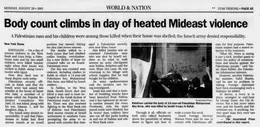
“Body count climbs in day of heated Mideast violence”
Page A5 of the Star Tribune. Five names in the copy and an arithmetic over the top of it. The line beneath the headline reads: A Palestinian man and his children were among those killed when their home was shelled; the Israeli army denied responsibility.
 CP-2001-016
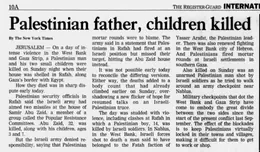
“Palestinian father, children killed”
Page 10A of the Register-Guard, the same Monday, the same dispatch, three words. Nothing in the copy made the difference between these two headlines. The difference was made at the paper.
 CP-2001-017
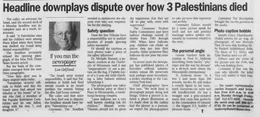
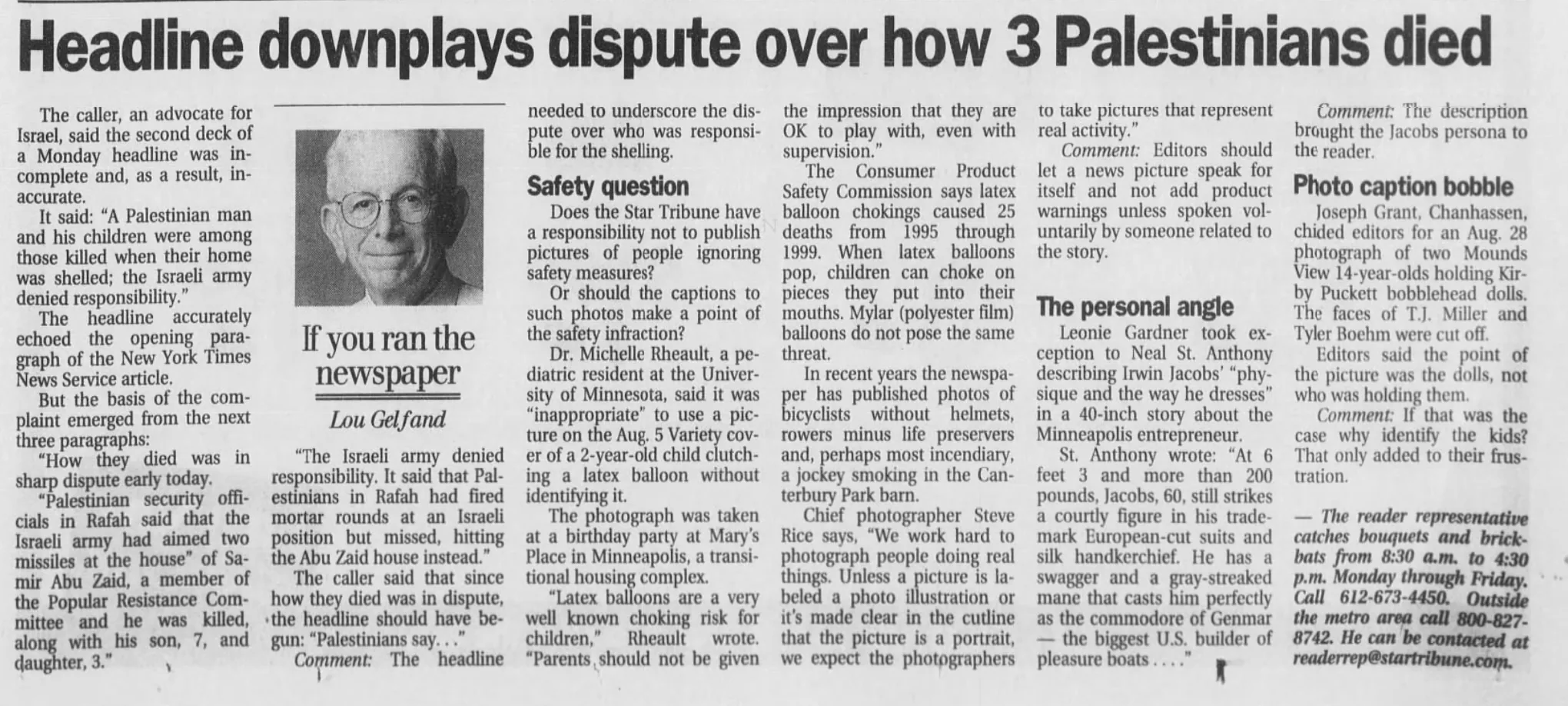
Then the part that almost never survives. On 26 August the Star Tribune’s reader’s representative, Lou Gelfand, devoted the top of his column to that headline, under a standing head that invites the reader to imagine running the paper.
“The caller, an advocate for Israel, said the second deck of a Monday headline was incomplete and, as a result, inaccurate… The caller said that since how they died was in dispute, the headline should have begun: ‘Palestinians say…’”
The column agrees. Its verdict is one sentence: Comment: The headline needed to underscore the dispute over who was responsible for the shelling.
CP-2001-018Read it twice and the shape comes out. The complaint is about the second deck, the one that already carried the army’s denial in its own clause. Nobody in the column raises the headline above it, the one a reader’s eye actually lands on, which turned a man and two small children into a body count. Of the two things that could have been said about that page, the only one that reached print was the one asking for more doubt about the dead.
The item directly below it in the same column concerns a photograph of a two-year-old holding a latex balloon, and whether the paper should print pictures of people ignoring safety measures.
There is no villain here and nothing was hidden. A reader called, an editor considered it fairly and answered in public, which is more than most papers in this archive ever did. That is the point. This is the process working, and what came out of it was a correction in one direction only.
The next time you read a headline over a story with names in it, the question is not whether the headline is accurate. It is which of the true things in the story it decided to be accurate about.