 The day anti-Zionism was first compared to antisemitismThe comparison was made at a convention in 1944 · 1898 to 2015

1898 to 2015
The day anti-Zionism was first compared to antisemitism
People argue now about whether criticizing Zionism is a form of antisemitism. That argument has a paper trail in American newspapers, and it runs for 117 years. This section follows it.
None of this settles the question. It shows where the comparison came from, because somebody made it out loud, at a convention, in front of a reporter, and a Baltimore newspaper printed it on 17 October 1944.
Everyone quoted in the first half of this section is Jewish. That is the point of it. For fifty years this was an argument Jews had with each other, in their own newspapers, in public, by name.
The whole of it, before the evidence:
Each of those is a clipping. Here they are.
1898: the argument starts, and it runs the other way
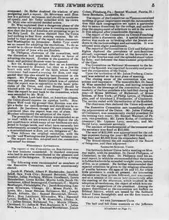
“Union of American Hebrew Congregations debates Zionism”
The governing body of American Reform Judaism spent an afternoon deciding whether to condemn Zionism, and a Jewish newspaper printed the floor debate with every name attached. Dr. Silverman said it “is a political movement and should be condemned openly.” Rabbi Calisch wanted the “silence of contempt.” Rabbi Tyor argued against condemning it at all, because that would throw doubt on the patriotism of the many Jews who were Zionists. And Simon Wolf took the position that reverses everything to come: Zionism “was simply a feeder for anti-Semitism.” In 1898 the worry was that Zionism would cause the hatred.
 CP-1898-002
One delegate, Rev. Dr. Krauskopf, gave the answer nobody has improved on since: as an American he opposed it, and as a Jew his heart was with the people whose treatment had caused the craving for Zion.
For the next forty years it is an ordinary word
Papers print it the way they print any political term. Nobody puts it in quotation marks and nobody treats disagreeing with it as a sign of anything.
- Jewish Opposition to ZionismThe Spokesman-Review, Spokane · 1905 · CP-1905-001
- JEWISH OPPOSITION TO ZIONISMEast Oregonian · 1907 · CP-1907-003
- AMERICANISM VS. ZIONISMThe New York Times · 1918 · CP-1918-005
- Criticizes Zionists’ MethodsThe American Israelite · 1920 · CP-1920-001
- THE ANTI-ZIONIST PROTESTThe American Jewish World · 1922 · CP-1922-003
Two of those five are Jewish newspapers. The New York Times sets the disagreement as a debate and gives the floor to a former attorney general of New York.
1942: the argument changes shape
The change happens in the middle of the Holocaust. That has to be said first, because it explains the pressure everyone in these clippings is under. The case for a refuge had stopped being theoretical, and the people making it had stopped being willing to treat the other side as a reasonable position.
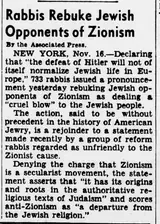
“Rabbis Rebuke Jewish Opponents of Zionism”
733 rabbis sign a statement the paper calls without precedent in the history of American Jewry. Opposing Zionism is a “cruel blow” to the Jewish people, and it is now “a departure from the Jewish religion.” Until that sentence, it had been a policy disagreement. After it, it is a question of whether you are still practicing your faith.
 CP-1942-003
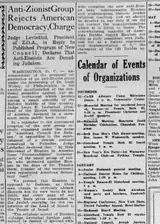
“Anti-Zionist Group Rejects American Democracy, Charge”
A month later, a second charge is added on top of the first. The head of the Zionist Organization of America answers the founding of the American Council for Judaism by calling it “irrational prejudice against our national movement.” The headline supplies the rest. A group of American rabbis who disagreed about Palestine are now rejecting American democracy.
 CP-1942-001
17 October 1944: the comparison, in a headline
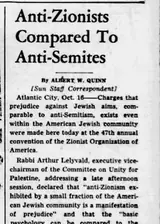
Two years later a reporter for the Baltimore Sun sat in a hotel in Atlantic City and wrote down the sentence this whole argument has been built on ever since.
“Anti-Zionists Compared To Anti-Semites”
Rabbi Arthur Lelyveld, at the 47th annual convention of the Zionist Organization of America, says anti-Zionism is a manifestation of prejudice and that its “basic psychology can be compared to the psychology which underlies anti-Semitism.” Then he builds the comparison in front of the room, piece by piece. “It feeds on untruths.” Where the antisemite imagines a council of the elders of Zion, the anti-Zionist imagines a political nation-in-exile. “Where the anti-Semite generalizes: ‘Jews are aggressive,’ the anti-Zionist generalizes: ‘Zionists are un-American.’” He is not describing something he found. He is making an argument, out loud, and he knows it. The people he is comparing to antisemites are American Jews.
CP-1944-001Read the headline again. Compared. The Sun is covering a speech, and reporting what a man in it said. In 1944 everyone in the room understood the difference.
1957: and now they are foreign
“Study of Arab Propaganda Here Lists Role of Anti-Zionist Jews”
A study of the Arab propaganda campaign in America “gives anti-Zionist Jews more credit for effective anti-Israel pressure than it allocates to Americans of Arab descent.” Fifteen years after the position became un-Jewish and un-American, it is foreign influence. The people described have not moved. The category around them has.
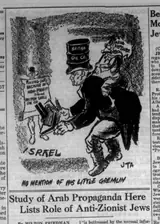 CP-1957-008
From 1968 the argument moves to a different word and a much louder room, and this archive follows it there: Zionism as racism, the 1975 UN vote and the repeal →
2015: the sentence turns all the way around
“Anti-Zionism is racism”
A column on the fortieth anniversary of the UN vote, describing that vote as “one of the worst instances of anti-Semitism since the end of the Second World War.” The headline is four words and it completes the circle. In 1898 a Jewish leader warned that Zionism would feed antisemitism. In 1944 a rabbi said opposing Zionism resembled antisemitism. By 2015 opposing it is the bigotry, with no comparison left in the sentence.
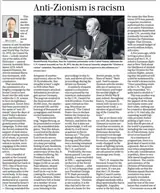 CP-2015-004
The 1944 comparison was made for a reason anybody can understand. Jews were being murdered in Europe at a scale nobody had words for, the argument about a refuge had become an argument about survival, and Lelyveld reached for the hardest thing he could say to people he thought were standing in the way.
What this archive can show is that he was reaching. The comparison was an argument that day, not a finding, and the newspaper printed it as one. What happened afterward is that the argument kept working long after the emergency that produced it, until the room it was made in was gone and the sentence was still standing.
The next time somebody tells you the two things are the same, ask when that comparison was first made, and by whom, and who was standing on the other side of the room when he made it. All three answers are in a newspaper. The people on the other side were rabbis.