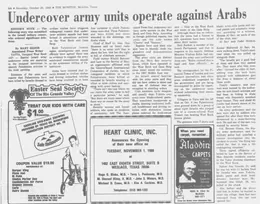
 The censor, printed in the paperThe deletions were ordered, and the paper said so · 1948 to 1988
1948 to 1988
The censor, printed in the paper
Sometimes the American newspaper tells you, in its own type, that what you are about to read has been through somebody else’s hands. Not in a memoir written later. On the page, above the first paragraph, on the morning it ran.
“JERUSALEM, Sept. 7 (Passed by Israeli censor) (AP)”
The Chicago Tribune. Four words inside the dateline, which a reader crosses on the way into the first sentence. No box, no note, no explanation of what was taken out.
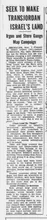 CP-1948-136
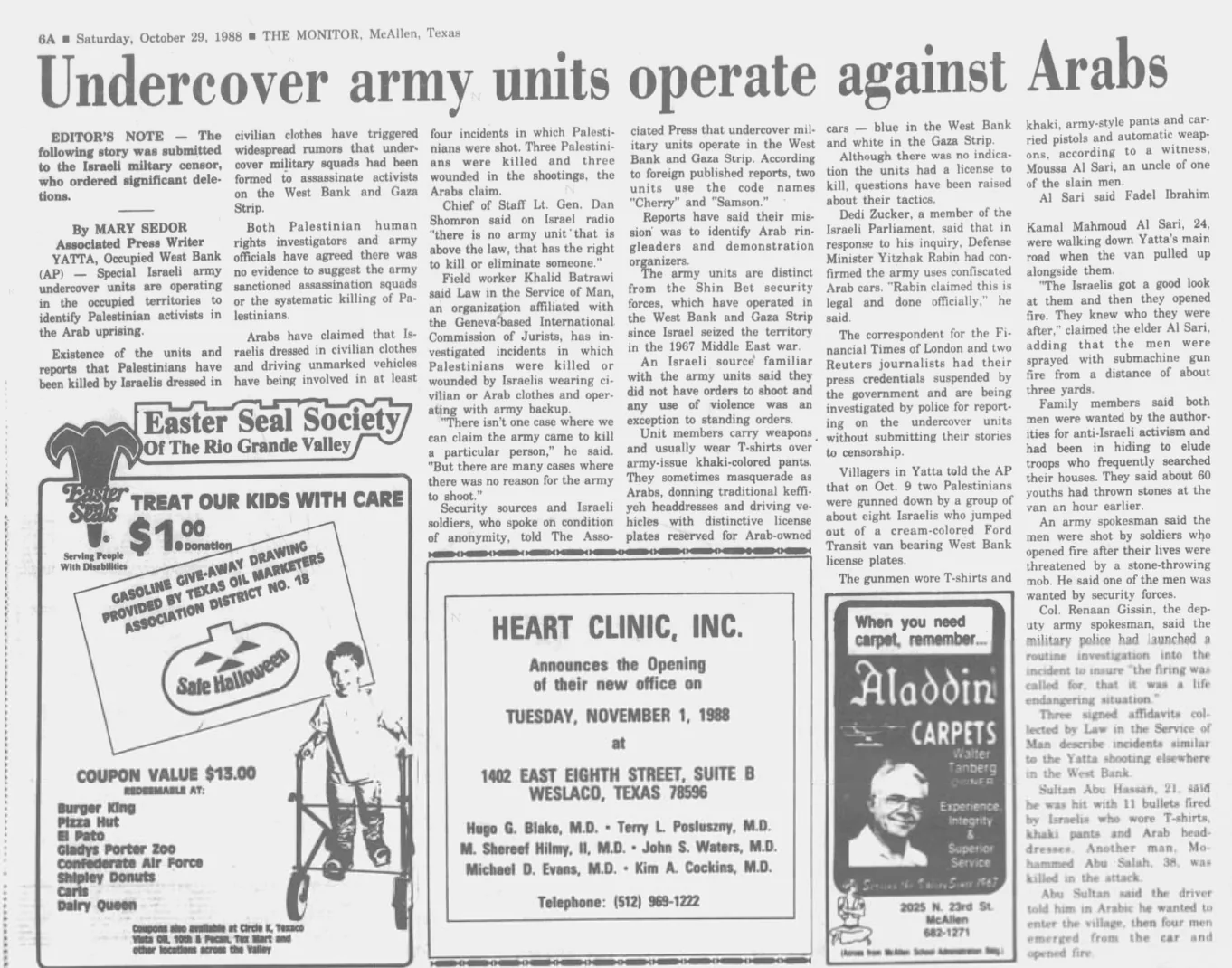
“EDITOR’S NOTE — The following story was submitted to the Israeli military censor, who ordered significant deletions.”
The Monitor, in bold, in its own block, before the byline. The reader is told there are holes and who made them, and is then handed the story anyway.
CP-1988-055May 1948: one survey, and the headlines disagree about who the censor is
On 10 May 1948 the Associated Press filed a survey of who was censoring what across the region. It ran all over the United States. The copy underneath is the same in every paper. The headlines are not, and they do not disagree about emphasis. They disagree about the subject of the sentence.
“Arab Censorship Strictest In Palestine War News”
The Oregonian picks Syria and Lebanon out of the survey and leads on them.
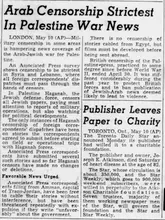 CP-1948-131
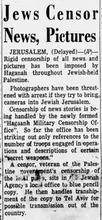
“Jews Censor News, Pictures”
The Daily News picks the other side. Three words, and the censor has a people attached to it.
 CP-1948-132
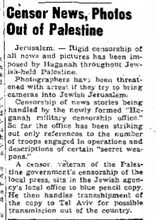
“Censor News, Photos Out of Palestine”
The Blizzard runs the same Jerusalem dispatch the same day with nobody in the sentence at all. Somebody censors. The headline does not say who.
 CP-1948-133
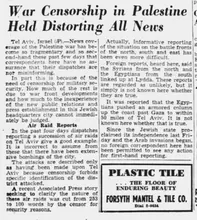
“War Censorship in Palestine Held Distorting All News”
The strongest of the seven, and the word held keeps it at one remove: somebody holds this, not the paper.
 CP-1948-135
What the correspondents themselves said is in the body of the Tel Aviv dispatch, and no headline carries it: that coverage had become so fragmentary and so second-hand that they had no assurance that their dispatches are not misinforming. That is not a critic’s charge. It is reporters saying it about their own copy, and American papers printing it.
October 1988: one censored dispatch, four papers
Forty years later, an Associated Press reporter named Mary Sedor filed from Yatta in the occupied West Bank on Israeli army undercover units. The dispatch went through the censor and came back shorter. It ran on a Saturday in at least four American papers.
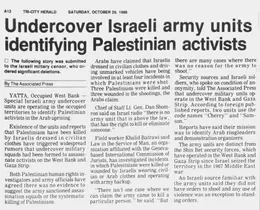
“Undercover Israeli army units identifying Palestinian activists”
The Tri-City Herald sets the disclosure as a flagged line rather than an editor’s note, and its headline says Palestinian activists where McAllen says Arabs.
 CP-1988-056
“Israel undercover army units operate against Arabs in Occupied Territories”
The only one of the four whose headline names the Occupied Territories. It carries the editor’s note.
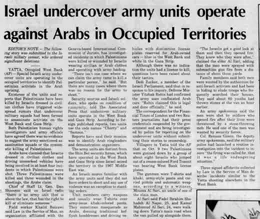 CP-1988-057
“Undercover army units battling uprising”
Eleven days later, a fourth headline, and the editor’s note is gone. A reader in Odessa got the story with the hole in it and no notice that a hole had been made. It runs beside an advertisement for car batteries.
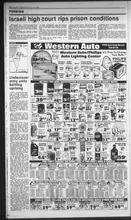 CP-1988-058
The censored story reports the punishment of the journalists who would not be censored. Inside Sedor’s dispatch, seven paragraphs down, is the sentence that closes the circle: the correspondent for the Financial Times and two Reuters journalists had lost their press credentials and were being investigated by police for reporting on these same units without submitting their stories to censorship.
What the government said it was doing
Israel’s Government Press Office explained the suspensions, and an American paper printed the explanation whole. It is worth reading twice, because it does not argue that the reporting was wrong.
“There is no connection between the accuracy or inaccuracy of the information published and the obligation to submit news stories to the censor. In spite of Israel’s security situation, Israeli authorities respect freedom of the press and act very liberally with overseas correspondents.”
The Government Press Office, in a statement, in the same story that reports three correspondents losing their credentials.
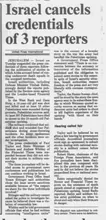 CP-1988-059
“We waited for them to call us and they didn’t so we assumed all was OK. I assumed what I had was right.”
Martin Fletcher of NBC News, after losing his press card with Glenn Frankel of the Washington Post. The story explains that censors usually telephone correspondents when they want to block certain stories. The two were punished for what they did not do: wait for the telephone to ring.
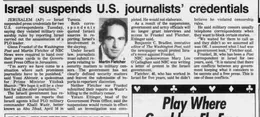 CP-1988-060
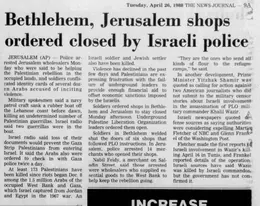
“Bethlehem, Jerusalem shops ordered closed by Israeli police”
The same morning, the same news agency, and here the credential suspensions are the last paragraph of a story about shopkeepers and flour. The phrase that introduces them is in another development.
 CP-1988-061
And what a reporter could see for himself
Censorship is one control. Access is another, and the archive holds a clean instance of a reporter simply counting.
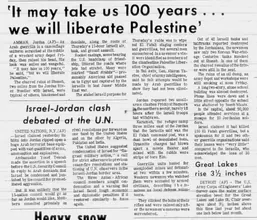
“Out of 42 Israeli tanks and halftracks reported destroyed by the Jordanians, the newsmen saw only two… Israel claimed it had killed 150 El Fatah guerrillas, but a spokesman for it and two other guerrilla organizations said their losses were ‘very little’ compared to the Israelis, who acknowledged the loss of 30 men.”
The Niles Daily Star, Michigan. Two claims, and a correspondent who went and looked. The same column records what happened to the cameras: armed men clicked the bolts of their rifles and were calmed only after the newsmen’s cameras were surrendered. The headline over all of it is a Palestinian’s sentence.
 CP-1968-006
March 1988: the territories are closed, and so is the news agency
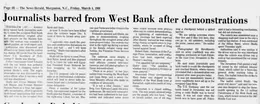
In the spring of 1988 the control stopped being a blue pencil and became a roadblock. On 4 March soldiers turned journalists back at the edge of the West Bank, and a North Carolina paper printed the reason officials gave and the denial they gave beside it, in consecutive paragraphs.
“There is no policy” to bar journalists from covering the West Bank and Gaza Strip, said a senior Defense Ministry official who spoke on condition of anonymity.
The next paragraph is the army spokesman saying “it is not a total closure.” Four paragraphs later a soldier at a spiked barrier outside Ramallah says it without the grammar of denial: All outsiders, including the press, cannot enter. The stated reason for keeping the cameras out is in the same column — Israeli officials contend television cameras and still photographers inflame demonstrations. The correspondent turned back that day is Mary Sedor, the reporter whose dispatch seven months later would run under an editor’s note about ordered deletions.
 CP-1988-066
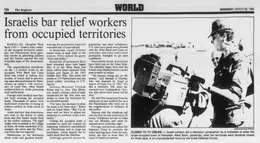
“Closing the occupied lands is intended to quell the violence by imposing collective punishment on Palestinians and to keep out journalists, whose reports the Israelis claim feed the rebellion.”
The Register, page 12A, under a banner reading WORLD. Not an accusation by a critic — a news agency sentence explaining a policy, printed in an American paper on a Wednesday. The photograph next to it shows soldiers turning a cameraman away from Ramallah, and the words above the caption are CLOSED TO TV CREWS. That same day foreign journalists asked Israel’s Supreme Court to overturn the ban, the first in more than twenty years of occupation.
 CP-1988-062
The next morning eight police officers walked into the Palestine Press Service in east Jerusalem and shut it for six months under emergency regulations written in 1948. It was the only Arab news agency in the territories, and with the West Bank and Gaza closed to reporters it had become, in the Associated Press’s own words, a critical source for journalists. Its last filing was a report of a woman shot dead in her kitchen in Deir Abu Mashal, made moments before it was closed.
One dispatch, John Rice’s, carried both facts. Three American papers printed it the same day and could not agree which one was the headline.
“Arab Press Agency Closed”
The killing is demoted to the line above, in small caps: PALESTINIAN WOMAN SLAIN. The agency is the news; the woman is the label on it.
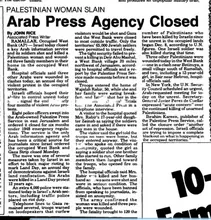 CP-1988-063
“Israeli troops kill Arab woman, close Palestine press service”
Both, in that order, in one sentence with one subject doing both verbs. This printing also keeps two paragraphs the others cut, including the publisher’s answer to being shut down.
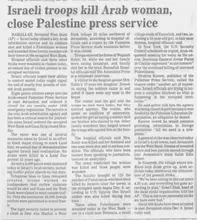 CP-1988-064
“Israeli soldiers kill Arab woman; key Palestinian press service closed”
The only one of the three on a front page, and the only one that writes Palestinian rather than Arab for the agency. The semicolon does what the Kerrville slug does, but without ranking them.
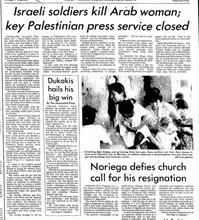 CP-1988-065
Ibrahim Kareen, who published the agency, said the police told him it was being closed partly because the Palestine Liberation Organization funded it, which he denied. Then he said what he intended to do about it, and one paper in Louisiana kept the line: “All we need is a telephone.”
Two paragraphs further down the same dispatch is the sentence that shows how far the closure reached. The hospital staff who described the shooting would not give their names, and the reason is printed: the officials, who have been banned from speaking to journalists, insisted on anonymity. Not the reporters, the doctors.
Before and after: an exhibit, and a reporter
Four years before the Palestine Press Service was shut, it was the source that gave an American paper the other description of a room.
“The east Jerusalem-based Palestine Press Service said 10 people were arrested late yesterday at An-Najah University in Nablus. It said the Israelis stormed into an exhibit of Palestinian folklore.”
The next paragraph is the occupation authorities’ account of the same room: a hostile exhibit, including nationalistic and provocative displays. Among the weapons the spokesman lists as confiscated are a plastic M-16 and a wooden model of a Kalashnikov. A man who answered the university’s telephone said everything was closed.
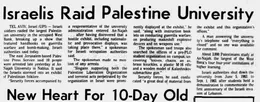 CP-1984-005
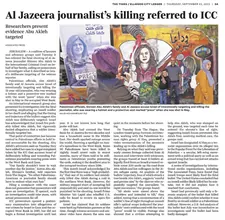
“Our family shouldn’t have to wait another day for justice. No other Palestinian-American or journalist family should have to endure what ours has.”
Anton Abu Akleh, speaking about his sister Shireen, who was wearing a helmet and a vest marked press when she was shot in the occupied West Bank in May 2022. The complaint her family joined accuses Israel of deliberately killing and wounding Palestinian journalists wearing press vests. Seventy-four years separate this from the Chicago dateline at the top of this section, and what is being controlled has moved from the copy to the correspondent.
 CP-2022-052
None of this is a claim that American newspapers were lied to, and this archive cannot show what was cut. The deletions are not on the page; that is what a deletion is. What is on the page is the mechanism, printed: a dateline saying the story was passed, an editor’s note saying deletions were ordered, a press office saying accuracy is not the point, and a reporter counting tanks because counting was the only thing nobody could take off him.
The next time you read a sentence that begins officials said, the useful question is not whether it is true. It is what the reporter was in a position to check.