The Register · 30 March 1988
CP-1988-062
Israelis bar relief workers from occupied territories
Associated Press
Transcribed from the clipping
RAMALLAH, Occupied West Bank (AP) — Israel’s army isolated the occupied territories yesterday, but Palestinians threw gasoline bombs at patrolling soldiers and the Israelis opened fire and wounded eight of the demonstrators.
The unprecedented crackdown on the 1.5 million Arabs in the occupied West Bank and Gaza Strip was aimed at halting four months of unrest and at preventing mass demonstrations by Palestinians on today’s 12th anniversary of Land Day, when Israeli soldiers killed six Arabs protesting land confiscation. Foreign relief workers were barred from entering the occupied lands.
Thousands of police were mobilized yesterday evening to enforce curfews in Arab towns in Israel. Arabs reported that demonstrators took to the streets in some areas and that Israeli troops fired at the curfew violators. The eight Arabs were wounded in the village of Zaita, 40 miles northwest of Jerusalem, the army and the Palestine Press Service reported.
Palestinians in the territories threw rocks and gasoline bombs. Among the protesters reported wounded was 13-year-old girl. In Ramallah, small children tossed rocks at each other in the streets. They called the game “Jews and Arabs.” Hundreds of protesters have been wounded since riots began Dec.
8 in the West Bank and Gaza, which Israel captured from Jordan and Egypt in the 1967 Middle East War. The death toll stands at 119 Palestinians and one Israeli soldier, according to U.N. figures. Defense Minister Yitzhak Rabin and Lt. Gen.
Dan Shomron, Israel’s military chief of staff, threatened for the first time yesterday to close the territories for an extended period. “For now, the decision to close the areas is for three days,” Rabin said on Israel radio. “But I’ve always said we have to adjust our measures to confront every eventuality.”
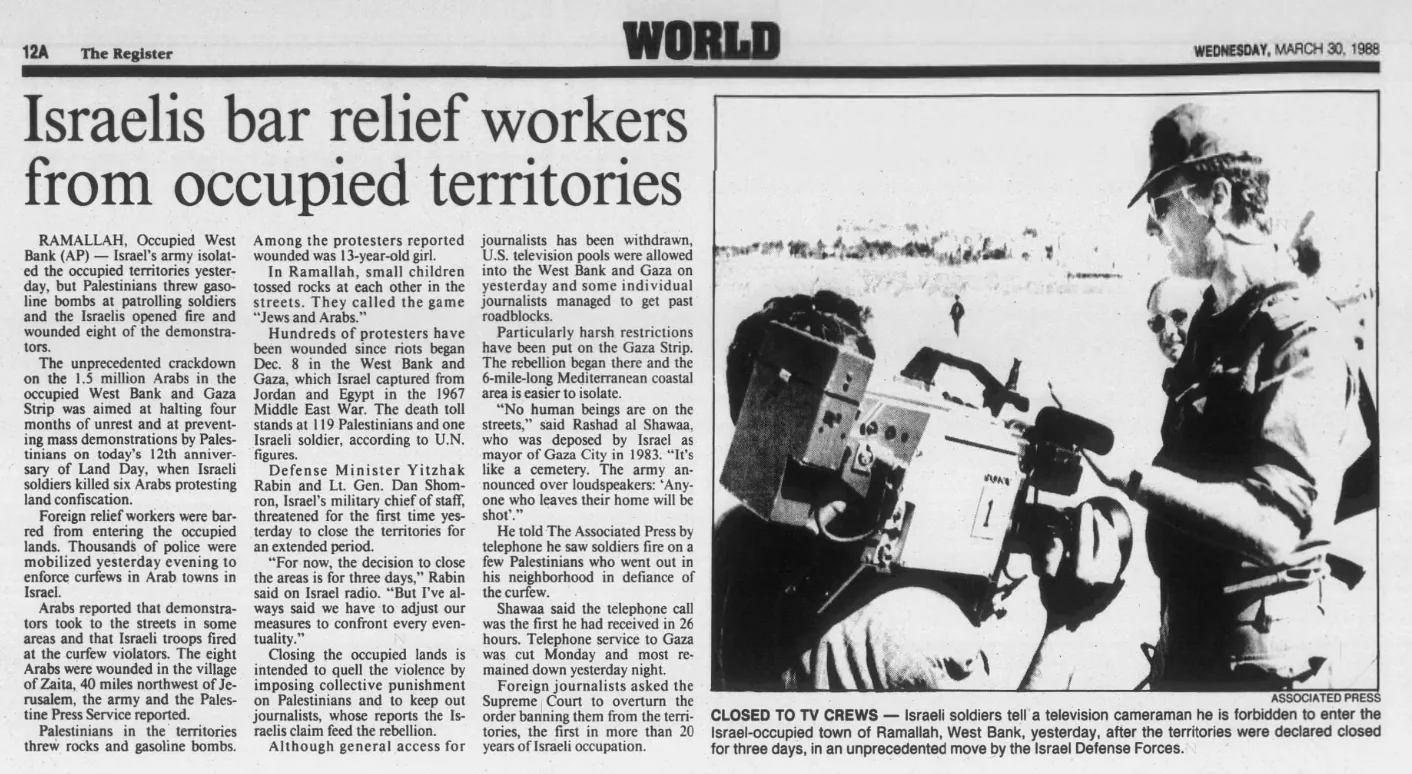
Closing the occupied lands is intended to quell the violence by imposing collective punishment on Palestinians and to keep out journalists, whose reports the Israelis claim feed the rebellion.
Although general access for journalists has been withdrawn, U.S. television pools were allowed into the West Bank and Gaza on yesterday and some individual journalists managed to get past roadblocks. Particularly harsh restrictions have been put on the Gaza Strip. The rebellion began there and the 6-mile-long Mediterranean coastal area is easier to isolate.
“No human beings are on the streets,” said Rashad al Shawaa, who was deposed by Israel as mayor of Gaza City in 1983. “It’s like a cemetery. The army announced over loudspeakers: ‘Anyone who leaves their home will be shot’.”
He told The Associated Press by telephone he saw soldiers fire on a few Palestinians who went out in his neighborhood in defiance of the curfew. Shawaa said the telephone call was the first he had received in 26 hours. Telephone service to Gaza was cut Monday and most remained down yesterday night.
Foreign journalists asked the Supreme Court to overturn the order banning them from the territories, the first in more than 20 years of Israeli occupation.
Context added by this archive
The sentence that explains the policy is in the eleventh paragraph and is not hedged: closing the occupied lands is intended to quell the violence by imposing collective punishment on Palestinians and to keep out journalists, whose reports the Israelis claim feed the rebellion. The photograph beside it shows a soldier telling a cameraman he may not enter Ramallah.
The words above that picture are CLOSED TO TV CREWS. On the same day, foreign journalists went to Israel’s Supreme Court to have the ban overturned, the first such order in more than twenty years of occupation.
Cite this item
"Israelis bar relief workers from occupied territories," The Register, 30 March 1988. Covering Palestine archive, CP-1988-062. https://coveringpalestine.org/archive/cp-1988-062
More from the 1980s
- Gaza Strip: the forgotten stepchildNorthwest Herald · 4 January 1988
- 'Iron Fist' Enslaves Gazans In Their LandThe Herald Sun · 6 January 1988
- Israel condemns U.N. vote on deportationsThe Birmingham News · 6 January 1988
- Israeli soldiers fire on protestersCarroll County Times · 6 January 1988
- Undaunted Palestinians resume violenceThe News & Observer · 6 January 1988
- Palestinian Killed; 250,000 Under CurfewDaily News · 15 January 1988
- All 164 clippings from the 1980s →
This record is part of Covering Palestine, an archive of American and Anglophone newspaper clippings about Palestinians, 1799 to 2023. Researched and assembled by Maria Robles.
The clipping belongs to the newspaper that printed it, or to the news agency that supplied the copy. It is reproduced here for research, criticism and commentary. The city is derived from the masthead, not read off the clipping.
Something wrong here, or something you know about this clipping? The archive is still being built and corrections are wanted: maria@rozumstudio.com, quoting CP-1988-062.
See it in the archive reel · Full text of every clipping · Dataset