The Monitor · McAllen, Texas · 29 October 1988
CP-1988-055
Undercover army units operate against Arabs
By Mary Sedor, Associated Press
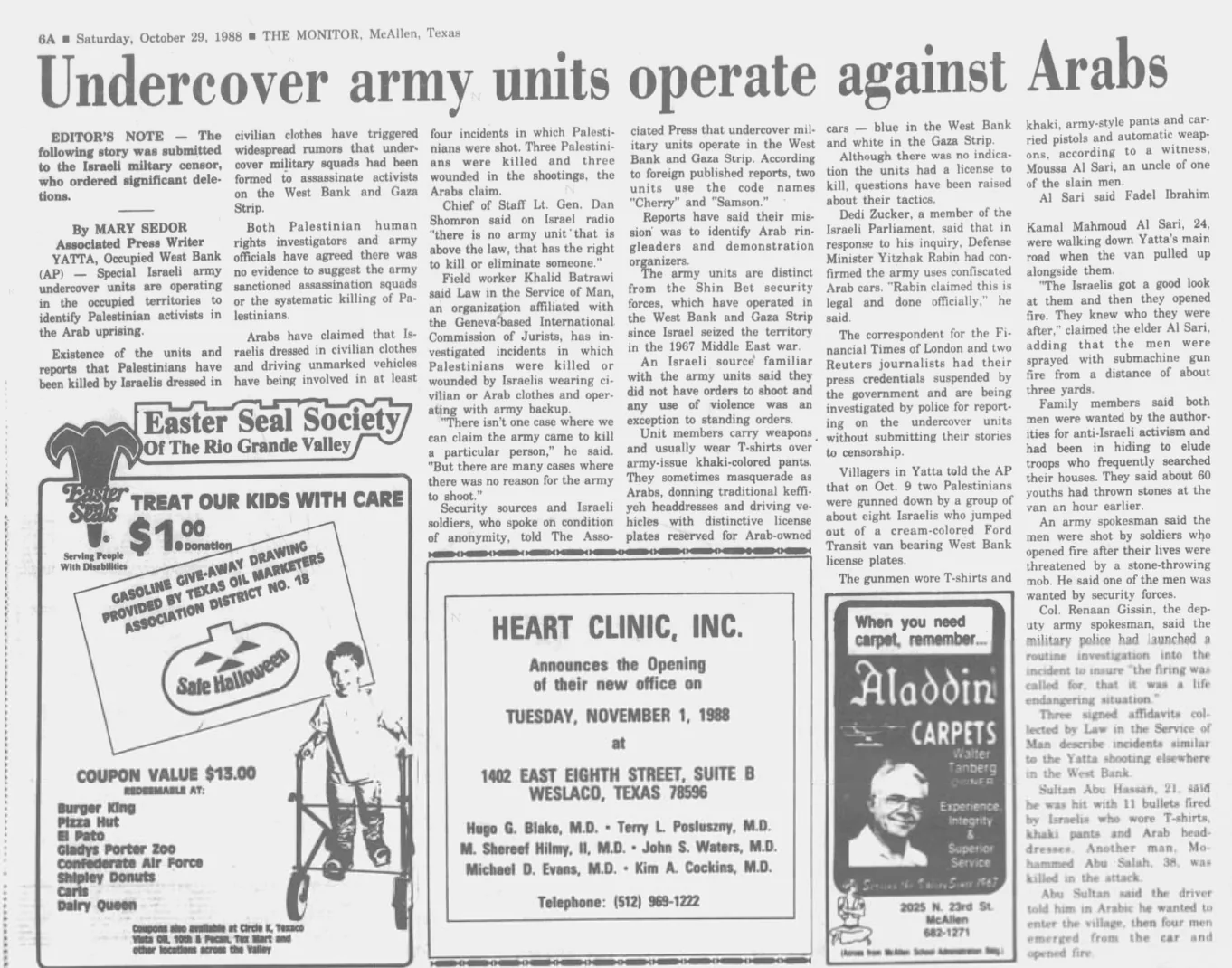
Transcribed from the clipping
“EDITOR’S NOTE — The following story was submitted to the Israeli military censor, who ordered significant deletions. By MARY SEDOR, Associated Press Writer. YATTA, Occupied West Bank (AP) — Special Israeli army undercover units are operating in the occupied territories to identify Palestinian activists in the Arab uprising.
Existence of the units and reports that Palestinians have been killed by Israelis dressed in civilian clothes have triggered widespread rumors that undercover military squads had been formed to assassinate activists on the West Bank and Gaza Strip.
Both Palestinian human rights investigators and army officials have agreed there was no evidence to suggest the army sanctioned assassination squads or the systematic killing of Palestinians. Arabs have claimed that Israelis dressed in civilian clothes and driving unmarked vehicles have being involved in at least four incidents in which Palestinians were shot.
Three Palestinians were killed and three wounded in the shootings, the Arabs claim. Chief of Staff Lt. Gen. Dan Shomron said on Israel radio ‘there is no army unit that is above the law, that has the right to kill or eliminate someone.’
Field worker Khalid Batrawi said Law in the Service of Man, an organization affiliated with the Geneva-based International Commission of Jurists, has investigated incidents in which Palestinians were killed or wounded by Israelis wearing civilian or Arab clothes and operating with army backup.
‘There isn’t one case where we can claim the army came to kill a particular person,’ he said. ‘But there are many cases where there was no reason for the army to shoot.’ Security sources and Israeli soldiers, who spoke on condition of anonymity, told The Associated Press that undercover military units operate in the West Bank and Gaza Strip.
According to foreign published reports, two units use the code names ‘Cherry’ and ‘Samson.’ Reports have said their mission was to identify Arab ringleaders and demonstration organizers.
The army units are distinct from the Shin Bet security forces, which have operated in the West Bank and Gaza Strip since Israel seized the territory in the 1967 Middle East war. An Israeli source familiar with the army units said they did not have orders to shoot and any use of violence was an exception to standing orders.
Unit members carry weapons and usually wear T-shirts over army-issue khaki-colored pants. They sometimes masquerade as Arabs, donning traditional keffiyeh headdresses and driving vehicles with distinctive license plates reserved for Arab-owned cars — blue in the West Bank and white in the Gaza Strip.
Although there was no indication the units had a license to kill, questions have been raised about their tactics. Dedi Zucker, a member of the Israeli Parliament, said that in response to his inquiry, Defense Minister Yitzhak Rabin had confirmed the army uses confiscated Arab cars. ‘Rabin claimed this is legal and done officially,’ he said.
The correspondent for the Financial Times of London and two Reuters journalists had their press credentials suspended by the government and are being investigated by police for reporting on the undercover units without submitting their stories to censorship. Villagers in Yatta told the AP that on Oct.
9 two Palestinians were gunned down by a group of about eight Israelis who jumped out of a cream-colored Ford Transit van bearing West Bank license plates. The gunmen wore T-shirts and khaki, army-style pants and carried pistols and automatic weapons, according to a witness, Moussa Al Sari, an uncle of one of the slain men.
Al Sari said Fadel Ibrahim Kamal Mahmoud Al Sari, 24, were walking down Yatta’s main road when the van pulled up alongside them. ‘The Israelis got a good look at them and then they opened fire. They knew who they were after,’ claimed the elder Al Sari, adding that the men were sprayed with submachine gun fire from a distance of about three yards.
Family members said both men were wanted by the authorities for anti-Israeli activism and had been in hiding to elude troops who frequently searched their houses. They said about 60 youths had thrown stones at the van an hour earlier. An army spokesman said the men were shot by soldiers who opened fire after their lives were threatened by a stone-throwing mob.
He said one of the men was wanted by security forces. Col. Renaan Gissin, the deputy army spokesman, said the military police had launched a routine investigation into the incident to insure ‘the firing was called for, that it was a life endangering situation.’
Three signed affidavits collected by Law in the Service of Man describe incidents similar to the Yatta shooting elsewhere in the West Bank. Sultan Abu Hassan, 21, said he was hit with 11 bullets fired by Israelis who wore T-shirts, khaki pants and Arab headdresses. Another man, Mohammed Abu Salah, 38, was killed in the attack.
Abu Sultan said the driver told him in Arabic he wanted to enter the village, then four men emerged from the car and opened fire.”
Context added by this archive
The censorship is printed inside the newspaper.
Before the first paragraph, in its own bold block, the paper tells the reader: the following story was submitted to the Israeli military censor, who ordered significant deletions. What follows is a story about undercover Israeli army units, and buried in the middle of it is the sentence that closes the circle — a Financial Times correspondent and two Reuters journalists had lost their press credentials for reporting on those same units without submitting their stories to censorship.
The dispatch that went through the censor reports the punishment of the journalists who did not. Note also who claims and who says. Palestinians claim throughout, including a man describing his nephew’s killing. The army said. Both are in the same column.
Cite this item
"Undercover army units operate against Arabs," The Monitor, 29 October 1988. Covering Palestine archive, CP-1988-055. https://coveringpalestine.org/archive/cp-1988-055
More from The Monitor
- Would Palestine recognition help peace talks?The Monitor · 26 December 2010
- WHAT’S IN A NAME?The Monitor · 8 January 2013
More from the 1980s
- Gaza Strip: the forgotten stepchildNorthwest Herald · 4 January 1988
- 'Iron Fist' Enslaves Gazans In Their LandThe Herald Sun · 6 January 1988
- Israel condemns U.N. vote on deportationsThe Birmingham News · 6 January 1988
- Israeli soldiers fire on protestersCarroll County Times · 6 January 1988
- Undaunted Palestinians resume violenceThe News & Observer · 6 January 1988
- Palestinian Killed; 250,000 Under CurfewDaily News · 15 January 1988
- All 159 clippings from the 1980s →
This record is part of Covering Palestine, an archive of American and Anglophone newspaper clippings about Palestinians, 1799 to 2023. Researched and assembled by Maria Robles.
The clipping belongs to the newspaper that printed it, or to the news agency that supplied the copy. It is reproduced here for research, criticism and commentary. The city is derived from the masthead, not read off the clipping.
Something wrong here, or something you know about this clipping? The archive is still being built and corrections are wanted: maria@rozumstudio.com, quoting CP-1988-055.
See it in the archive reel · Full text of every clipping · Dataset