The News Herald · Morganton, North Carolina · 4 March 1988
CP-1988-066
Journalists barred from West Bank after demonstrations
Associated Press
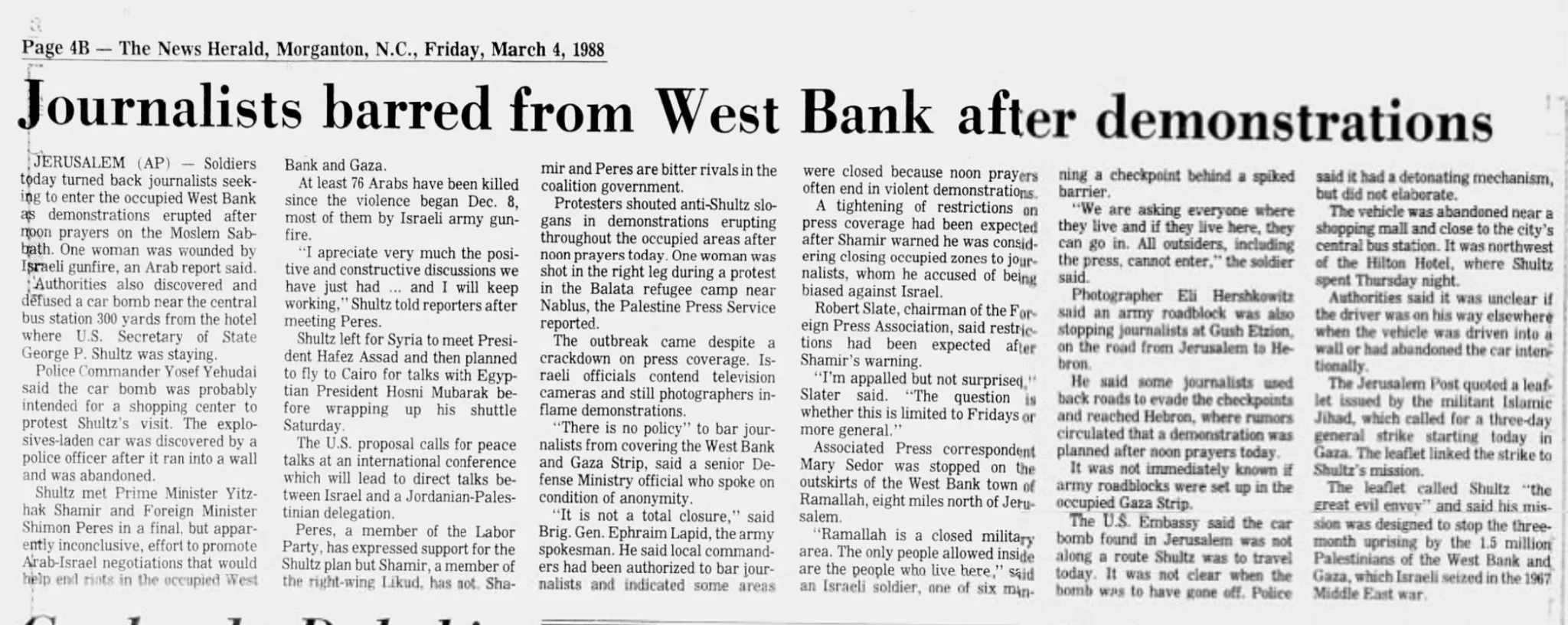
Transcribed from the clipping
JERUSALEM (AP) — Soldiers today turned back journalists seeking to enter the occupied West Bank as demonstrations erupted after noon prayers on the Moslem Sabbath. One woman was wounded by Israeli gunfire, an Arab report said. Authorities also discovered and defused a car bomb near the central bus station 300 yards from the hotel where U.S. Secretary of State George P.
Shultz was staying. Police Commander Yosef Yehudai said the car bomb was probably intended for a shopping center to protest Shultz’s visit. The explosives-laden car was discovered by a police officer after it ran into a wall and was abandoned.
Shultz met Prime Minister Yitzhak Shamir and Foreign Minister Shimon Peres in a final, but apparently inconclusive, effort to promote Arab-Israel negotiations that would help end riots in the occupied West Bank and Gaza. At least 76 Arabs have been killed since the violence began Dec. 8, most of them by Israeli army gunfire.
“I apreciate very much the positive and constructive discussions we have just had ... and I will keep working,” Shultz told reporters after meeting Peres. Shultz left for Syria to meet President Hafez Assad and then planned to fly to Cairo for talks with Egyptian President Hosni Mubarak before wrapping up his shuttle Saturday.
The U.S. proposal calls for peace talks at an international conference which will lead to direct talks between Israel and a Jordanian-Palestinian delegation. Peres, a member of the Labor Party, has expressed support for the Shultz plan but Shamir, a member of the right-wing Likud, has not. Shamir and Peres are bitter rivals in the coalition government.
Protesters shouted anti-Shultz slogans in demonstrations erupting throughout the occupied areas after noon prayers today. One woman was shot in the right leg during a protest in the Balata refugee camp near Nablus, the Palestine Press Service reported. The outbreak came despite a crackdown on press coverage.
Israeli officials contend television cameras and still photographers inflame demonstrations. “There is no policy” to bar journalists from covering the West Bank and Gaza Strip, said a senior Defense Ministry official who spoke on condition of anonymity. “It is not a total closure,” said Brig. Gen. Ephraim Lapid, the army spokesman.
He said local commanders had been authorized to bar journalists and indicated some areas were closed because noon prayers often end in violent demonstrations. A tightening of restrictions on press coverage had been expected after Shamir warned he was considering closing occupied zones to journalists, whom he accused of being biased against Israel.
Robert Slate, chairman of the Foreign Press Association, said restrictions had been expected after Shamir’s warning. “I’m appalled but not surprised,” Slater said. “The question is whether this is limited to Fridays or more general.”
Associated Press correspondent Mary Sedor was stopped on the outskirts of the West Bank town of Ramallah, eight miles north of Jerusalem. “Ramallah is a closed military area. The only people allowed inside are the people who live here,” said an Israeli soldier, one of six manning a checkpoint behind a spiked barrier.
“We are asking everyone where they live and if they live here, they can go in. All outsiders, including the press, cannot enter,” the soldier said. Photographer Eli Hershkowitz said an army roadblock was also stopping journalists at Gush Etzion, on the road from Jerusalem to Hebron.
He said some journalists used back roads to evade the checkpoints and reached Hebron, where rumors circulated that a demonstration was planned after noon prayers today. It was not immediately known if army roadblocks were set up in the occupied Gaza Strip. The U.S. Embassy said the car bomb found in Jerusalem was not along a route Shultz was to travel today.
It was not clear when the bomb was to have gone off. Police said it had a detonating mechanism, but did not elaborate. The vehicle was abandoned near a shopping mall and close to the city’s central bus station. It was northwest of the Hilton Hotel, where Shultz spent Thursday night.
Authorities said it was unclear if the driver was on his way elsewhere when the vehicle was driven into a wall or had abandoned the car intentionally. The Jerusalem Post quoted a leaflet issued by the militant Islamic Jihad, which called for a three-day general strike starting today in Gaza. The leaflet linked the strike to Shultz’s mission.
The leaflet called Shultz “the great evil envoy” and said his mission was designed to stop the three-month uprising by the 1.5 million Palestinians of the West Bank and Gaza, which Israeli seized in the 1967 Middle East war.
Context added by this archive
Three weeks before the territories were closed outright, a wire report on the reason given for keeping cameras out: Israeli officials contend television cameras and still photographers inflame demonstrations. The denial and the confirmation sit in consecutive paragraphs — an unnamed Defense Ministry official says “there is no policy” to bar journalists, the army spokesman says “it is not a total closure,” and then a soldier at a checkpoint says plainly that all outsiders including the press cannot enter.
The correspondent turned back at Ramallah is Mary Sedor, whose dispatch seven months later carried an editor’s note saying the censor had ordered deletions.
Cite this item
"Journalists barred from West Bank after demonstrations," The News Herald, 4 March 1988. Covering Palestine archive, CP-1988-066. https://coveringpalestine.org/archive/cp-1988-066
More from the 1980s
- Gaza Strip: the forgotten stepchildNorthwest Herald · 4 January 1988
- 'Iron Fist' Enslaves Gazans In Their LandThe Herald Sun · 6 January 1988
- Israel condemns U.N. vote on deportationsThe Birmingham News · 6 January 1988
- Israeli soldiers fire on protestersCarroll County Times · 6 January 1988
- Undaunted Palestinians resume violenceThe News & Observer · 6 January 1988
- Palestinian Killed; 250,000 Under CurfewDaily News · 15 January 1988
- All 164 clippings from the 1980s →
This record is part of Covering Palestine, an archive of American and Anglophone newspaper clippings about Palestinians, 1799 to 2023. Researched and assembled by Maria Robles.
The clipping belongs to the newspaper that printed it, or to the news agency that supplied the copy. It is reproduced here for research, criticism and commentary. The city is derived from the masthead, not read off the clipping.
Something wrong here, or something you know about this clipping? The archive is still being built and corrections are wanted: maria@rozumstudio.com, quoting CP-1988-066.
See it in the archive reel · Full text of every clipping · Dataset