 One town, four namesOne town, four names, and the word that left the dateline · 1917 to 1997
1917 to 1997
One town, four names
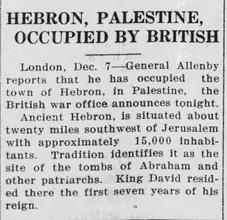
On 8 December 1917 a paper in Miles City, Montana set three words in capitals across the top of a wire brief: HEBRON, PALESTINE, OCCUPIED BY BRITISH. Nobody was making a point. That was the name of the town.
It had been the name for a long time by then. The oldest clipping in this archive is a Vermont weekly from 8 August 1799, reporting Napoleon in Syria under the standing head Foreign Intelligence. The word Palestine appears in it three times and does nothing but name the place: the French advanced on Acre “in order to make themselves masters of the whole of Palestine,” ships were “to be conveyed to Palestine,” the army came “into Palestine.” Gaza, Jaffa, Acre, Nablouse and Jerusalem are all in the same two columns. It is a dispatch about a French general, printed in Vergennes, Vermont, for readers who would never go there.
Eighty years later the same town appears in the New York Daily News under a dateline that reads HEBRON, West Bank. In between, an American reader could have found it called two other things. Here are all four, in the type they were set in.
“Hebron, Palestine”
In the headline, in capitals.
Miles City Star · CP-1917-005
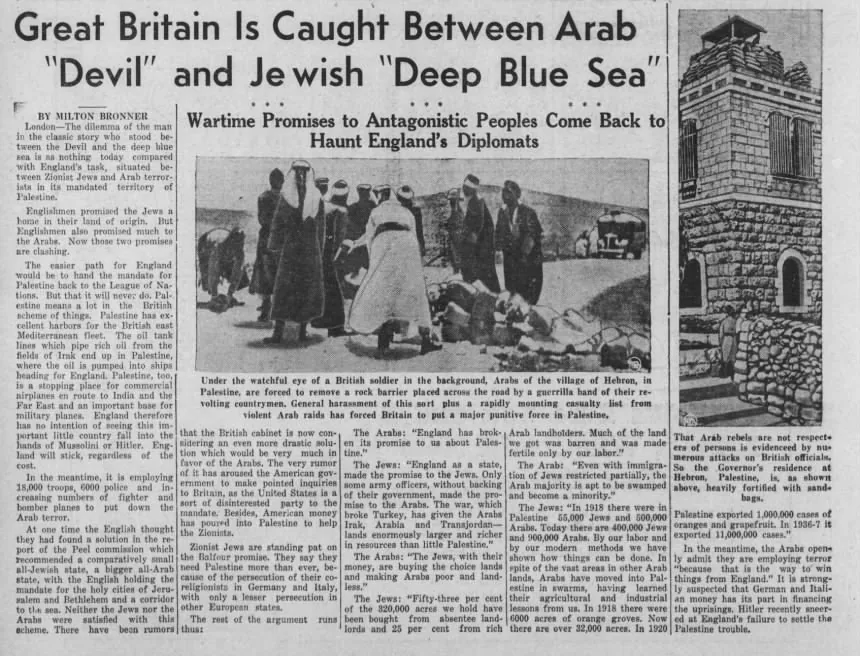
“the village of Hebron, in Palestine”
In a photograph caption.
The Daily Tribune · CP-1938-008
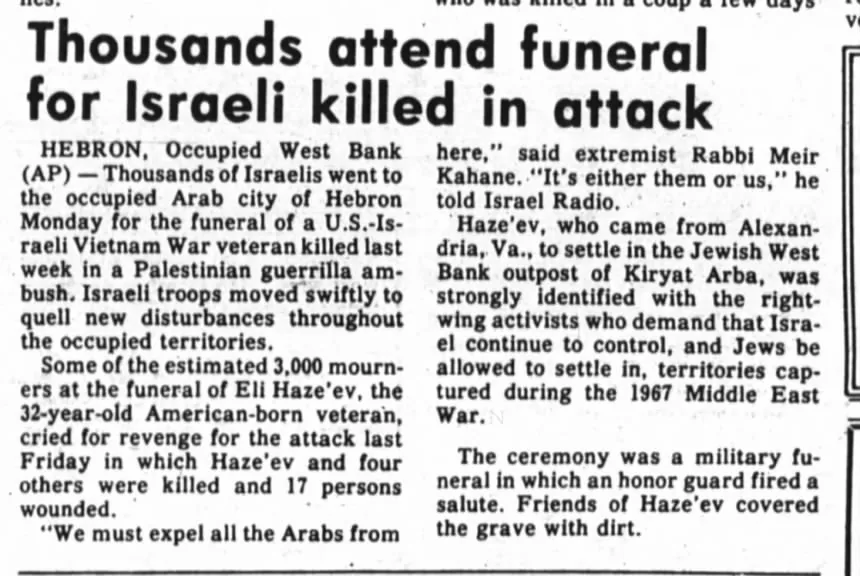
“HEBRON, Occupied West Bank”
In the dateline, Associated Press.
Poughkeepsie Journal · CP-1980-010
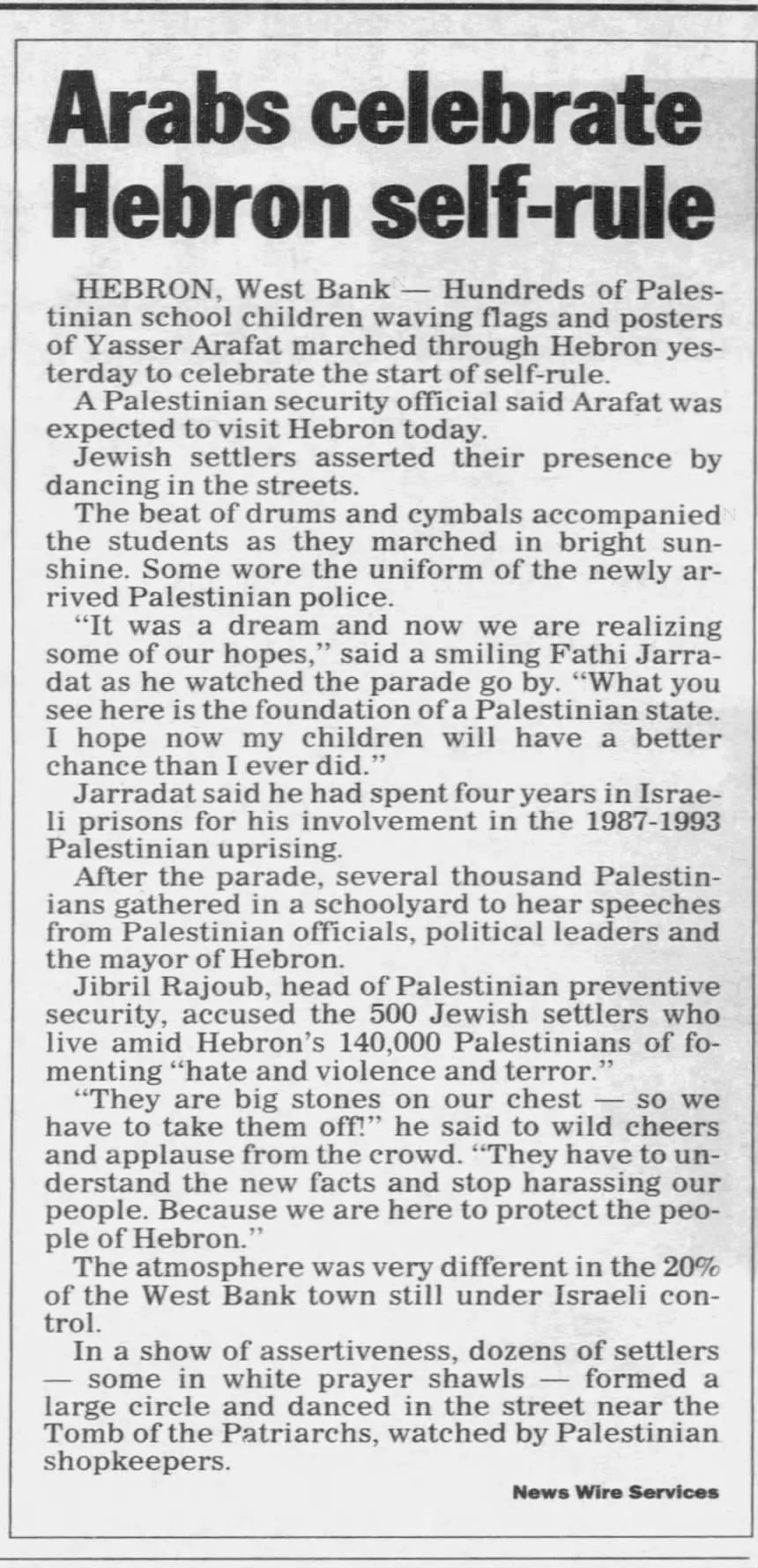
“HEBRON, West Bank”
In the dateline. Occupied has gone.
Daily News · CP-1997-007
Hebron never became part of a country called the West Bank. No government changed its name to that. And between 1980 and 1997 the word occupied left the dateline while the thing it described stayed where it was.
Except that it was never a sequence
Four plates in a row invite a reading that the archive cannot support, and the correction is worth more than the tidy version. The two forms did not replace one another. They ran side by side for at least twenty years. HEBRON, West Bank, with no adjective, is in the Star-Ledger in March 1977 — three years before the Poughkeepsie dateline above. HEBRON, Occupied West Bank is still in use in the Flint Journal in 1985 and the Clarion-Ledger in 1988. The Los Angeles Times went further than either and datelined Hebron Israeli-Occupied West Bank in 1979.
And the dateline often disagrees with the copy beneath it. The 1977 story is datelined West Bank and its first sentence says the occupied West Bank. The 1985 story is datelined Occupied West Bank and its first sentence says the Israeli-controlled West Bank. A dateline is a label with a character budget. A sentence is an assertion. Counting one as though it were the other would be a mistake, and it would be this project's mistake, not the papers'.
Here is what settles it. On 3 February 1989 the Associated Press moved one dispatch from Hebron. Two American papers printed it that morning. The copy is the same. The quoted speakers are the same. Three things are not.
Miami Herald
Dateline: HEBRON, West Bank
Levinger predicts riots by “thousands”
no mention of the man killed that day
CP-1989-013
Worcester Telegram
Dateline: HEBRON, Occupied West Bank
Levinger predicts riots by “tens of thousands”
“a Palestinian was killed… bringing the toll to 371”
CP-1989-014
So the adjective was never a decade. It was a desk. One paper called the territory occupied and one did not, on the same morning, from the same copy — and the same paper that dropped the adjective also dropped a man's death and a running count of three hundred and seventy-one. The difference between the two quotations is a factor of ten, inside quotation marks, attributed to a named man. What an American understood a settler leader to have predicted depended on which paper was on the table.
Every dated Hebron location line in this archive
says occupied says West Bank, no adjective says Palestine
Eighteen printings. Palestine holds the location line until at least 1938 and never returns to it. Occupied first appears in 1970 and is still there in 1989 — and from 1977 to 1989 the two forms run at the same time, in the same years, sometimes on the same wire. 1980 has three printings and all three say occupied; 1985 has two and they disagree; 1989 has two, from one dispatch, and they disagree. The word that disappears is not the contested one.
The four plates above are still four real printings and the dates are right. They are a range of usages sampled at intervals, not a progression, and the honest summary is narrower and stranger than a drift: the word Palestine leaves the location line and does not come back, while occupied comes and goes by desk and is still there in 1988. That is the opposite of a euphemism quietly creeping in.
The 1997 story is worth reading twice for a second reason. The headline says Arabs. The story underneath it says Palestinian six times: Palestinian school children, Palestinian police, a Palestinian state, Palestinian officials. One word was fine in the body and a different word went in the display type.
What the counting shows
The word itself can be measured, and it has to be measured carefully, because the number of old newspaper pages that have been digitised changes enormously by decade. A raw count of the word “Palestine” falls 94 per cent between 1900 and 1960, which looks devastating and is mostly an artefact of how many pages exist to search. What follows is a rate: appearances of the word per thousand searchable pages in the same year, measured against a word that appears on nearly every page.
Library of Congress, Chronicling America · “Palestine” per 1,000 searchable pages
Flat for forty years, then a fourfold spike in the year of the war. What happens next is the part worth sitting with: in 1950, two years after Israel was founded, the word is back at 14.02, which is the same rate as 1900, 1920 and 1940. Statehood did not move it. The first drop below the half-century baseline comes between 1950 and 1953.
Newspapers.com · per 1,000 pages, measured separately
Palestine Palestinian
A second collection, which reaches past 1963 where the first one stops. These two charts must not be read across: different papers, different digitising, different search engines. Inside this one, between 1993 and 2000, Palestine falls by half while Palestinian rises. A gap in what has been digitised moves both words the same way at once. It cannot move them in opposite directions.
That divergence is the closest thing here to an answer. The people did not go out of the newspaper. The country did. By 2000 an American reader met the adjective three and a half times as often as the place, and a person can be Palestinian in a sentence that never says where that is.
One dispatch, one morning, two front pages. On 14 October 1948 the Associated Press moved a short item: Lebanon and Syria had recognised the Palestine Arab government set up at Gaza. The Daily Advertiser in Lafayette, Louisiana ran it on page one under a headline, Recognize Arab Gaza Palestine Government, and printed the place as Gaza, Palestine. The St. Augustine Record in Florida also ran it on page one, as two lines in a column of world briefs with no headline at all, between a Communist leader killed in Java and prisoners of war returning to Austria, and printed the place as Gaza. Same wire, same morning, both on the front. One kept the word.
What this does not show
It does not show why. A word missing from a page is a fact about the page; the reason it is missing needs a memo, a stylebook or an editor saying so, and this archive holds newspapers.
Nor was any of this quiet. The phrase occupied Palestinian territories appears on more than nine thousand pages in this corpus after 1980, and Judea and Samaria on better than fifty-three thousand since 1967. The West Bank has had more than one contested name in American print, and the argument about which one to use was conducted in the open, in display type, by people who paid for the space.
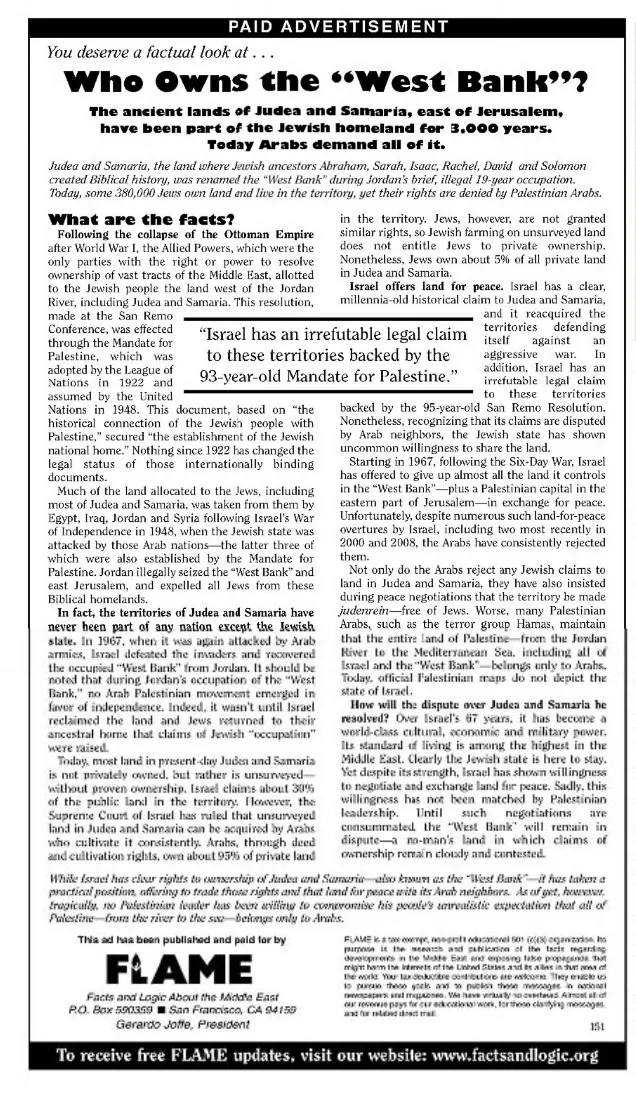
This is an advertisement, not reporting, and the paper said so across the top of it. It is here because of what it does with the name. It puts West Bank inside quotation marks nine times, and it argues that West Bank is itself the renaming: the land “was renamed the ‘West Bank’ during Jordan’s brief, illegal 19-year occupation.” Whatever a reader makes of that, it settles one question. The name of that territory was not drifting. Someone bought a page to argue about it.
These measurements are narrow and they are not a verdict on anyone’s motives. What they establish is a shape: a word that was ordinary for half a century, that survived the founding of a state without flinching, that thinned out afterwards in two steps, and that has been outnumbered by its own adjective since at least 1970.
The next time you read a dispatch from the West Bank, find the dateline and read the two words after the city. Then look up what the same paper called the same town the last time it was in the news, and the time before that.