 Who was already there757,182 people, counted by the government that ran the place · 1891 to 1932
A country, counted
Who was already there
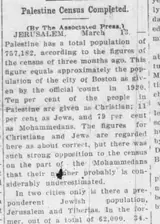
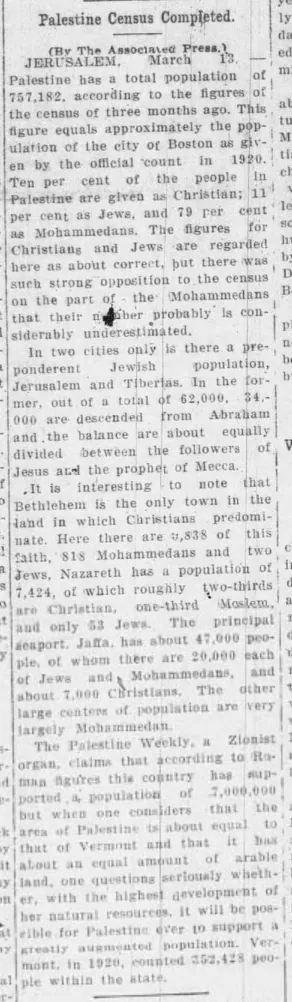
On 13 March 1923 the Associated Press moved a short dispatch from Jerusalem, and the Madison Courier in Indiana printed it. Palestine had a total population of 757,182. 79% Muslim, 11% Jewish, 10% Christian. The news agency explained the number by comparing it to a city its readers knew: about the size of Boston.
That is a government counting people and a newspaper making the figure legible to Americans, twenty-five years before 1948.
The rest of this section is the same kind of material: not a case being made, but the ordinary vocabulary of papers that assumed a populated country because they were describing one.
An American government document
In October 1908 the Rochester Journal printed a report from Thomas R. Wallace, the United States consul in Jerusalem, itemizing what the Palestinian peasantry grew and ate. Barley bread, olives and olive oil, cheese, leben, dried figs. Grapes and figs around Jerusalem, watermelons “grown largely on the plains,” apricots, tomatoes, cucumbers, onions, garlic. Then the sentence that does the most work:
They grow other vegetables, but ordinarily do not consume them but sell them.
Thomas R. Wallace, United States consul in Jerusalem, in Consular Reports · Rochester Journal and the Post Express, 31 October 1908
Sell them to somebody, somewhere. The report distinguishes throughout between country people and townspeople, who ate three times a day. A consul wrote it, the State Department published it, and a New York paper carried it.
A crop, by the boxful
The Akron Beacon Journal explained the Jaffa orange trade in 1893: recently famous, good for thirty or forty days in transit, three months if properly packed. The Perris Progress, in the California citrus belt, put a number on it in 1901 — a crop of about 300,000 boxes, grafted on lemon stock. Those readers knew exactly what that meant, because it was their own business.
Shipping and produce columns are the hardest evidence in this archive, because they had no argument to make.
Land, and who reallocated it
The Cincinnati Enquirer of March 1910 called the fellaheen “the aboriginal inhabitants of the Holy Land” in its own subheading, and then set out the machinery of a village: land held as freehold or in common, the common land apportioned among the villagers every year by lot, a sheikh who governed and was “the father of the community,” and one building in every village kept for strangers.
Eight years later a United Press dispatch in the Freeport Journal-Standard gave Nablus “about 25,000 population,” in the same paragraph in which it overstated an advance of 3,000 yards as the capture of a city thirty-three miles away.
The word
Searching Chronicling America, the Library of Congress’s collection of scanned American newspapers, for “fellaheen” returns 2,130 candidate pages. Most are not about this: 1,688 of them also mention Egypt, where American papers used the word far more often. 270 mention Palestine, steadily from the 1880s through the 1920s.
What the word carries is the argument. You cannot write the fellaheen of Palestine about an empty country. Settled agriculture, land tenure, a harvest and a market are inside the term, which is why papers reaching for it were documenting the thing later denied, without meaning to and without anyone contesting it at the time.
And the other description, running at the same time
None of this was the only thing Americans read. The second-oldest clipping in this archive, an 1812 Philadelphia reprint of Chateaubriand, describes villages “laid waste by fire and sword” and Jerusalem as “a cemetery in midst of a desert.” The Kansas City Times in 1937 called it “the barren country.” A Brooklyn traveler in 1931 saw “miles and miles of arid, unbeautiful land… nothing green, nothing growing.”
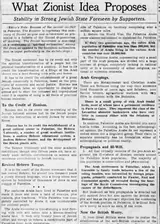
And in October 1938 the Des Moines Register reprinted a Zionist Organization of America bulletin, saying plainly whose bulletin it was, which argued that “only two generations ago, the entire Arab population of Palestine was less than 300,000.”
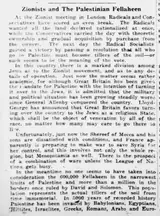
Set that against the Associated Press counting 757,182 fifteen years earlier, and the Philadelphia Inquirer counting 600,000 fellaheen in 1920 and calling them “the actual tillers of the soil from time immemorial.”
“no one seems to have taken into consideration the 600,000 Fellaheen in the narrowest limits of Palestine and more than a million in the borders once ruled by David and Solomon. This population represents the actual tillers of the soil from time immemorial.”
The Philadelphia Inquirer, under the headline Zionists and The Palestinian Fellaheen. CP-1920-002
 CP-1920-002
“Palestine has a total population of 757,182, according to the figures of the census of three months ago. This figure equals approximately the population of the city of Boston as given by the official count in 1920.”
The Madison Courier, Indiana, carrying Associated Press copy. A government counting the people it governed, translated for American readers into a city they knew. CP-1923-001
CP-1923-001“Only two generations ago, the entire Arab population of Palestine was less than 300,000.”
The Des Moines Register, reprinting a bulletin of the Zionist Organization of America and saying whose bulletin it was. Fifteen years after the census, and a third of its figure. CP-1938-004
 CP-1938-004