 The majority, named by subtractionThe same construction, every decade · 1918 to 1977
One grammatical form, eight decades
The majority, named by subtraction
There is a way of writing about the people of a country that never says who they are. It says who they are not. In 1899 they were the non-Jewish population; in 1917 the existing non-Jewish communities; in 1919 the non-Jewish inhabitants; in 1929 the non-Zionist population. They were about nine-tenths of the country. Every one of these sentences was printed in an American newspaper.
This is not a pattern inferred from a count. It is a form of words, and it is on the page.
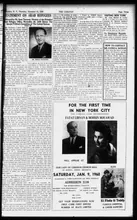
“You see another difficulty, Excellency, in the existence of the non-Jewish population in Palestine. But who would think of sending them away?”
Theodor Herzl to Youssuf Zia Al-Khalidi, 19 March 1899, answering al-Khalidi’s objection that the country already had people in it. Printed in English in an Arab American weekly in Brooklyn in 1959, inside a Palestinian’s statement to the United Nations, with the document number in a footnote. The letter is where the footnote says it is: the annexes volume of the report of the UN Special Committee on Palestine carries it in the French original and in the committee’s own translation, attached to the special note of the Indian member. The spelling Hertzl on that page is the paper’s.
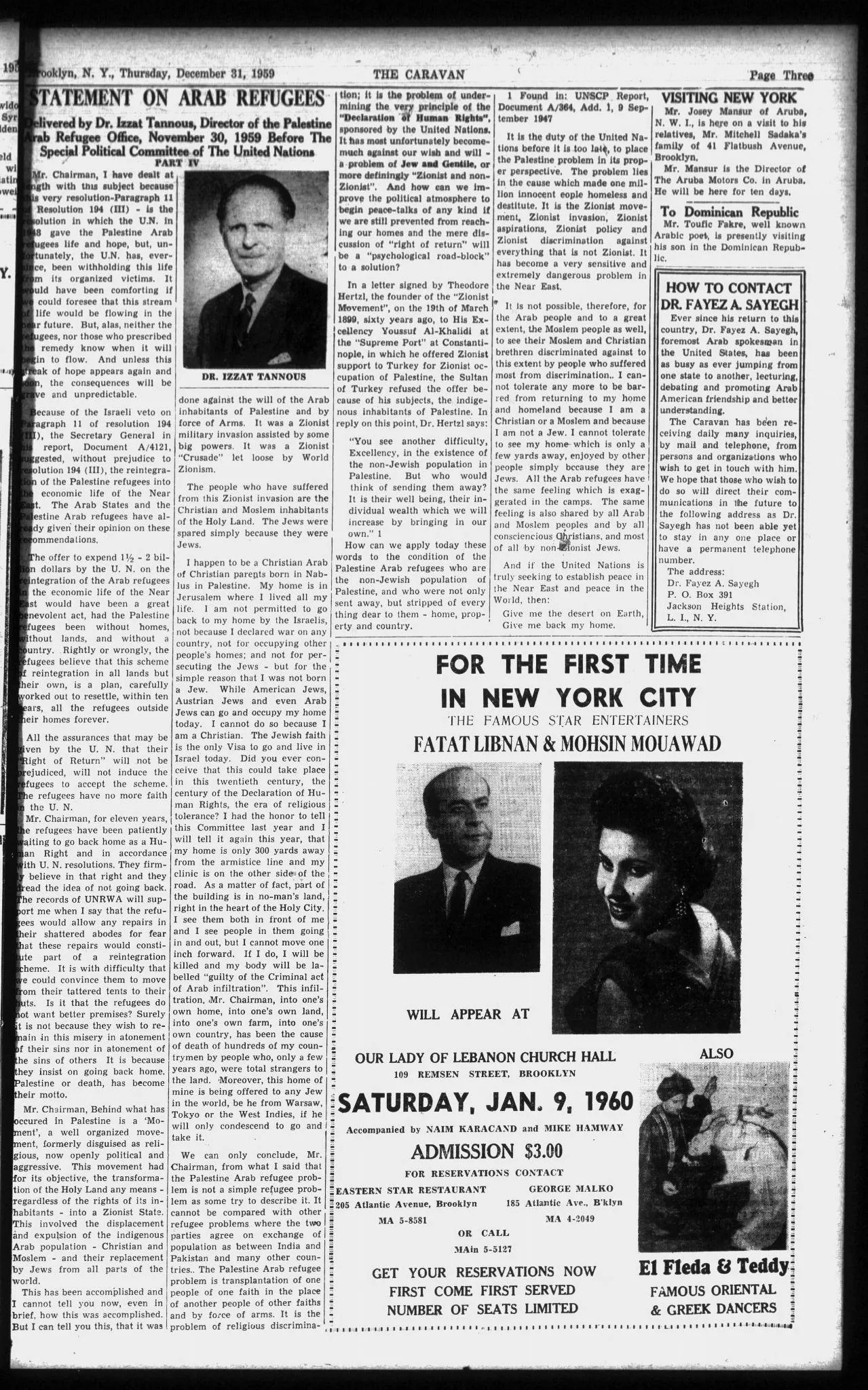
CP-1959-006“nothing shall be done which may prejudice the civil and religious rights of existing non-Jewish communities in Palestine”
The Balfour Declaration, quoted in The New Republic a year after it was issued. The sentence protects their rights and does not give them a name. Jews outside Palestine, in the second half of the same sentence, are called Jews.
 CP-1918-004
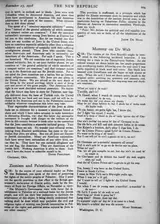
“The very first question that was put to the spokesmen of Palestine Jewry was ‘What would be the attitude of the Jews toward the non-Jewish inhabitants of Palestine?’”
The Jewish Monitor, reporting the American commission of inquiry sent to the region by the Paris peace conference. The commission’s very first question about the country’s majority describes them by what they are not, and it is asked of somebody else.
 CP-1919-013
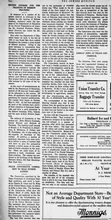
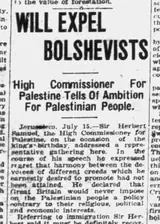
“The interests of the non-Jewish population would be not only safeguarded by the mandate itself but likewise in the instrument referred to in which the future constitution of the country would be defined.”
Sir Herbert Samuel, the first High Commissioner for Palestine, on the king’s birthday, in a Knoxville daily. Two paragraphs earlier in the same speech he had called them the Palestinian people. When he turns to what the law will do for them, the other phrase comes out.
 CP-1921-004
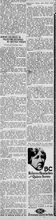
“A group of Moslems, Christians and Jews waited upon the president of the Syrian state and protested against the situation of the non-Zionist population of Palestine”
The World News, Roanoke. The subtracted term has changed from a religion to a political movement, and the sentence now has to list three faiths at the front to say who is doing the protesting.
 CP-1929-007
What the form is for
By 1949 it was doing arithmetic. The first report of the UN Economic Survey Mission for the Middle East arrived at the number of refugees like this: by taking the former non-Jewish population of the territory at present held by Israel and deducting therefrom the present non-Jewish population of that territory. A people defined by subtraction, then counted by subtraction, in the same sentence.
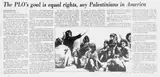
And the form outlives the documents that made it. In December 1977 a Boston reporter, writing sympathetically about Palestinians living in the United States, put this in his own copy:
“The non-Jewish population of Israel is 530,000, and it is overwhelmingly Palestinian.”
The Boston Globe. Nobody made him write it that way. He reaches for the phrase first and then, in the second half of the sentence, has to translate it back into a people.
 CP-1977-004
Seventy-eight years separate the first of these sentences from the last. The subtracted term changes — Jewish, Zionist — and the noun changes — population, communities, inhabitants — but the operation never does. You are told the size of a group, the rights it will be allowed and the number it has fallen to, and you are never told what it calls itself.
This is worth knowing because it is checkable, and because you can do it yourself. Next time you read a sentence about a group of people, look at whether the sentence gives them a name or gives them a subtraction. It usually takes one reading to see, and once you have seen it you will not stop seeing it.