 Disabled Palestinians, and the warning that becomes the defenseNamed once, counted often · 1994 to 2022
1994 to 2022
Disabled Palestinians, and the warning that becomes the defense
In November 2001 the Associated Press moved a story about Shimon Peres and the possibility of restarting talks. Two-thirds of the way down, in the paragraphs where the day’s deaths are listed, is this.
Sarasota Herald-Tribune, 10 November 2001 · CP-2001-013
He was deaf. The reason given for shooting him is that he did not answer when spoken to, in two languages. Both sentences are printed, one after the other, and nothing in the paper connects them. He is not named. The story runs above a furniture sale, 50 to 70 per cent off, just in time for the holidays.
Fifteen months later the same construction appears in a different paper, about a different person, and this time she has a name.
The Salt Lake Tribune, 7 February 2003 · CP-2003-011
That is twice now, fifteen months apart, different papers, different people. Both times the warning is what makes the death defensible. Both times the reason the warning failed is printed in the same sentence as the warning.
Where they came from
In January 1996 two papers ran the same dispatch about Palestinians suing Israel for injuries. It carried the army’s own arithmetic: a total of 1,067 Palestinians were killed by Israelis and 17,987 were injured between the start of the uprising on Dec. 9, 1987, and Nov. 2, 1994
. More than a thousand of the disabled had filed claims. Peres answered that he would pay If it is mutual
, and not otherwise. The San Francisco Examiner, the same morning, reported what the cabinet decided: no blanket compensation, a bill granting the state blanket immunity to the claims
, and a committee for exceptional cases.
Ali Fanoun, shot in the spine at fourteen leaving dawn prayers, is called Palestinian Ali Fanoun in the body of the story. The headline set over his photograph reads PARALYZED ARAB SUES.
How they appear
Once the papers have them, disabled Palestinians appear mostly inside stories about someone else, and mostly without names. A man hugged by Arafat in 1994, one of about 20 in wheelchairs
assembled to welcome him home, unnamed on a page where six ordinary Gazans are named. A man in 1997 whom the volunteers have come to meet, named nowhere in a caption that names three Americans. A caption in 2009 that reads, in its entirety, An elderly, disabled Palestinian man sits with his relatives.
A handshake with the Arab League in 2010. 400 of them assembled as an audience for a speech by Abbas in 2005.
And in 1997, one sentence inside a story about a firebombed army truck: settlers at Itamar were arrested for beating a disabled Palestinian, because The stone-throwers fled, leaving behind the disabled man
, who then became the only person who could identify them.
Two editorial pages, on the same subject, doing opposite things. In 2003 the York Dispatch used six sentences to object to the deportation of a blind, diabetic, stateless Palestinian
who had been asked to sign his own release without a lawyer, and put on a plane before his family could drive from Philadelphia. The paper could not say where he had been sent, because he had no country to be sent to.
In 2004 The Day, editorializing on the killing of Sheikh Ahmed Yassin, reached for his disability as a prediction: the military assassination of an elderly and disabled cleric held in wide esteem has had the opposite effect
. His quadriplegia is not the subject of that sentence. It is the reason the paper expects the killing to go badly.
And then they organize
In Rafah in 2003 the Palestinian Authority froze the accounts of nine charities, and the people whose welfare ran through them marched. The photograph shows men in wheelchairs at the front, carrying signs written in English. One of them reads LET US LIVE WITH DIGNITY. In 2010 disabled refugees in Lebanon demonstrated for a flotilla carrying supplies to disabled people in Gaza, in a story whose own reporting is that Israel had permitted potato chips and refused medical devices
.
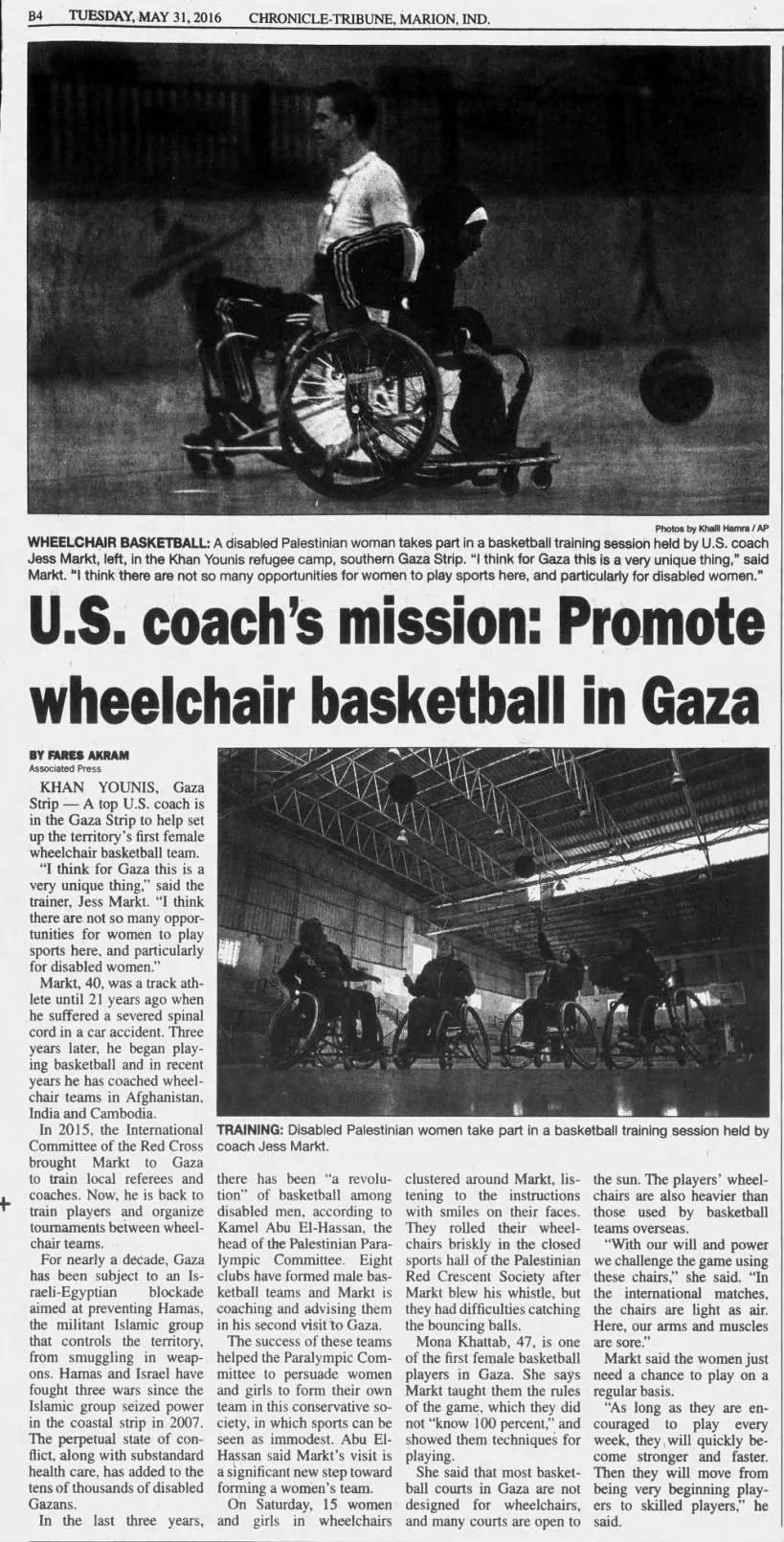
And in May 2016 a coach from Oregon spent a week in a Red Crescent hall in Khan Younis with fifteen women and girls, setting up the territory’s first women’s wheelchair basketball team. Mona Khattab is forty-seven and one of the first female players in Gaza. On the chairs they have:
Mona Khattab, 47, Khan Younis · Chronicle-Tribune, 31 May 2016 · CP-2016-005
Two papers ran that story the same day. One headline kept the word female. The other took it out of a story about the first women’s team.
On 12 July 2014 an Israeli missile hit the Palestine Charity in Beit Lahiya, a residential center for physically and mentally disabled people. Its director, Jamila Alaiweh, counted for the wire: nine residents, four away with their families for the weekend, two of the remaining five killed, three burned. One of the dead had cerebral palsy. Among the wounded was a quadriplegic. The last thing the Associated Press reported from the site was what the rescuers pulled out of the rubble — a folded-up wheelchair and a children’s workbook
.