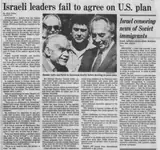
 The censor, printed in the paperThe censor’s deletions, marked by hand on the clipping · 1948 to 2012
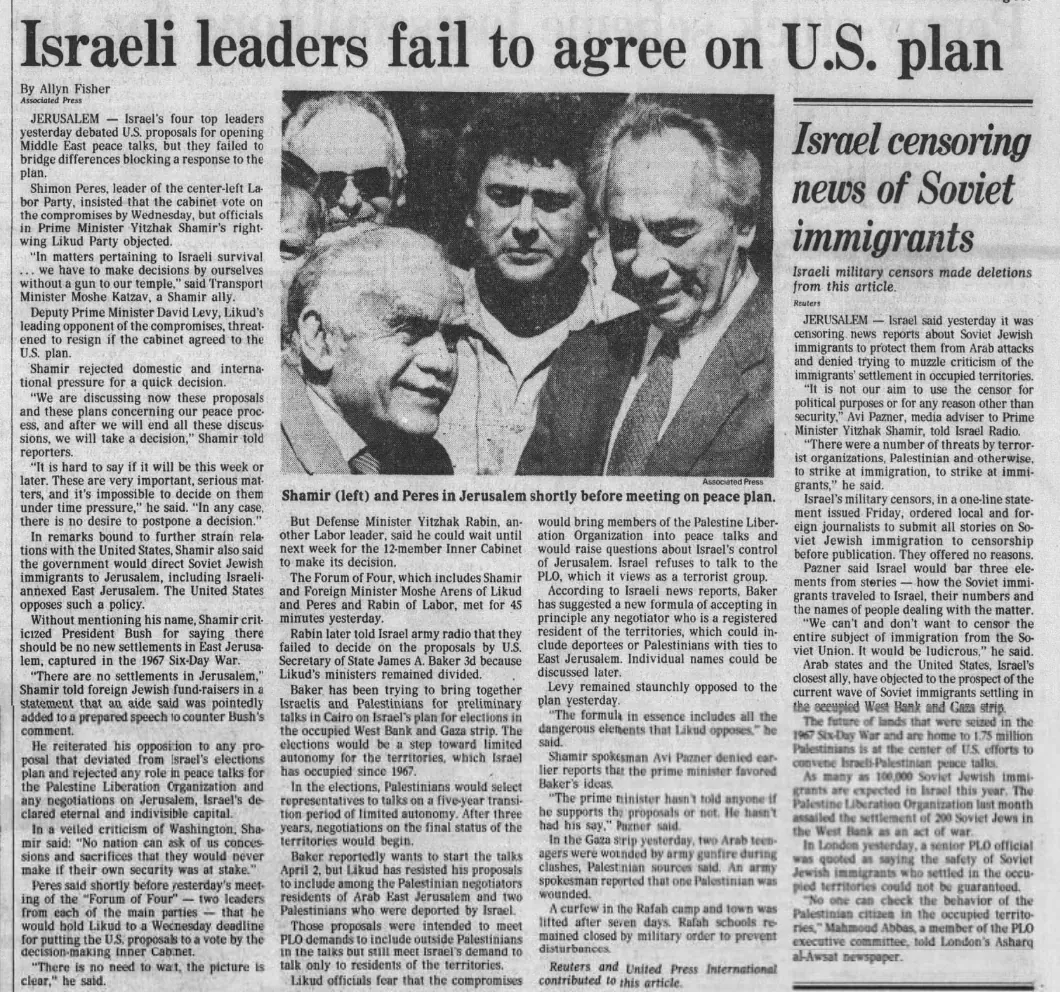
What did not reach the page
The censor, printed in the paper
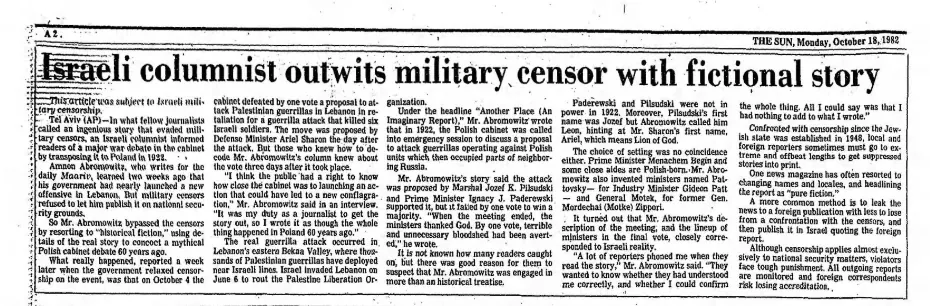
On 18 October 1982 the Baltimore Sun ran a dispatch from Tel Aviv with a line sitting above the dateline, before the story had begun: “This article was subject to Israeli military censorship.” The story underneath was about an Israeli columnist who had got a cabinet debate past the censor by rewriting it as Polish history from 1922.
A censor who works well leaves nothing behind. These are the clippings where one left something — a notice above a story, a deletion marked on the page, a sentence explaining why the reporting could not be checked.
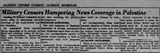
“Military Censors Hampering News Coverage in Palestine.”
Jackson Citizen Patriot, Associated Press from London. A news agency auditing the censorship around it, the day before the state was declared. It reports that “In Palestine Haganah, the Jewish defense force, censors all Jewish papers,” and that the strictest censorship of the whole region is in Syria and Lebanon. The machinery is older than the state it would serve.
 CP-1948-033
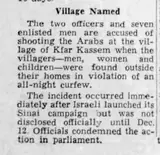
“The incident occurred immediately after Israeli launched its Sinai campaign but was not disclosed officially until Dec. 12.”
The Evening Gazette, on the trial of the officers and men who shot the villagers of Kafr Qasim. Six weeks between the killings and the disclosure, stated by the paper as ordinary background. “Israeli” for “Israel” is the paper’s.
 CP-1957-012
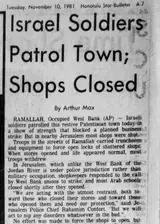
“Israel Soldiers Patrol Town; Shops Closed.”
Honolulu Star-Bulletin, Associated Press from Ramallah. Two youths arrested for unfurling a flag, and a pair of Palestinian newspapers shut or their editors arrested, reported inside a story about a business strike.
 CP-1981-002
“This article was subject to Israeli military censorship.”
The Baltimore Sun, Associated Press from Tel Aviv. The notice is the first line of a dispatch about evading the censor: Amnon Abromowitz of Maariv had learned of a near-offensive in Lebanon, and “military censors refused to let him publish it on national security grounds.” So he published it as a Polish cabinet debate of sixty years earlier.
 CP-1982-021
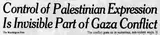
“The conflict goes on in numerous, non-violent ways. It includes the closure or publication restrictions by Israeli mil…”
Omaha World-Herald, under the headline Control of Palestinian Expression Is Invisible Part of Gaza Conflict. The clipping is the headline, the credit line and two lines of the story. The rest was not cut out, so where the sentence was going is not known.
 CP-1984-001
“Despite government claims that restricting residents and closing off the area to journalists would inhibit violence, military officials said there were major incidents in at least 23 locations.”
Press & Sun-Bulletin, on Land Day. The paper says in its own column that it cannot check the army’s account, and reports in the same column that the army had just closed the Palestinian news agency the correspondents relied on.
 CP-1988-011
“The military censor, meanwhile, has asked police to open an investigation into a report in the Sunday Times of London…”
Ann Arbor News, Associated Press from Jerusalem. The censor is not only cutting copy at home; he is asking for a criminal investigation into a paper printed in another country. The army spokesman quoted in the same dispatch is, by regulation, not named.
 CP-1989-009
“Israel censoring news of Soviet immigrants.”
The sidebar carries its own warning in italics — Israeli military censors made deletions from this article — and on the clipping two phrases about the occupied West Bank and Gaza are underlined by hand, where the deletions fell. Somebody marked the holes before filing it away. This is the clipping at the top of this section.
CP-1990-001“Israel bans film about battle at refugee camp.”
The Star-Ledger, on Jenin, Jenin. Four words of headline for a documentary the state would not allow to be shown.
 CP-2002-021
“lifting a nearly 25-year veil of secrecy and allowing a rare glimpse into the shadowy world of its secret operations.”
Roanoke Times, Associated Press, on Israel confirming it killed Khalil al-Wazir in Tunisia in 1988. It could be printed in 2012 because a military censor allowed it to be. The gardener killed on the way in is mentioned twice and never named.
 CP-2012-001
The censor turns up in these ten in four ways: as a notice set above the story, as a deletion marked on the page, as a reporter’s explanation of why an account could not be checked, and as a delay — six weeks in 1957, twenty-four years in 2012. In 1948 the machinery is already running, and running on papers rather than on foreign correspondents, eight days before there is a state.
What this cannot show is the censorship that worked. Every clipping here is a case where an American paper printed the fact of it, which is to say a case where the censoring was visible, reported, or eventually released. A deletion nobody marked and a story nobody filed leave no clipping behind, and this archive is made of clippings. The ten below are the floor, not the measure.
See these ten in the archive →
Ten clippings, 1948 to 2012, found by searching for the censor rather than for any event. The archive’s wider censorship collection is larger and takes in suppression of other kinds, including a word struck out of a United Nations resolution to get it past the United States.