Omaha World-Herald · Omaha, Nebraska · 30 May 1984
CP-1984-001
Control of Palestinian Expression Is Invisible Part of Gaza Conflict
The Washington Post
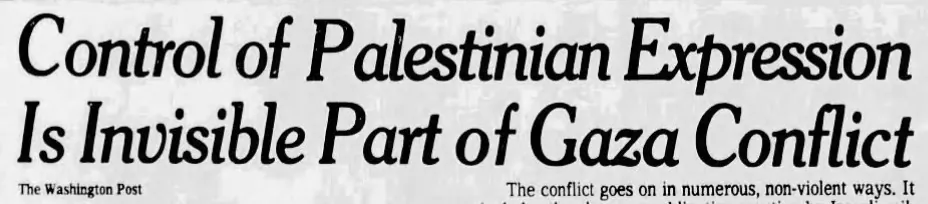
Transcribed from the clipping
“Jabalia Camp, Gaza Strip — In April 1982, Suhain Ghabin, a 7-year-old Palestinian, was shot and killed by Israeli soldiers during a violent demonstration in this squalid refugee camp where he lived. The youth was one of scores of people killed that spring in the disturbances that swept the Israeli-occupied West Bank and Gaza Strip.
But he lived on in the memory of his family, including his uncle, Fathi Ghabin, a locally prominent Palestinian painter. Some time after the incident, Ghabin painted a picture of his slain nephew, Suhain.
It showed the youth lying on his side, blood gushing from a wound in his chest, while in the background a crowd of demonstrators was shown with uplifted arms, a sign of defiance. COLORS OF PLO FLAG. The most prominent colors in the picture — the youth’s green and white sweater, his black trousers, the red blood — are those of the Palestinian flag.
Because of that picture, and seven others he exhibited in the Gaza Strip last summer, Fathi Ghabin is now serving a six-month prison sentence. He was convicted by an Israeli military court earlier this month on charges of possessing and displaying ‘inciting material.’
‘First it is the colors — you have the colors of the PLO flag,’ an Israeli military official said in explaining Ghabin’s conviction. ‘That is considered inciting material because it insinuates the ongoing armed struggle.’
Other symbolism used by Ghabin, he said, included a ‘broken Star of David,’ a picture of an old man with a bleeding boy and billowing smoke (representing the Israeli occupation) in the background and ‘the use of an eagle with a beak nose as a representative of the Jews.’
Ghabin’s exhibition, the official said, ‘had a theme with a whole story, about the Israeli occupation, that we (Palestinians) are the oppressed, about the struggle and revenge. The use of colors is to incite for revenge.’ ‘The Western mind won’t understand a lot of this,’ the official said. ‘But inside the paintings there are symbols.
It’s like a puzzle.’ ONGOING CONFLICT. They said Ghabin’s case illustrates an often invisible aspect of the ongoing Israeli-Palestinian conflict in the West Bank and Gaza.
It is essentially the conflict between authorities who are intent on maintaining order and those who use the symbols and other expressions of Palestinian nationalism that are thought by the authorities to be disturbing to that order. The conflict goes on in numerous, non-violent ways.
It includes the close, prepublication scrutiny by Israeli military censors of the Arabic-language newspapers that are published in east Jerusalem. Once, one of the newspapers managed to slip past the censor a seemingly routine crossword puzzle in which the blacked-out squares formed the letters PLO — Palestine Liberation Organization.
This spring, in a once abandoned and fire-gutted movie theater in east Jerusalem, a Palestinian theater company has performed a play that is banned in the West Bank and Gaza Strip.
But under Israeli law, Arab east Jerusalem has been annexed and is not subject to stringent occupation laws, said Jackie Lubeck, 31, an American-born Jew and the only non-Palestinian member of the El Hakawati Theater Co.
Raising money largely from wealthy Palestinians who live abroad, the theater group invested more than $100,000 in a six-month renovation of the abandoned movie theater, creating ‘the Hakawati Theater and Art Center of Jerusalem,’ Ms. Lubeck said. The company has existed since 1977 and performs often in Israel, the West Bank and Gaza.
But two of the four productions it has created are not licensed for performance in the occupied territories.
One of them, whose English title is ‘1001 Nights of a Stone Thrower,’ includes a character named ‘Gidi (the mean and rotten),’ who is described as a ‘military governor’ and who early in the play is depicted as ‘enjoying the company of the weapons salesmen and their wares,’ according to a synopsis. ‘NOT ALL POLITICS’.
‘They can’t have everybody under lock and key,’ said Ms. Lubeck short before the first performance of ‘1001 Nights of a Stone Thrower’ at the Hakawati center. ‘We are going by the book. We get no PLO money, no black money.’ Ms.
Lubeck said the theater company plans to further test the limits of its license to perform the play in Israel by busing people to the east Jerusalem theater from the adjacent West Bank.
She argues that no serious attempt at Palestinian theater could omit references to the Israeli occupation, which has included countless military governors who may or may not resemble the fictional character ‘Gidi.’ ‘We are creating material about us,’ she said. ‘It’s not all politics. In the play we have a kid who throws a stone.
Well, Palestinian kids play with stones the way American kids play with a ball. Is that political?’”
How this transcription was made
Transcribed in full. The paper’s own short before the first performance is kept. Subheadings are set as printed. The record previously held only the headline, the credit line and the first two lines, which was all that had been clipped; the full article replaced it on 29 September 2026. The scan was replaced the same day with the full article; the record previously carried only the headline strip.
Context added by this archive
A painter jailed for six months for eight paintings, and an Israeli military official explaining the conviction to an American reporter in terms of color. The picture that did it shows Suhain Ghabin, the painter’s seven-year-old nephew, shot dead at Jabalia in April 1982, lying on his side with blood from a chest wound.
The official’s objection is that the boy’s green and white sweater, his black trousers and his blood are the colors of the Palestinian flag. That is considered inciting material because it insinuates the ongoing armed struggle. He then explains how to read a painting: a broken Star of David, an old man with a bleeding boy, an eagle with a beak nose.
‘The Western mind won’t understand a lot of this. But inside the paintings there are symbols. It’s like a puzzle.’ Two other things sit in this story. A censored Arabic newspaper in east Jerusalem once got a crossword past the censor whose blacked-out squares spelled PLO.
And Jackie Lubeck of the Hakawati theatre company, asked whether her play is political, answers with the plainest sentence in the archive about what counts as politics when Palestinians do it: Palestinian kids play with stones the way American kids play with a ball. Is that political?
Cite this clipping
"Control of Palestinian Expression Is Invisible Part of Gaza Conflict," Omaha World-Herald, 30 May 1984, p. 1. Covering Palestine archive, CP-1984-001. https://coveringpalestine.org/archive/cp-1984-001
This clipping is read closely in the section below
More from Omaha World-Herald
- Arabs Fear Zionists Menace in PalestineOmaha World-Herald · 17 March 1919
- Arabs Violently Opposed to ZionismOmaha World-Herald · 1 June 1919
- Palestine Is Listing Her Landless ArabsOmaha World-Herald · 15 February 1931
- KILL ARAB RIOTERS IN JAFFA, PALESTINEOmaha World-Herald · 28 October 1933
- BRITISH CONTINUE PALESTINE CURFEWOmaha World-Herald · 20 October 1937
- Bomb, Shots Jolt PalestineOmaha World-Herald · 20 October 1937
- 21 more from this paper in the full text →
More from the 1980s
- Shamir meets Israel's Arab citizensThe New York Times · 5 January 1984
- Cultural-hatred roots run deep in West BankThe Oregonian · 5 January 1984
- P.L.O. IdeologistsThe New York Times · 12 January 1984
- Bedouin Herdsmen Arrested In Negev Stabbing IncidentThe New York Times · 17 January 1984
- Israeli police stoned; Palestinian killedJackson Citizen Patriot · 29 January 1984
- Zionists attack Palestinian busThe Columbian · 5 March 1984
- All 527 clippings from the 1980s →
In these collections
Last updated 2 November 2026
This record is part of Covering Palestine, an archive of American newspaper clippings about Palestinians, 1724 to 2023. Researched and assembled by Maria Robles.
The clipping belongs to the newspaper that printed it, or to the news agency that supplied the copy. It is reproduced here for research, criticism and commentary. A city here is where the newspaper was published, not where the story came from, and on most records it was taken from the masthead.
Something wrong here, or something you know about this clipping? The archive is still being built and corrections are wanted: maria@rozumstudio.com, quoting CP-1984-001.
Read in: What the censor left behind
Everything printed in 1984 · Printed on this day · See it in the archive reel · Full text of every clipping · Dataset