 The word for what they saidThe sentences were reprinted in order to dismiss them · 1919 to 2002
1919 to 2002
The word for what they said
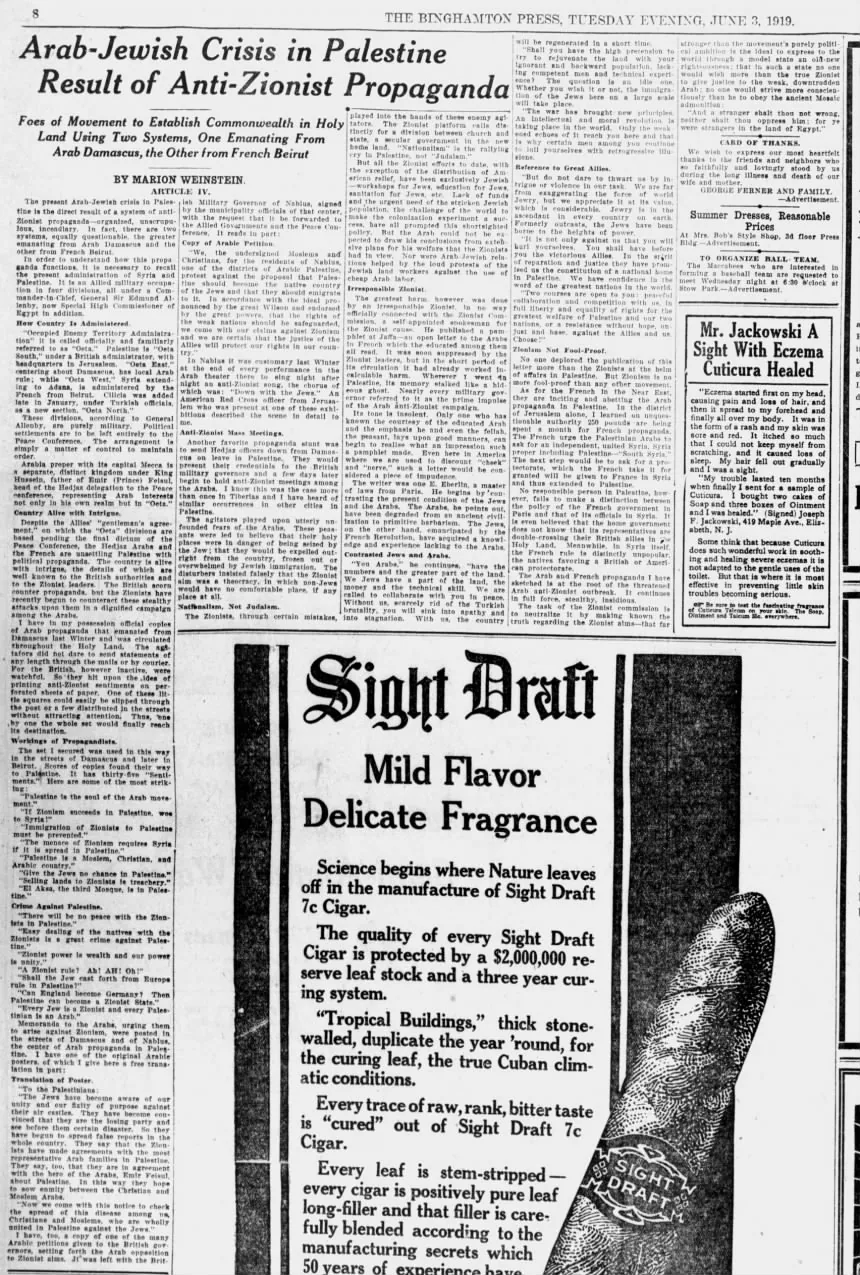
In June 1919 a newspaper in Binghamton, New York printed fifteen sentences that Palestinians had written about their own country. It printed them in order to explain that they were propaganda.
The article is the fourth in a series by a correspondent named Marion Weinstein, and what it describes, once you read past the headline, is a small act of publishing. Palestinians were writing political sentences and having them printed on perforated sheets, small enough that a single square could go through the post or be handed to somebody in the street without the British noticing. Weinstein had a set. It held thirty-five of them, and the article calls them “Sentiments.”
“So they hit upon the idea of printing anti-Zionist sentiments on perforated sheets of paper. One of these little squares could easily be slipped through the post or a few distributed in the streets without attracting attention.”
Two paragraphs earlier the same article describes the other side’s effort as a dignified campaign. The difference between a campaign and propaganda, on this page, is not a difference in method. Both sides are circulating arguments. One of them is named.
CP-1919-016Because the article reprints what it is condemning, it preserves it. Here are three of the thirty-five, printed in an American daily eighty-three years before an American columnist would write that there had never been such a people.
“Palestine is the soul of the Arab movement.”
“Palestine is a Moslem, Christian, and Arabic country.”
“Every Jew is a Zionist and every Palestinian is an Arab.”
And a street poster from Nablus, translated in the same column, which opens with a word of address: “To the Palestinians.”
The piece ran at least three times. The two other printings in this archive are the same numbered article and they disagree only about the headline.
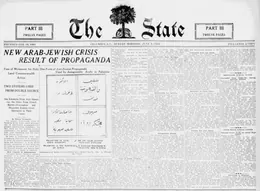
“New Arab-Jewish Crisis Result of Propaganda”
The only one of the three that drops anti-Zionist and leaves the word standing by itself as the cause of the crisis. Part III of the Sunday paper.
 CP-1919-018
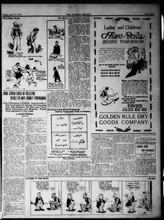
“Arab-Jewish Crisis in Palestine Result of Anti-Zionist Propaganda”
Page three, between a Ripley cartoon and a ladies’ and children’s shoe sale. This printing reproduces the Arabic leaflet as a photograph, captioned One Form of Anti-Zionist Propaganda Used by Antagonistic Arabs in Palestine. The document is shown. What it says is not translated.
 CP-1919-017
What the category will hold
Once a word is available it gets used, and the interesting thing about this one is how little it needs the speaker to be Palestinian. Over the next fifty years the same category takes in a lecture bureau, a president’s pastor, a Jewish council, the Student Nonviolent Coordinating Committee, refugee relief charities and a man showing tourists around the city he lives in.
“They furnish lecturers to all parts of the United States, on any Middle East topic from archaeology to oil-politics.”
Arab-American organizations in seven cities, circulating articles and sending out speakers. Their own description of themselves — purely educational, open to non-Arabs, American with no foreign connections — is printed inside quotation marks, which is how a paper prints a claim it is not accepting.
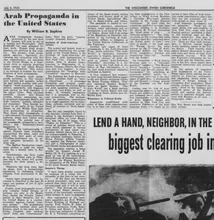 CP-1945-015
“Study of Arab Propaganda Here Lists Role of Anti-Zionist Jews”
The clipping that shows what the category is actually sorting for. Everyone inside the Arab propaganda machine here is American, and the ones given the most credit are Jews: a council, an author, President Eisenhower’s pastor, an executive director quoted saying precisely because we are Jews. Americans of Arab descent come further down the list. The test is not who is speaking.
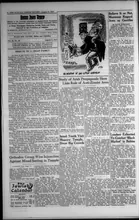 CP-1957-022
“He described SNCC as a ‘black racist and leftwing revolutionary organization’ and its ‘polar opposite, NSRP,’ as ‘neo-Nazi, white racist.’”
Four months after June 1967. The link asserted between a civil rights organization and a neo-Nazi party is not a shared politics — the report insists they are opposites — but a shared source, and the charge is word-for-word dependence. That is a claim about where a sentence came from rather than whether it is true. A second news agency carried the same announcement four days later and put SNCC first in the headline.
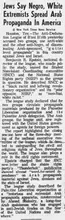 CP-1967-030
“Many welfare groups to alleviate the plight of Arab refugees have been established or reactivated… In some of them, ‘humanitarian aims … seem to be accompanied by ill will or propagandistic intent toward Israel.’”
Church congregations, student groups, Black organizations and refugee relief are all listed as fronts or targets. Once relief itself is a delivery system, there is no form the speech can take that clears the bar.
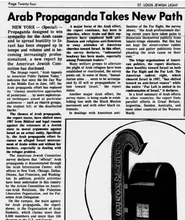 CP-1969-012
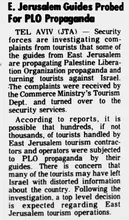
“Security forces are investigating complaints from tourists that some of the guides from East Jerusalem are propagating Palestine Liberation Organization propaganda and turning tourists against Israel.”
Seven sentences, and this is the whole item. A tourist complains about what a guide said; the Tourism Department passes it to the security services. What is under investigation is a man describing the city he is from.
 CP-1978-010
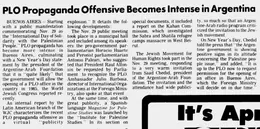
“PLO Propaganda Offensive Becomes Intense in Argentina”
The offensive is a United Nations day of solidarity, observed in a municipal hall, with two members of the Argentine parliament speaking and a Jewish human rights group attending. The copy describes their invitation as very warm.
 CP-1985-009
Where it ends up
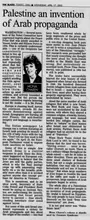
In April 2002 a syndicated column ran in Toledo. By then the word has stopped being applied to what Palestinians say and has been applied to Palestinians.
“The whole idea of a Palestinian nation and a Palestinian people is an invention of Arab propaganda… It is not and never was ‘Palestinian land.’”
The column’s evidence that the country was empty is a traveller’s impression of one valley in 1867.
 CP-2002-029
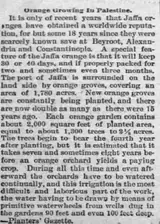
This archive can answer that from its own shelves, and it does not need an argument to do it. Twenty-six years after Mark Twain rode through the Jezreel valley, an Ohio newspaper printed a report on the port of Jaffa, which it said was surrounded on the land side by orange groves covering 1,780 acres, doubled in fifteen years, irrigated by hand from wells dug ninety and a hundred feet deep.
“The port of Jaffa is surrounded on the land side by orange groves, covering an area of 1,780 acres. New orange groves are constantly being planted, and there are now double as many as there were 15 years ago.”
Nobody arguing about anything. An export trade with a shelf life and a shipping problem, written up for American readers nine years before the word propaganda arrives in this collection.
 CP-1893-001
None of these papers were lying, and most of them were not even hostile in the way the 2002 column is. The 1919 correspondent went to the trouble of translating a poster. The 1957 report is careful about names and titles. What the word does is not deceive. It sorts. It puts a sentence into a category where the question of whether it is true does not come up, and the reader is released from having to decide.
The next time you meet a claim described as propaganda, the useful thing to notice is not whether the label fits. It is whether anybody, anywhere in the piece, went on to say what the sentence actually claimed — and whether it was so.