Chicago Sunday Tribune · Chicago, Illinois · 11 January 1959
CP-1959-001
Plight of Refugees in Jordan Depicted
Arab view on Middle East
Chesly Manly, Chicago Sunday Tribune
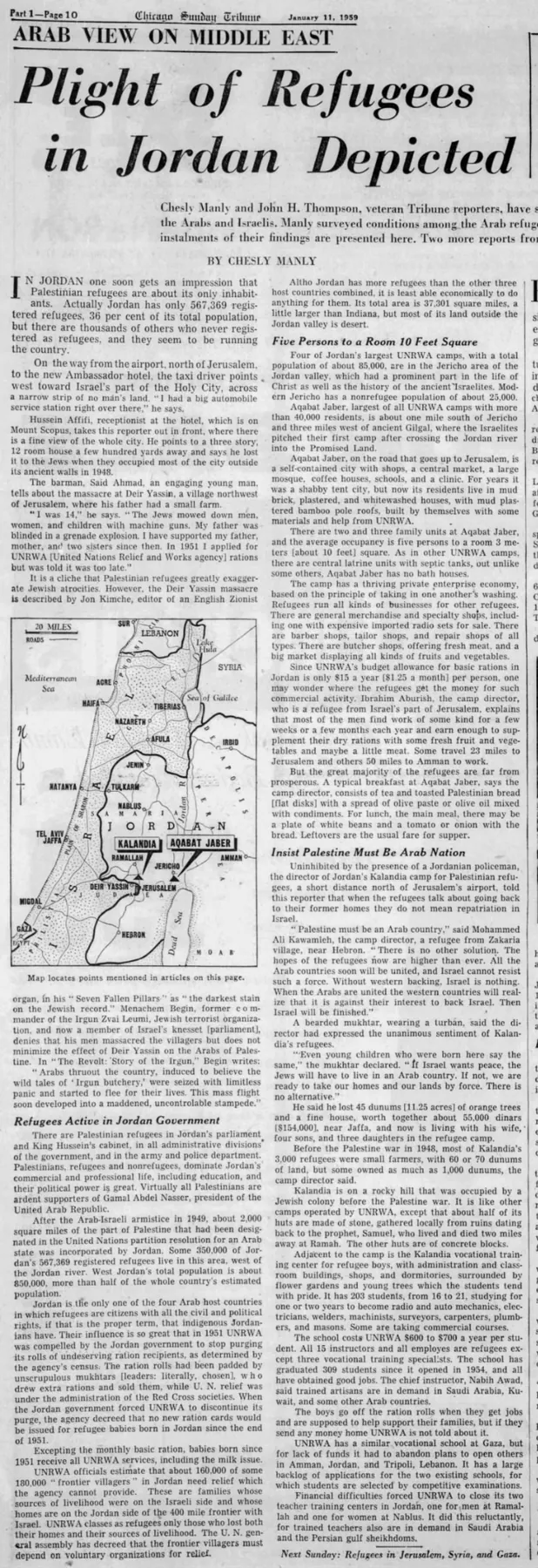
Transcribed from the clipping
“IN JORDAN one soon gets an impression that Palestinian refugees are about its only inhabitants. Actually Jordan has only 567,369 registered refugees, 36 per cent of its total population, but there are thousands of others who never registered as refugees, and they seem to be running the country.
On the way from the airport, north of Jerusalem, to the new Ambassador hotel, the taxi driver points west toward Israel’s part of the Holy City, across a narrow strip of no man’s land. ‘I had a big automobile service station right over there,’ he says.
Hussein Affifi, receptionist at the hotel, which is on Mount Scopus, takes this reporter out in front, where there is a fine view of the whole city. He points to a three story, 12 room house a few hundred yards away and says he lost it to the Jews when they occupied most of the city outside its ancient walls in 1948.
The barman, Said Ahmad, an engaging young man, tells about the massacre at Deir Yassin, a village northwest of Jerusalem, where his father had a small farm. ‘I was 14,’ he says. ‘The Jews mowed down men, women, and children with machine guns. My father was blinded in a grenade explosion. I have supported my father, mother, and two sisters since then.
In 1951 I applied for UNRWA [United Nations Relief and Works agency] rations but was told it was too late.’ It is a cliche that Palestinian refugees greatly exaggerate Jewish atrocities.
However, the Deir Yassin massacre is described by Jon Kimche, editor of an English Zionist organ, in his ‘Seven Fallen Pillars’ as ‘the darkest stain on the Jewish record.’
Menachem Begin, former commander of the Irgun Zvai Leumi, Jewish terrorist organization, and now a member of Israel’s knesset [parliament], denies that his men massacred the villagers but does not minimize the effect of Deir Yassin on the Arabs of Palestine.
In ‘The Revolt: Story of the Irgun,’ Begin writes: ‘Arabs thruout the country, induced to believe the wild tales of “Irgun butchery,” were seized with limitless panic and started to flee for their lives. This mass flight soon developed into a maddened, uncontrollable stampede.’…
Five Persons to a Room 10 Feet Square. Four of Jordan’s largest UNRWA camps, with a total population of about 85,000, are in the Jericho area of the Jordan valley… Aqabat Jaber, largest of all UNRWA camps with more than 40,000 residents, is about one mile south of Jericho and three miles west of ancient Gilgal, where the Israelites pitched their first camp after crossing the Jordan river into the Promised Land… There are two and three family units at Aqabat Jaber, and the average occupancy is five persons to a room 3 meters [about 10 feet] square… Since UNRWA’s budget allowance for basic rations in Jordan is only $15 a year [$1.25 a month] per person, one may wonder where the refugees get the money for such commercial activity.
Ibrahim Aburish, the camp director, who is a refugee from Israel’s part of Jerusalem, explains that most of the men find work of some kind for a few weeks or a few months each year…
Insist Palestine Must Be Arab Nation. ‘Palestine must be an Arab country,’ said Mohammed Ali Kawamleh, the camp director, a refugee from Zakaria village, near Hebron. ‘There is no other solution. The hopes of the refugees now are higher than ever. All the Arab countries soon will be united, and Israel cannot resist such a force.
Without western backing, Israel is nothing. When the Arabs are united the western countries will realize that it is against their interest to back Israel. Then Israel will be finished.’ A bearded mukhtar, wearing a turban, said the director had expressed the unanimous sentiment of Kalandia’s refugees.
‘Even young children who were born here say the same,’ the mukhtar declared. ‘If Israel wants peace, the Jews will have to live in an Arab country. If not, we are ready to take our homes and our lands by force. There is no alternative.’
He said he lost 45 dunums [11.25 acres] of orange trees and a fine house, worth together about 55,000 dinars [$154,000], near Jaffa, and now is living with his wife, four sons, and three daughters in the refugee camp.
Before the Palestine war in 1948, most of Kalandia’s 3,000 refugees were small farmers, with 60 or 70 dunums of land, but some owned as much as 1,000 dunums, the camp director said.”
Context added by this archive
A Chicago reporter in 1959 writing down what refugees told him, with their names, their trades and what they had owned. He also checks the Deir Yassin account against a Zionist editor and against Begin’s own book, and quotes both.
Cite this clipping
"Plight of Refugees in Jordan Depicted," Chicago Sunday Tribune, 11 January 1959, p. 1. Covering Palestine archive, CP-1959-001. https://coveringpalestine.org/archive/cp-1959-001
More from the 1950s
- Evangelist-Archaeologist Tells of Jerusalem WorkThe Columbus Enquirer · 23 March 1959
- ISRAEL EXPANDS HOMES FOR ARABSThe New York Times · 31 May 1959
- Dr. Sayegh Elected President of Palestine Arab GroupCaravan · 30 July 1959
- ISRAELIS KILL 3 ARABSThe New York Times · 21 September 1959
- U.N. Unit Condemns Israel for Driving Out BedouinsStar Tribune · 8 October 1959
- Plight Of The PalestinianOdessa American · 10 November 1959
- All 215 clippings from the 1950s →
In these collections
Last updated 2 November 2026
This record is part of Covering Palestine, an archive of American newspaper clippings about Palestinians, 1724 to 2023. Researched and assembled by Maria Robles.
The clipping belongs to the newspaper that printed it, or to the news agency that supplied the copy. It is reproduced here for research, criticism and commentary. A city here is where the newspaper was published, not where the story came from, and on most records it was taken from the masthead.
Something wrong here, or something you know about this clipping? The archive is still being built and corrections are wanted: maria@rozumstudio.com, quoting CP-1959-001.
Everything printed in 1959 · Printed on this day · See it in the archive reel · Full text of every clipping · Dataset