The New York Times · New York, New York · 14 December 1913
CP-1913-004
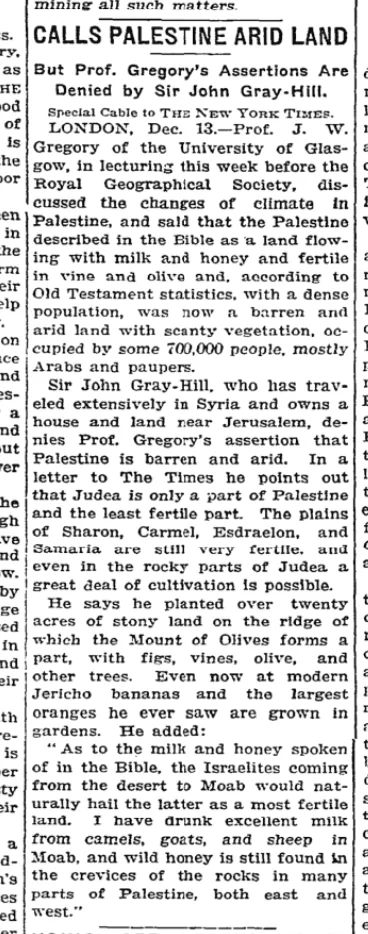
CALLS PALESTINE ARID LAND
But Prof. Gregory’s Assertions Are Denied by Sir John Gray-Hill.
Transcribed from the clipping
LONDON, Dec. 13.—Prof. J. W.
Gregory of the University of Glasgow, in lecturing this week before the Royal Geographical Society, discussed the changes of climate in Palestine, and said that the Palestine described in the Bible as a land flowing with milk and honey and fertile in vine and olive and, according to Old Testament statistics, with a dense population, was now a barren and arid land with scanty vegetation, occupied by some 700,000 people, mostly Arabs and paupers.
Sir John Gray-Hill, who has traveled extensively in Syria and owns a house and land near Jerusalem, denies Prof. Gregory’s assertion that Palestine is barren and arid. In a letter to The Times he points out that Judea is only a part of Palestine and the least fertile part.
The plains of Sharon, Carmel, Esdraelon, and Samaria are still very fertile, and even in the rocky parts of Judea a great deal of cultivation is possible. He says he planted over twenty acres of stony land on the ridge of which the Mount of Olives forms a part, with figs, vines, olive, and other trees.
Even now at modern Jericho bananas and the largest oranges he ever saw are grown in gardens. He added: “As to the milk and honey spoken of in the Bible, the Israelites coming from the desert to Moab would naturally hail the latter as a most fertile land.
I have drunk excellent milk from camels, goats, and sheep in Moab, and wild honey is still found in the crevices of the rocks in many parts of Palestine, both east and west.”
How this transcription was made
Read from the scan by a machine looking at the image of the page, not by optical character recognition and not by a person. The clipping carries no masthead or date line, so its date and newspaper rest on the record it arrived with, not on anything visible in the scan.
Context added by this archive
Date check: No masthead appears on this clipping — it is a trimmed single column. The credit line under the deck reads "Special Cable to THE NEW YORK TIMES.", which agrees with `pub`. The dateline reads "LONDON, Dec. 13.", one day before the slide date of 1913-12-14, which is the normal gap for a cabled story. No printed date is visible to verify the year.
Cite this clipping
"CALLS PALESTINE ARID LAND," The New York Times, 14 December 1913. Covering Palestine archive, CP-1913-004. https://coveringpalestine.org/archive/cp-1913-004
More from The New York Times
- The Maine Colony in PalestineThe New York Times · 12 November 1866
- Jewish Colonization in PalestineThe New York Times · 9 December 1883
- Jewish State in Palestine OpposedThe New York Times · 9 July 1897
- ZIONIST CONGRESS IN BASELThe New York Times · 31 August 1897
- ROME FEARS THE ZIONISTSThe New York Times · 12 September 1897
- PROGRESS OF ZIONISMThe New York Times · 16 December 1901
- 852 more from this paper in the full text →
More from the 1910s
- New Era In PalestineThe Cochran Journal · 17 April 1913
- Condition Of Jews In Russia Not Helped By Our StandCourier Post · 26 April 1913
- …ough the Desert to the Holy LandEvansville Courier & Press · 22 June 1913
- HOLY LAND NATIVES SCARED.El Paso Times · 29 December 1913
- JEWISH COLONISTS REDEEM PALESTINEThe New York Times · 13 October 1912
- CHRISTIANS MOWED DOWN BY MOSLEMS AT JAFFA, PALESTINEReading Times · 21 November 1912
- All 77 clippings from the 1910s →
Last updated 2 November 2026
This record is part of Covering Palestine, an archive of American newspaper clippings about Palestinians, 1724 to 2023. Researched and assembled by Maria Robles.
The clipping belongs to the newspaper that printed it, or to the news agency that supplied the copy. It is reproduced here for research, criticism and commentary. A city here is where the newspaper was published, not where the story came from, and on most records it was taken from the masthead.
Something wrong here, or something you know about this clipping? The archive is still being built and corrections are wanted: maria@rozumstudio.com, quoting CP-1913-004.
Everything printed in 1913 · Printed on this day · See it in the archive reel · Full text of every clipping · Dataset