The New York Times · 25 October 1998
CP-1998-028
In the West Bank, Almost Zero Jubilation
‘I Don’t Want to Get My Hopes Up,’ Is General Reaction to Pact
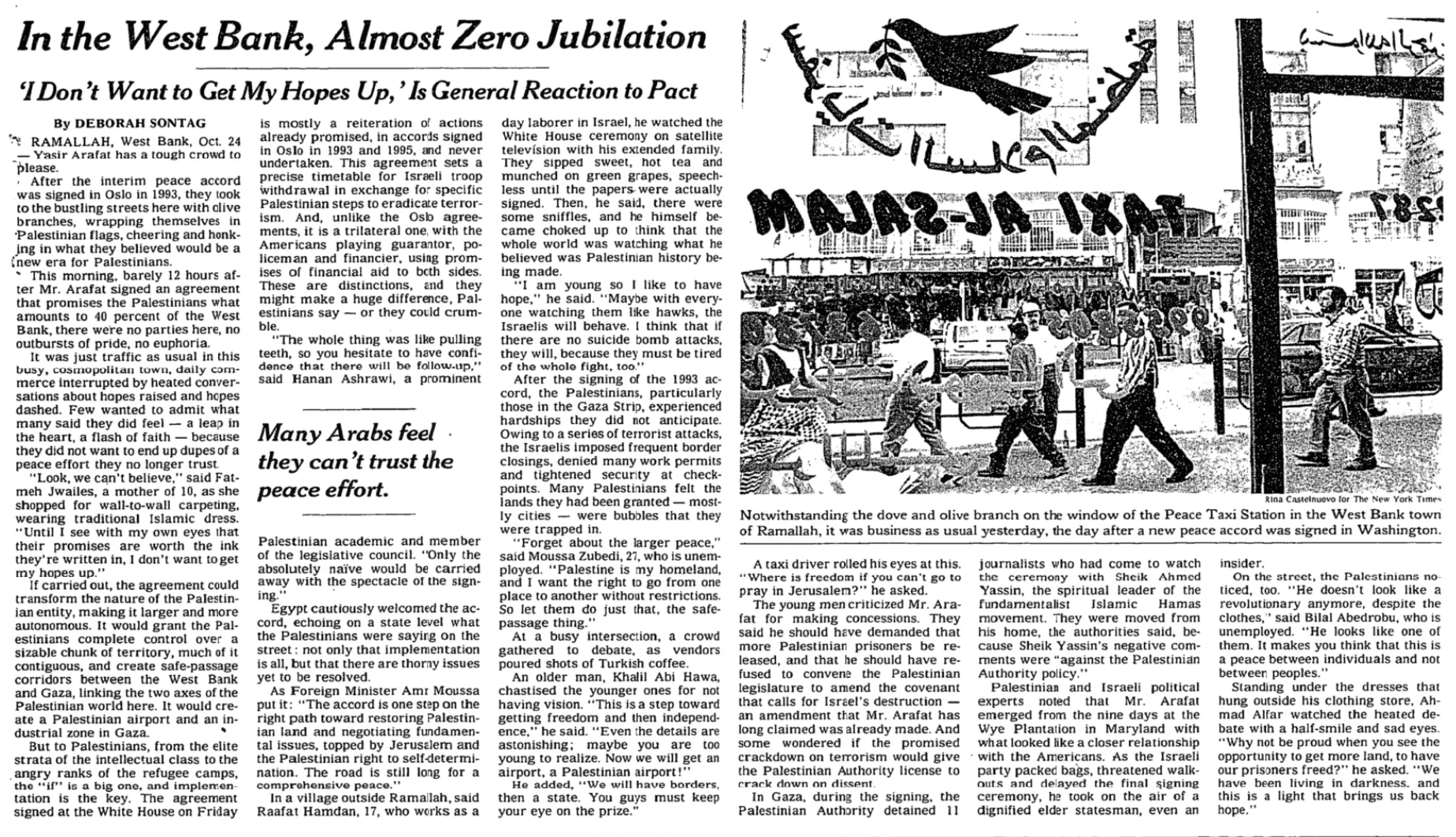
Transcribed from the clipping
RAMALLAH, West Bank, Oct. 24 — Yasir Arafat has a tough crowd to please. After the interim peace accord was signed in Oslo in 1993, they took to the bustling streets here with olive branches, wrapping themselves in Palestinian flags, cheering and honking in what they believed would be a new era for Palestinians. This morning, barely 12 hours after Mr.
Arafat signed an agreement that promises the Palestinians what amounts to 40 percent of the West Bank, there were no parties here, no outbursts of pride, no euphoria. It was just traffic as usual in this busy, cosmopolitan town, daily commerce interrupted by heated conversations about hopes raised and hopes dashed.
Few wanted to admit what many said they did feel — a leap in the heart, a flash of faith — because they did not want to end up dupes of a peace effort they no longer trust. “Look, we can’t believe,” said Fatmeh Jwailes, a mother of 10, as she shopped for wall-to-wall carpeting, wearing traditional Islamic dress.
“Until I see with my own eyes that their promises are worth the ink they’re written in, I don’t want to get my hopes up.” If carried out, the agreement could transform the nature of the Palestinian entity, making it larger and more autonomous.
It would grant the Palestinians complete control over a sizable chunk of territory, much of it contiguous, and create safe-passage corridors between the West Bank and Gaza, linking the two axes of the Palestinian world here. It would create a Palestinian airport and an industrial zone in Gaza.
But to Palestinians, from the elite strata of the intellectual class to the angry ranks of the refugee camps, the “if” is a big one, and implementation is the key. The agreement signed at the White House on Friday is mostly a reiteration of actions already promised, in accords signed in Oslo in 1993 and 1995, and never undertaken.
This agreement sets a precise timetable for Israeli troop withdrawal in exchange for specific Palestinian steps to eradicate terrorism. And, unlike the Oslo agreements, it is a trilateral one, with the Americans playing guarantor, policeman and financier, using promises of financial aid to both sides.
These are distinctions, and they might make a huge difference, Palestinians say — or they could crumble. “The whole thing was like pulling teeth, so you hesitate to have confidence that there will be follow-up,” said Hanan Ashrawi, a prominent Palestinian academic and member of the legislative council.
“Only the absolutely naïve would be carried away with the spectacle of the signing.” Egypt cautiously welcomed the accord, echoing on a state level what the Palestinians were saying on the street: not only that implementation is all, but that there are thorny issues yet to be resolved.
As Foreign Minister Amr Moussa put it: “The accord is one step on the right path toward restoring Palestinian land and negotiating fundamental issues, topped by Jerusalem and the Palestinian right to self-determination. The road is still long for a comprehensive peace.”
In a village outside Ramallah, said Raafat Hamdan, 17, who works as a day laborer in Israel, he watched the White House ceremony on satellite television with his extended family. They sipped sweet, hot tea and munched on green grapes, speechless until the papers were actually signed.
Then, he said, there were some sniffles, and he himself became choked up to think that the whole world was watching what he believed was Palestinian history being made. “I am young so I like to have hope,” he said. “Maybe with everyone watching them like hawks, the Israelis will behave.
I think that if there are no suicide bomb attacks, they will, because they must be tired of the whole fight, too.” After the signing of the 1993 accord, the Palestinians, particularly those in the Gaza Strip, experienced hardships they did not anticipate.
Owing to a series of terrorist attacks, the Israelis imposed frequent border closings, denied many work permits and tightened security at checkpoints. Many Palestinians felt the lands they had been granted — mostly cities — were bubbles that they were trapped in. “Forget about the larger peace,” said Moussa Zubedi, 27, who is unemployed.
“Palestine is my homeland, and I want the right to go from one place to another without restrictions. So let them do just that, the safe-passage thing.” At a busy intersection, a crowd gathered to debate, as vendors poured shots of Turkish coffee. An older man, Khalil Abi Hawa, chastised the younger ones for not having vision.
“This is a step toward getting freedom and then independence,” he said. “Even the details are astonishing; maybe you are too young to realize. Now we will get an airport, a Palestinian airport!” He added, “We will have borders, then a state. You guys must keep your eye on the prize.”
How this transcription was made
Transcribed from the slide scan by a reader working off magnified crops, not by optical character recognition. The newspaper is printed on the clipping, in the photograph’s credit line “Rina Castelnuovo for The New York Times”. There is no masthead and no folio. The date is derived from the printed dateline, “RAMALLAH, West Bank, Oct. 24”, from the caption’s “yesterday, the day after a new peace accord was signed in Washington”, and from the text, which says the agreement was signed at the White House on the Friday and that this morning was barely twelve hours later; the year is fixed by the Oslo accords of 1993 and 1995 being described as past. 24 October 1998 was a Saturday. The excerpt stops at the end of the third column; two further named Palestinians, Bilal Abedrobu and Ahmad Alfar, are quoted on the clipping beyond it.
Cite this clipping
"In the West Bank, Almost Zero Jubilation," The New York Times, 25 October 1998. Covering Palestine archive, CP-1998-028. https://coveringpalestine.org/archive/cp-1998-028
More from The New York Times
- The Maine Colony in PalestineThe New York Times · 12 November 1866
- Jewish Colonization in PalestineThe New York Times · 9 December 1883
- Jewish State in Palestine OpposedThe New York Times · 9 July 1897
- ZIONIST CONGRESS IN BASELThe New York Times · 31 August 1897
- ROME FEARS THE ZIONISTSThe New York Times · 12 September 1897
- PROGRESS OF ZIONISMThe New York Times · 16 December 1901
- 852 more from this paper in the full text →
More from the 1990s
- Israeli Arabs Living Inside a Jewish Neighborhood Know FearLos Angeles Times · 5 February 1998
- Arab citizens of Israel despair they’ll never be acceptedThe St. Augustine Record · 6 February 1998
- Palestinian protesters voice support for IraqisChicago Tribune · 10 February 1998
- Netanyahu Snubs BritishTulsa World · 18 March 1998
- Israeli Arabs March Home, To a Place They Can’t Live InThe New York Times · 29 March 1998
- Palestinians confront past, betrayals on path to statehoodKalamazoo Gazette · 5 April 1998
- All 374 clippings from the 1990s →
Last updated 2 November 2026
This record is part of Covering Palestine, an archive of American newspaper clippings about Palestinians, 1724 to 2023. Researched and assembled by Maria Robles.
The clipping belongs to the newspaper that printed it, or to the news agency that supplied the copy. It is reproduced here for research, criticism and commentary. A city here is where the newspaper was published, not where the story came from, and on most records it was taken from the masthead.
Something wrong here, or something you know about this clipping? The archive is still being built and corrections are wanted: maria@rozumstudio.com, quoting CP-1998-028.
Everything printed in 1998 · Printed on this day · See it in the archive reel · Full text of every clipping · Dataset