Kalamazoo Gazette · 5 April 1998
CP-1998-009
Palestinians confront past, betrayals on path to statehood
By Laura King, The Associated Press, Gaza City, Gaza Strip
Transcribed from the clipping
“GAZA CITY, Gaza Strip — His memories are scraps torn from childhood’s fabric: a peacock’s jewel-toned tail feathers. Town streets abruptly giving way to the desert’s bleak beauty. And his mother’s sewing machine. Palestinian psychiatrist Eyad Sarraj was 4 when his family hastily left their home in what is now the Israeli town of Beersheba. And the clearest image he can call up from that spring day in 1948 is the sight of his mother trying to lug her prized machine — a wondrous contraption of heavy-wrought metal — to a waiting truck. Stop, his father told her. Don’t be silly. You don’t need to bring that. We’ll be back in two weeks. For the Sarraj family — and some three-quarters of a million other Palestinians who fled or were driven out when the British withdrew and the land was partitioned — those weeks somehow expanded into half a century. Today, the Palestinian people — some 8 million worldwide, by United Nations count — remain scattered and stateless… Almost from the beginning, Israelis and Palestinians denied one another’s very existence as a people… And the late Israeli prime minister, Golda Meir, once said there was no such thing as a Palestinian. Palestinians fared little better at Arab hands. After partition, neighboring states grabbed chunks of land; Jordan annexed the West Bank, and Egypt seized the Gaza Strip. It was the kind of betrayal the Palestinians would experience again and again… If 1948 marked the original catastrophe — ‘al-nakba,’ in Arabic — for Palestinians, its echo came in 1967, when Israel and its Arab neighbors again went to war. It was a rout. Israel captured the West Bank and east Jerusalem from Jordan, the Gaza Strip from Egypt and the Golan Heights from Syria. Another 300,000 Palestinians became refugees — and lost hope that the Arab world would be their savior… ‘It’s fine to talk about the end of occupation, but if I walk to the end of this road, I see Israeli soldiers,’ said Gaza merchant Salim Kamal. ‘So it’s ours, this land? It doesn’t look like ours.’”
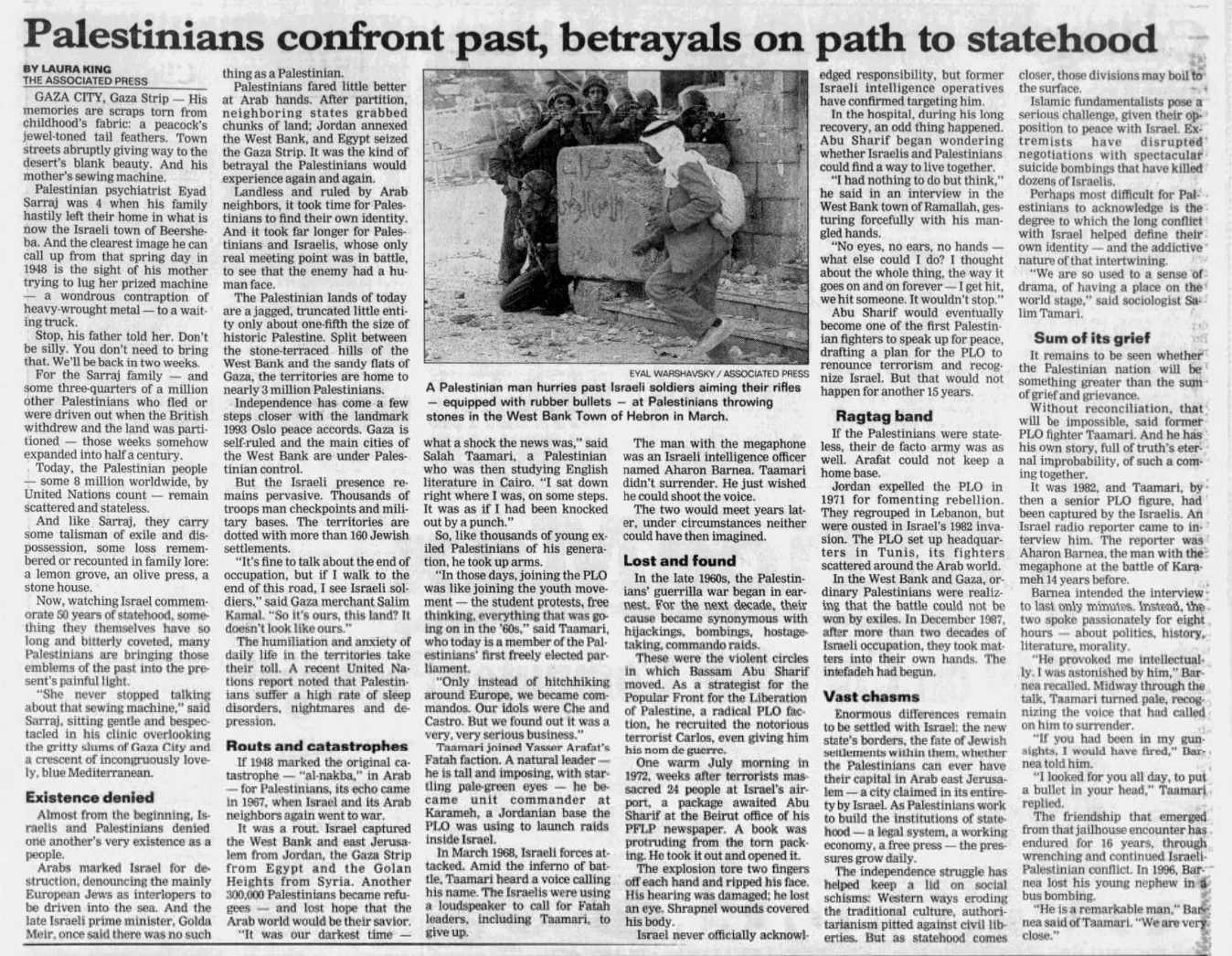
Photograph caption
“A Palestinian man hurries past Israeli soldiers aiming their rifles — equipped with rubber bullets — at Palestinians throwing stones in the West Bank Town of Hebron in March.” Eyal Warshavsky, Associated Press.
Context added by this archive
The word in Arabic, glossed, in an American daily in April 1998, in a piece that also prints Golda Meir on there being no such thing as a Palestinian and then spends a page disproving her with named people. The subheadings are “Existence denied,” “Routs and catastrophes,” “Ragtag band,” “Lost and found,” “Vast chasms” and “Sum of its grief.”
Cite this item
"Palestinians confront past, betrayals on path to statehood," Kalamazoo Gazette, 5 April 1998. Covering Palestine archive, CP-1998-009. https://coveringpalestine.org/archive/cp-1998-009
Elsewhere in the archive
- Palestinian freed after 6 years in Israeli jailJournal Tribune · 15 April 1998 · the same year
- Netanyahu tells Palestine: Don’t declare stateThe Herald · 28 April 1998 · the same year
- Netanyahu: No PalestineThe Atlanta Constitution · 8 May 1998 · the same year
This record is part of Covering Palestine, an archive of American and Anglophone newspaper clippings about Palestinians, 1812 to 2022. Researched and assembled by Maria Robles.
The clipping belongs to the newspaper that printed it, or to the wire service that supplied the copy. It is reproduced here for research, criticism and commentary.
Something wrong here, or something you know about this clipping? The archive is still being built and corrections are wanted: maria@rozumstudio.com, quoting CP-1998-009.
See it in the archive reel · Full text of every clipping · Dataset