Los Angeles Times · Los Angeles, CA · 5 February 1998
CP-1998-029
Israeli Arabs Living Inside a Jewish Neighborhood Know Fear
■ Mideast: Three women in West Jerusalem endure firebombs and insults—but also receive support.
By MARJORIE MILLER, TIMES STAFF WRITER
Transcribed from the clipping
JERUSALEM—Each time there is a knock on their soot-blackened front door, Wafa and Sonya Khoury remove a Post-it from the peephole, peer into the hallway of their apartment building and ask the visitors to identify themselves. Satisfied the callers are not hostile, they unbolt and then unlock the door.
What may be normal precautions in another country would seem like paranoia in low-crime Israel, except for the fact that the Arab women have twice found firebombs on the doorstep of their fourth-floor apartment in predominantly Jewish West Jerusalem.
The Khoury sisters and roommate Manal Diab, another Arab Israeli from the Galilee, say they were not looking for trouble in July when they moved into the new building that borders a religious neighborhood and the dividing line between East and West Jerusalem. They just wanted a nice and reasonably priced place to live.
When the first fire was set in their stairwell in October, they went looking for safer quarters. But after the second bomb was detonated before dawn Nov. 30, in the hands of a police officer who was trying to dismantle it, they decided to stay and fight. “If we leave, they will do the same to others, and then all Arabs will have to leave,” said Sonya Khoury, 25.
“It is very dangerous, but if we don’t fight for our rights, it will be even more dangerous.” While many eyes are focused on the battle between Israelis and Palestinians in East Jerusalem, the flames outside the women’s apartment have brought to light racial and religious tensions that also exist in West Jerusalem.
Many Arab citizens of Israel, whose families remained in the country after the state was formed in 1948, say that, by and large, they feel unwelcome and unwanted by Jewish compatriots in Jerusalem. Firebombs are not the norm, but many Arab Israelis say hostility is.
They hunt for housing among reluctant landlords and, when they find something, neighbors seem unhappy to see them moving in. If they speak Arabic among themselves on buses or in restaurants, they say, they receive angry stares and sniping comments. Sometimes they are prevented from entering public places.
Despite their Israeli citizenship and fluency in Hebrew, they say they are regarded as outsiders or, worse, as a potential fifth column in the Israeli-Palestinian conflict. In the aftermath of Palestinian suicide bombings in Jerusalem—five in the last 2½ years that have left more than 65 people dead—they feel they must lie low.
“It is always more difficult after an explosion,” said Iyad Ighbarieh, 25, a Hebrew University student from the Arab village of Umm al Fahm in northern Israel. “Usually, we just stay home. Or we come to campus, but they look at us differently. When there is an explosion, we avoid contact with them.”
How this transcription was made
Date confirmed on the page (folio-verified (the folio line across the top of the page reads “A10 THURSDAY, FEBRUARY 5, 1998 /F” at the left and “LOS ANGELES TIMES” at the right. 5 February 1998 was a Thursday).
Context added by this archive
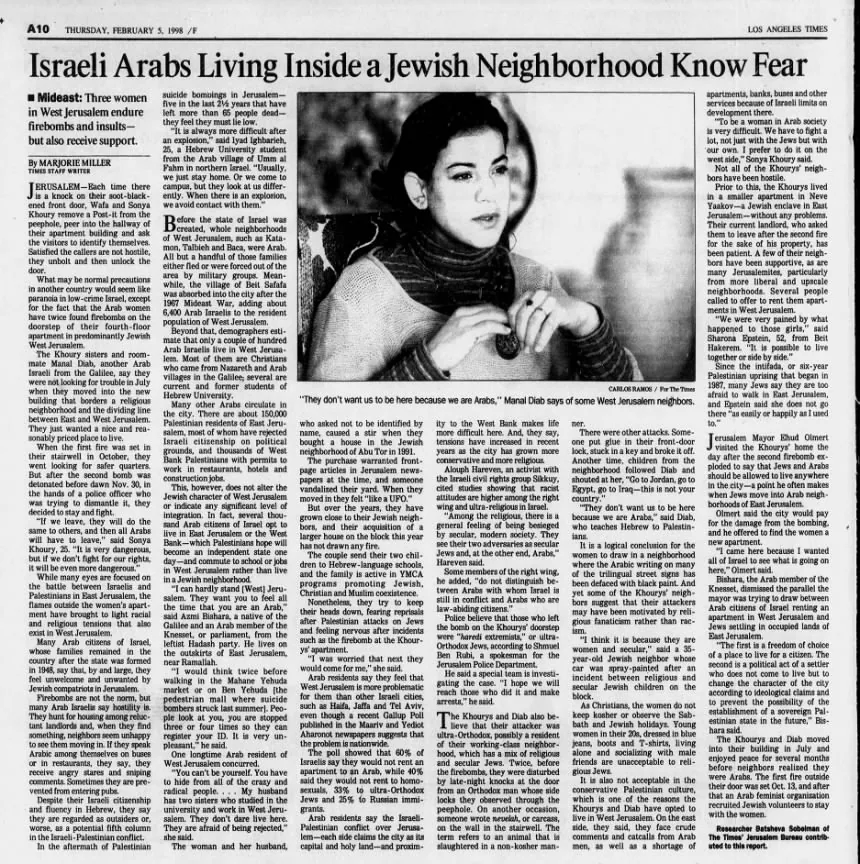
Photo credit CARLOS RAMOS / For The Times. Photo caption: “‘They don’t want us to be here because we are Arabs,’ Manal Diab says of some West Jerusalem neighbors.” Tagline at the foot: “Researcher Batsheva Sobelman of The Times’ Jerusalem Bureau contributed to this report.”
Other figures printed on the page: 6,400 Arab Israelis added to West Jerusalem when Beit Safafa was absorbed after 1967; only a couple of hundred Arab Israelis living in West Jerusalem; about 150,000 Palestinian residents of East Jerusalem; a Gallup poll in Maariv and Yediot Aharonot showing 60% of Israelis would not rent an apartment to an Arab, 40% not to homosexuals, 33% not to ultra-Orthodox Jews, 25% not to Russian immigrants.
Police spokesman Shmuel Ben Rubi says the bombers were “haredi extremists”; someone wrote nevelah, or carcass, on the stairwell wall. This is the clipping to show Maria first.
Cite this clipping
"Israeli Arabs Living Inside a Jewish Neighborhood Know Fear," Los Angeles Times, 5 February 1998, p. A10. Covering Palestine archive, CP-1998-029. https://coveringpalestine.org/archive/cp-1998-029
More from Los Angeles Times
- Bomb Victim Had Expected DeathLos Angeles Times · 10 July 1972
- Mrs. Meir's Safety StudiedLos Angeles Times · 11 January 1973
- Show of Artists from PalestineLos Angeles Times · 24 June 1977
- Jews of the Arab World?Los Angeles Times · 2 November 1986
- Islamic Group Challenges PLO Over PalestineLos Angeles Times · 5 September 1988
- U.N.: Israel Condemned for Palestinian DeathsLos Angeles Times · 13 October 1990
- 35 more from this paper in the full text →
More from the 1990s
- Arab citizens of Israel despair they’ll never be acceptedThe St. Augustine Record · 6 February 1998
- Palestinian protesters voice support for IraqisChicago Tribune · 10 February 1998
- Netanyahu Snubs BritishTulsa World · 18 March 1998
- Israeli Arabs March Home, To a Place They Can’t Live InThe New York Times · 29 March 1998
- Palestinians confront past, betrayals on path to statehoodKalamazoo Gazette · 5 April 1998
- Palestinian freed after 6 years in Israeli jailJournal Tribune · 15 April 1998
- All 374 clippings from the 1990s →
Last updated 2 November 2026
This record is part of Covering Palestine, an archive of American newspaper clippings about Palestinians, 1724 to 2023. Researched and assembled by Maria Robles.
The clipping belongs to the newspaper that printed it, or to the news agency that supplied the copy. It is reproduced here for research, criticism and commentary. A city here is where the newspaper was published, not where the story came from, and on most records it was taken from the masthead.
Something wrong here, or something you know about this clipping? The archive is still being built and corrections are wanted: maria@rozumstudio.com, quoting CP-1998-029.
Everything printed in 1998 · Printed on this day · See it in the archive reel · Full text of every clipping · Dataset