Los Angeles Times · Los Angeles, California · 2 November 1986
CP-1986-006
Jews of the Arab World?
Paperback Originals · The Book Review
Jonathan Kirsch
Transcribed from the clipping
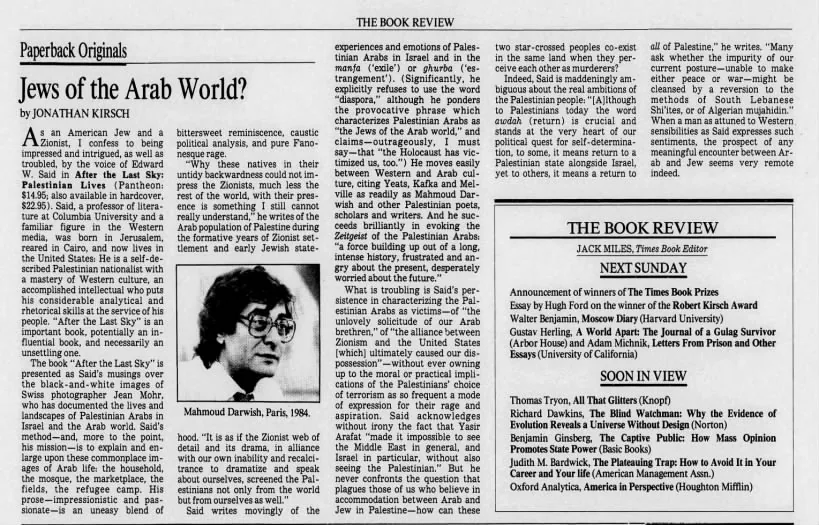
“As an American Jew and a Zionist, I confess to being impressed and intrigued, as well as troubled, by the voice of Edward W. Said in ‘After the Last Sky: Palestinian Lives’ (Pantheon: $14.95; also available in hardcover, $22.95). Said, a professor of literature at Columbia University and a familiar figure in the Western media, was born in Jerusalem, reared in Cairo, and now lives in the United States. He is a self-described Palestinian nationalist with a mastery of Western culture, an accomplished intellectual who puts his considerable analytical and rhetorical skills at the service of his people. ‘After the Last Sky’ is an important book, potentially an influential book, and necessarily an unsettling one. The book is presented as Said’s musings over the black-and-white images of Swiss photographer Jean Mohr, who has documented the lives and landscapes of Palestinian Arabs in Israel and the Arab world. Said’s method — and, more to the point, his mission — is to explain and enlarge upon these commonplace images of Arab life: the household, the mosque, the marketplace, the fields, the refugee camp… ‘Why these natives in their untidy backwardness could not impress the Zionists, much less the rest of the world, with their presence is something I still cannot really understand,’ he writes of the Arab population of Palestine during the formative years of Zionist settlement and early Jewish statehood. ‘It is as if the Zionist web of detail and its drama, in alliance with our own inability and recalcitrance to dramatize and speak about ourselves, screened the Palestinians not only from the world but from ourselves as well.’ Said writes movingly of the experiences and emotions of Palestinian Arabs in Israel and in the manfa (‘exile’) or ghurba (‘estrangement’). (Significantly, he explicitly refuses to use the word ‘diaspora,’ although he ponders the provocative phrase which characterizes Palestinian Arabs as ‘the Jews of the Arab world,’ and claims — outrageously, I must say — that ‘the Holocaust has victimized us, too.’) He moves easily between Western and Arab culture, citing Yeats, Kafka and Melville as readily as Mahmoud Darwish and other Palestinian poets, scholars and writers.… What is troubling is Said’s persistence in characterizing the Palestinian Arabs as victims… without ever owning up to the moral or practical implications of the Palestinians’ choice of terrorism as so frequent a mode of expression for their rage and aspiration… ‘awdah (return) is crucial and stands at the very heart of our political quest for self-determination,’ he writes… When a man as attuned to Western sensibilities as Said expresses such sentiments, the prospect of any meaningful encounter between Arab and Jew seems very remote indeed.”
Photograph caption
“Mahmoud Darwish, Paris, 1984.”
Context added by this archive
A book review that states its own standpoint in its first six words, which is rarer in this archive than any of the arguments that follow it. The passage Said is quoted on is close to the reason this collection exists: that the Palestinians were screened from the world, and from themselves. The photograph chosen to illustrate a review of Said’s book is of Mahmoud Darwish, whose poem an American wire story would print as a threat eighteen months later and whose obituaries this archive holds five printings of.
Cite this item
"Jews of the Arab World?," Los Angeles Times, 2 November 1986. Covering Palestine archive, CP-1986-006. https://coveringpalestine.org/archive/cp-1986-006
Elsewhere in the archive
- Palestine: Islamic IssueLos Angeles Times · 5 September 1988 · the same newspaper
- Show of Artists from PalestineLos Angeles Times · 24 June 1977 · the same newspaper
- Palestinian artist, Dutch Jewish film maker make film about homecomingHouston Chronicle · 26 October 1986 · the same year
- U.N. members vote for budget boostThe Indianapolis News · 9 December 1986 · the same year
This record is part of Covering Palestine, an archive of American and Anglophone newspaper clippings about Palestinians, 1812 to 2022. Researched and assembled by Maria Robles.
The clipping belongs to the newspaper that printed it, or to the wire service that supplied the copy. It is reproduced here for research, criticism and commentary. The city is derived from the masthead, not read off the clipping.
Something wrong here, or something you know about this clipping? The archive is still being built and corrections are wanted: maria@rozumstudio.com, quoting CP-1986-006.
See it in the archive reel · Full text of every clipping · Dataset