The Daily Ledger · 18 April 1986
CP-1986-007
Views on terrorism differ
Washington today
An AP News Analysis by Barry Schweid, AP Diplomatic Writer
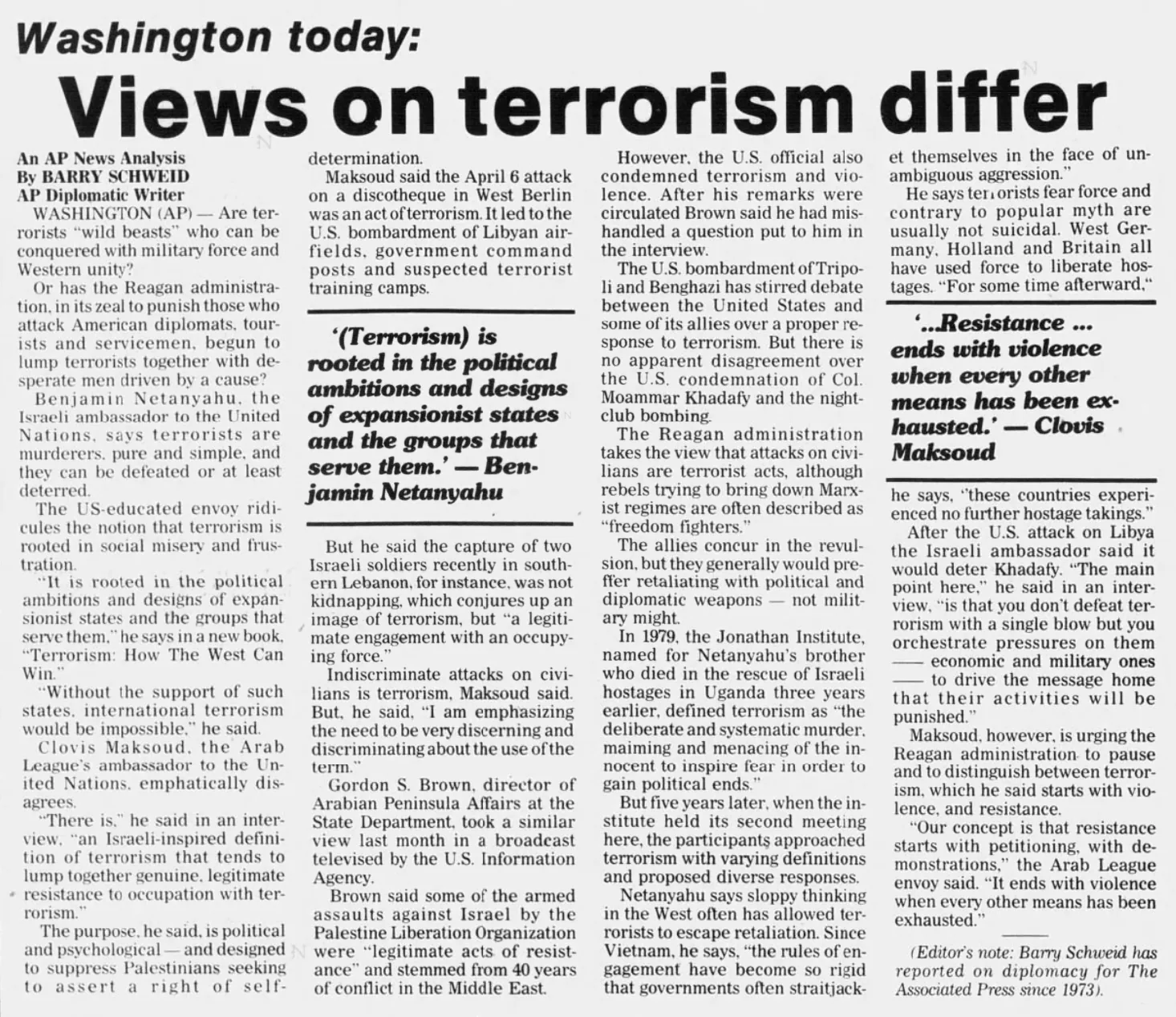
Transcribed from the clipping
“Washington today: Views on terrorism differ WASHINGTON (AP) — Are terrorists ‘wild beasts’ who can be conquered with military force and Western unity? Or has the Reagan administration, in its zeal to punish those who attack American diplomats, tourists and servicemen, begun to lump terrorists together with desperate men driven by a cause?
Benjamin Netanyahu, the Israeli ambassador to the United Nations, says terrorists are murderers, pure and simple, and they can be defeated or at least deterred. The US-educated envoy ridicules the notion that terrorism is rooted in social misery and frustration.
‘It is rooted in the political ambitions and designs of expansionist states and the groups that serve them,’ he says in a new book, ‘Terrorism: How The West Can Win.’ ‘Without the support of such states, international terrorism would be impossible,’ he said.
Clovis Maksoud, the Arab League’s ambassador to the United Nations, emphatically disagrees. ‘There is,’ he said in an interview, ‘an Israeli-inspired definition of terrorism that tends to lump together genuine, legitimate resistance to occupation with terrorism.’
The purpose, he said, is political and psychological — and designed to suppress Palestinians seeking to assert a right of self-determination. Maksoud said the April 6 attack on a discotheque in West Berlin was an act of terrorism. It led to the U.S. bombardment of Libyan airfields, government command posts and suspected terrorist training camps.
But he said the capture of two Israeli soldiers recently in southern Lebanon, for instance, was not kidnapping, which conjures up an image of terrorism, but ‘a legitimate engagement with an occupying force.’ Indiscriminate attacks on civilians is terrorism, Maksoud said.
But, he said, ‘I am emphasizing the need to be very discerning and discriminating about the use of the term.’ Gordon S. Brown, director of Arabian Peninsula Affairs at the State Department, took a similar view last month in a broadcast televised by the U.S. Information Agency.
Brown said some of the armed assaults against Israel by the Palestine Liberation Organization were ‘legitimate acts of resistance’ and stemmed from 40 years of conflict in the Middle East. However, the U.S. official also condemned terrorism and violence. After his remarks were circulated Brown said he had mishandled a question put to him in the interview.
The U.S. bombardment of Tripoli and Benghazi has stirred debate between the United States and some of its allies over a proper response to terrorism. But there is no apparent disagreement over the U.S. condemnation of Col. Moammar Khadafy and the nightclub bombing.
The Reagan administration takes the view that attacks on civilians are terrorist acts, although rebels trying to bring down Marxist regimes are often described as ‘freedom fighters.’ The allies concur in the revulsion, but they generally would prefer retaliating with political and diplomatic weapons — not military might.
In 1979, the Jonathan Institute, named for Netanyahu’s brother who died in the rescue of Israeli hostages in Uganda three years earlier, defined terrorism as ‘the deliberate and systematic murder, maiming and menacing of the innocent to inspire fear in order to gain political ends.’
But five years later, when the institute held its second meeting here, the participants approached terrorism with varying definitions and proposed diverse responses. Netanyahu says sloppy thinking in the West often has allowed terrorists to escape retaliation.
Since Vietnam, he says, ‘the rules of engagement have become so rigid that governments often straitjacket themselves in the face of unambiguous aggression.’ He says terrorists fear force and contrary to popular myth are usually not suicidal. West Germany, Holland and Britain all have used force to liberate hostages.
‘For some time afterward,’ he says, ‘these countries experienced no further hostage takings.’ After the U.S. attack on Libya the Israeli ambassador said it would deter Khadafy.
‘The main point here,’ he said in an interview, ‘is that you don’t defeat terrorism with a single blow but you orchestrate pressures on them — economic and military ones — to drive the message home that their activities will be punished.’
Maksoud, however, is urging the Reagan administration to pause and to distinguish between terrorism, which he said starts with violence, and resistance. ‘Our concept is that resistance starts with petitioning, with demonstrations,’ the Arab League envoy said. ‘It ends with violence when every other means has been exhausted.’
(Editor’s note: Barry Schweid has reported on diplomacy for The Associated Press since 1973).”
Context added by this archive
Two ambassadors to the United Nations, in the same news-agency analysis, given equal type. Benjamin Netanyahu is quoted in a pull quote set beside the text: (Terrorism) is rooted in the political ambitions and designs of expansionist states and the groups that serve them.
Clovis Maksoud of the Arab League gets the second pull quote and the last word: …Resistance … ends with violence when every other means has been exhausted. Between them the piece records a State Department official calling some armed assaults on Israel legitimate acts of resistance and then saying he had mishandled the question.
It also names the Jonathan Institute and its 1979 definition, and notes that by the institute’s second meeting the participants no longer agreed on one.
Cite this item
"Views on terrorism differ," The Daily Ledger, 18 April 1986. Covering Palestine archive, CP-1986-007. https://coveringpalestine.org/archive/cp-1986-007
More from the 1980s
- Palestinian artist, Dutch Jewish film maker make film about homecomingHouston Chronicle · 26 October 1986
- Jews of the Arab World?Los Angeles Times · 2 November 1986
- Denied an identity, Gazans losing hope in land of despairThe Palm Beach Post · 8 December 1986
- U.N. members vote for budget boostThe Indianapolis News · 9 December 1986
- Arabs Protest Israeli KillingsPress of Atlantic City · 10 December 1986
- 1,000 March Peacefully to Protest Killing of Three Arabs by IsraelisThe Buffalo News · 10 December 1986
- All 139 clippings from the 1980s →
This record is part of Covering Palestine, an archive of American and Anglophone newspaper clippings about Palestinians, 1799 to 2023. Researched and assembled by Maria Robles.
The clipping belongs to the newspaper that printed it, or to the news agency that supplied the copy. It is reproduced here for research, criticism and commentary. The city is derived from the masthead, not read off the clipping.
Something wrong here, or something you know about this clipping? The archive is still being built and corrections are wanted: maria@rozumstudio.com, quoting CP-1986-007.
See it in the archive reel · Full text of every clipping · Dataset