The New York Times · 29 March 1998
CP-1998-025
Israeli Arabs March Home, To a Place They Can’t Live In
Transcribed from the clipping
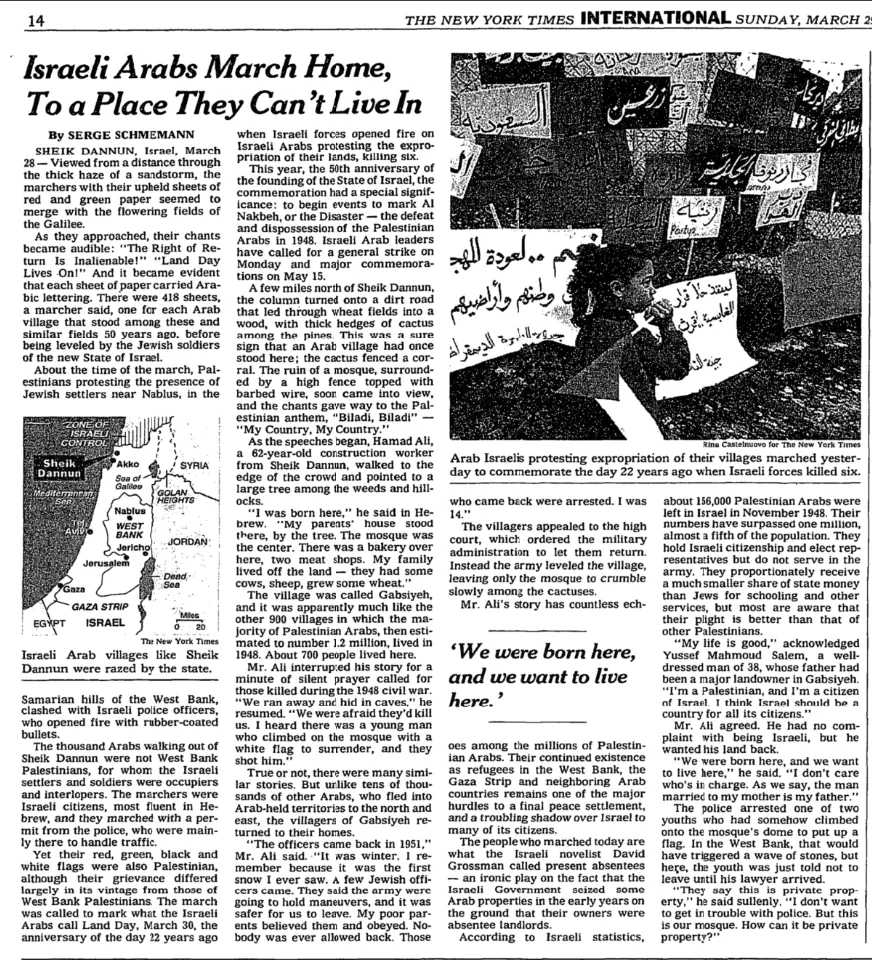
SHEIK DANNUN, Israel, March 28 — Viewed from a distance through the thick haze of a sandstorm, the marchers with their upheld sheets of red and green paper seemed to merge with the flowering fields of the Galilee. As they approached, their chants became audible: “The Right of Return Is Inalienable!” “Land Day Lives On!”
And it became evident that each sheet of paper carried Arabic lettering. There were 418 sheets, a marcher said, one for each Arab village that stood among these and similar fields 50 years ago, before being leveled by the Jewish soldiers of the new State of Israel.
About the time of the march, Palestinians protesting the presence of Jewish settlers near Nablus, in the Samarian hills of the West Bank, clashed with Israeli police officers, who opened fire with rubber-coated bullets. The thousand Arabs walking out of Sheik Dannun were not West Bank Palestinians, for whom the Israeli settlers and soldiers were occupiers and interlopers.
The marchers were Israeli citizens, most fluent in Hebrew, and they marched with a permit from the police, who were mainly there to handle traffic. Yet their red, green, black and white flags were also Palestinian, although their grievance differed largely in its vintage from those of West Bank Palestinians.
The march was called to mark what the Israeli Arabs call Land Day, March 30, the anniversary of the day 22 years ago when Israeli forces opened fire on Israeli Arabs protesting the expropriation of their lands, killing six.
This year, the 50th anniversary of the founding of the State of Israel, the commemoration had a special significance: to begin events to mark Al Nakbeh, or the Disaster — the defeat and dispossession of the Palestinian Arabs in 1948. Israeli Arab leaders have called for a general strike on Monday and major commemorations on May 15.
A few miles north of Sheik Dannun, the column turned onto a dirt road that led through wheat fields into a wood, with thick hedges of cactus among the pines. This was a sure sign that an Arab village had once stood here; the cactus fenced a corral.
The ruin of a mosque, surrounded by a high fence topped with barbed wire, soon came into view, and the chants gave way to the Palestinian anthem, “Biladi, Biladi” — “My Country, My Country.”
As the speeches began, Hamad Ali, a 62-year-old construction worker from Sheik Dannun, walked to the edge of the crowd and pointed to a large tree among the weeds and hillocks. “I was born here,” he said in Hebrew. “My parents’ house stood there, by the tree. The mosque was the center. There was a bakery over here, two meat shops.
My family lived off the land — they had some cows, sheep, grew some wheat.” The village was called Gabsiyeh, and it was apparently much like the other 900 villages in which the majority of Palestinian Arabs, then estimated to number 1.2 million, lived in 1948. About 700 people lived here. Mr.
Ali interrupted his story for a minute of silent prayer called for those killed during the 1948 civil war. “We ran away and hid in caves,” he resumed. “We were afraid they’d kill us. I heard there was a young man who climbed on the mosque with a white flag to surrender, and they shot him.” True or not, there were many similar stories.
But unlike tens of thousands of other Arabs, who fled into Arab-held territories to the north and east, the villagers of Gabsiyeh returned to their homes. “The officers came back in 1951,” Mr. Ali said. “It was winter. I remember because it was the first snow I ever saw. A few Jewish officers came.
They said the army were going to hold maneuvers, and it was safer for us to leave. My poor parents believed them and obeyed. Nobody was ever allowed back. Those who came back were arrested. I was 14.” The villagers appealed to the high court, which ordered the military administration to let them return.
Instead the army leveled the village, leaving only the mosque to crumble slowly among the cactuses. Mr. Ali’s story has countless echoes among the millions of Palestinian Arabs.
Their continued existence as refugees in the West Bank, the Gaza Strip and neighboring Arab countries remains one of the major hurdles to a final peace settlement, and a troubling shadow over Israel to many of its citizens.
The people who marched today are what the Israeli novelist David Grossman called present absentees — an ironic play on the fact that the Israeli Government seized some Arab properties in the early years on the ground that their owners were absentee landlords. According to Israeli statistics, about 156,000 Palestinian Arabs were left in Israel in November 1948.
Their numbers have surpassed one million, almost a fifth of the population. They hold Israeli citizenship and elect representatives but do not serve in the army. They proportionately receive a much smaller share of state money than Jews for schooling and other services, but most are aware that their plight is better than that of other Palestinians.
“My life is good,” acknowledged Yussef Mahmoud Salem, a well-dressed man of 38, whose father had been a major landowner in Gabsiyeh. “I’m a Palestinian, and I’m a citizen of Israel. I think Israel should be a country for all its citizens.” Mr. Ali agreed. He had no complaint with being Israeli, but he wanted his land back.
“We were born here, and we want to live here,” he said. “I don’t care who’s in charge. As we say, the man married to my mother is my father.” The police arrested one of two youths who had somehow climbed onto the mosque’s dome to put up a flag.
In the West Bank, that would have triggered a wave of stones, but here, the youth was just told not to leave until his lawyer arrived. “They say this is private property,” he said sullenly. “I don’t want to get in trouble with police. But this is our mosque. How can it be private property?”
Cite this clipping
"Israeli Arabs March Home, To a Place They Can’t Live In," The New York Times, 29 March 1998, p. 14. Covering Palestine archive, CP-1998-025. https://coveringpalestine.org/archive/cp-1998-025
More from The New York Times
- The Maine Colony in PalestineThe New York Times · 12 November 1866
- Jewish Colonization in PalestineThe New York Times · 9 December 1883
- Jewish State in Palestine OpposedThe New York Times · 9 July 1897
- ZIONIST CONGRESS IN BASELThe New York Times · 31 August 1897
- ROME FEARS THE ZIONISTSThe New York Times · 12 September 1897
- PROGRESS OF ZIONISMThe New York Times · 16 December 1901
- 852 more from this paper in the full text →
More from the 1990s
- Israeli Arabs Living Inside a Jewish Neighborhood Know FearLos Angeles Times · 5 February 1998
- Arab citizens of Israel despair they’ll never be acceptedThe St. Augustine Record · 6 February 1998
- Palestinian protesters voice support for IraqisChicago Tribune · 10 February 1998
- Netanyahu Snubs BritishTulsa World · 18 March 1998
- Palestinians confront past, betrayals on path to statehoodKalamazoo Gazette · 5 April 1998
- Palestinian freed after 6 years in Israeli jailJournal Tribune · 15 April 1998
- All 374 clippings from the 1990s →
Last updated 2 November 2026
This record is part of Covering Palestine, an archive of American newspaper clippings about Palestinians, 1724 to 2023. Researched and assembled by Maria Robles.
The clipping belongs to the newspaper that printed it, or to the news agency that supplied the copy. It is reproduced here for research, criticism and commentary. A city here is where the newspaper was published, not where the story came from, and on most records it was taken from the masthead.
Something wrong here, or something you know about this clipping? The archive is still being built and corrections are wanted: maria@rozumstudio.com, quoting CP-1998-025.
Everything printed in 1998 · Printed on this day · See it in the archive reel · Full text of every clipping · Dataset